காலநிலை மாற்றங்கள்
\"இந்த வருடம் வானிலை வேறு\" என்று சொல்கிறோம்: மழை தாமதமாகியது, கோடை இரவிலும் வெக்கையாக இருக்கிறது, மலையோரக் குளிர் குறைந்துவருகிறது. தாத்தா பாட்டி சொல்வதில் உண்மை உண்டா? Climate Change (காலநிலை மாற்றம்) என்பது தனியான ஒரு செய்தி அல்ல; இது 20-ம் நூற்றாண்டிலிருந்து புவியின் சராசரி வெப்பநிலையும் காலநிலை வடிவங்களும் (patterns) மாறிக்கொண்டிருப்பதைக் குறிக்கிறது. இப்போது அந்த மாற்றம் வேகமடைந்துள்ளது. இதற்கு முக்கிய காரணம் மனிதனின் தொழில்மயமாதல், வாகனப் பயன்பாடு, காடழிப்பு ஆகியவையாகும்; இவை வளி மண்டலத்தில் பசுமை இல்ல வாயுக்களை (Greenhouse Gases, GHG) வெளியேற்றுகின்றன. இந்த அலகில் (1) காலநிலையும் வானிலையும் (climate vs weather), (2) பசுமை இல்ல விளைவு (Greenhouse effect), (3) காரணங்கள், (4) விளைவுகள், (5) Paris Agreement, சர்வதேச நடவடிக்கைகள், (6) இலங்கையில் ஏற்படும் தாக்கம் ஆகியவற்றைப் பார்ப்போம்.

1. Weather vs Climate vs Climate Change
அடிக்கடி குழப்பப்படும் மூன்று வேறுபட்ட எண்ணக்கருக்கள் (concepts):
- Weather (வானிலை): குறிப்பிட்ட நேரத்தில் குறிப்பிட்ட இடத்தில் வளி மண்டலத்தின் நிலை; temperature, rainfall, humidity, wind ஆகியவை இதில் அடங்கும். காலம்: minutes, hours, days. \"இன்று மாலை மழை வரும்\".
- Climate (காலநிலை): ஒரு பகுதியின் 30 ஆண்டுச் சராசரி வானிலை (weather). காலம்: decades+. \"நுவரெலியா குளிராக இருக்கும்\".
- Climate Change (காலநிலை மாற்றம்): 30+ ஆண்டுகளில் காலநிலையில் ஏற்படும் நிலையான மாற்றம்; இது பொதுவாகப் படிப்படியாக நிகழும் (typically gradual). தற்போது anthropogenic எனப்படும் மனிதச் செயற்பாடுகளால் விரைவாக நிகழ்கிறது (rapid).
Natural vs Anthropogenic
- Natural climate change — இயற்கையான மாறுபாடுகளும் சுழற்சிகளும் (variability, cycles). Ice ages, Milankovitch cycles (puvi axis tilt + orbit eccentricity), volcanic eruptions, solar cycles. Time scale: thousands-millions of years.
- Anthropogenic climate change — மனிதனின் செயற்பாடுகளால் ஏற்படுவது: fossil fuel + deforestation + industry + agriculture. Time scale: ~200 years (since Industrial Revolution).
2. Greenhouse Effect — காலநிலை மாற்றத்தின் செயல்முறை
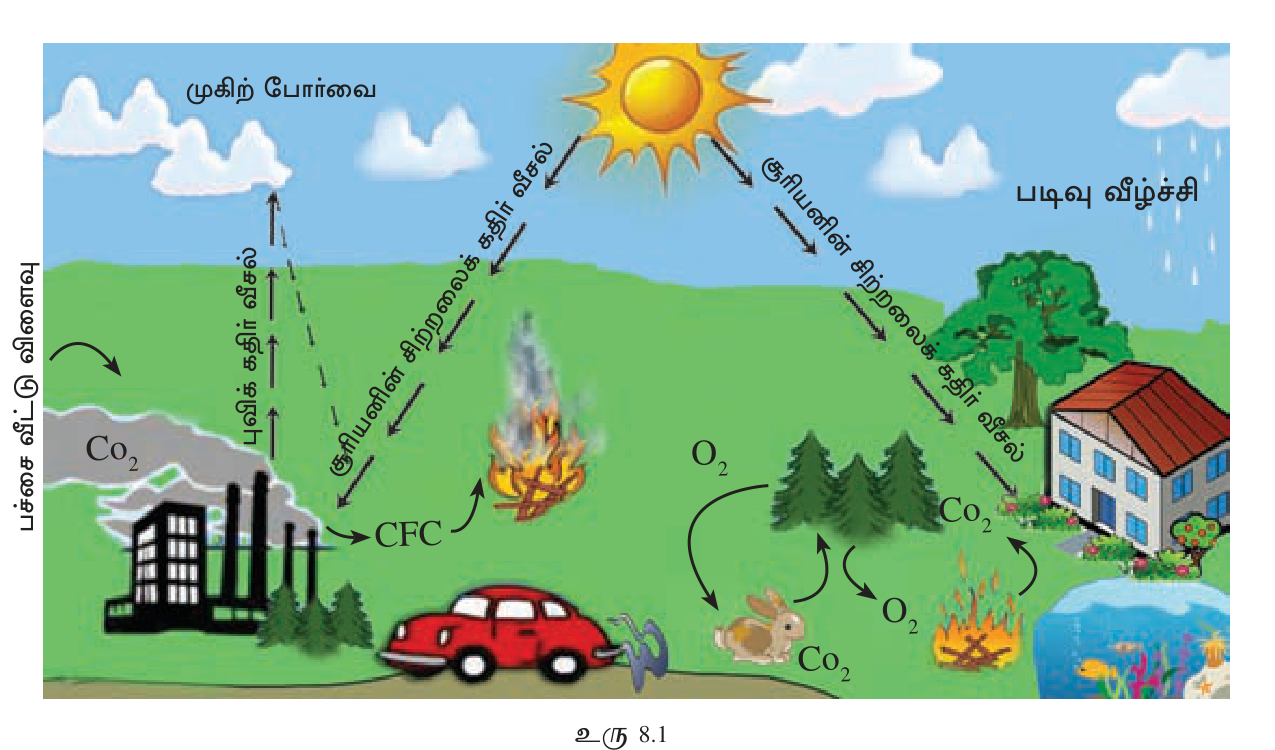
Natural Greenhouse Effect
புவியின் வளி மண்டலத்தில் இயற்கையாகவே H₂O, CO₂, CH₄, N₂O ஆகிய சில greenhouse gases உள்ளன. சூரியனிலிருந்து short-wave radiation (UV + visible light) கீழே வந்து புவியை வெப்பப்படுத்தும். புவி அந்த வெப்பத்தை long-wave infrared radiation ஆக மீண்டும் வெளிவிடும். GHGs அவற்றைத் தடுத்து (trap) வளி மண்டலத்தை வெப்பமாக வைத்திருக்கின்றன.
Natural greenhouse effect இல்லாவிட்டால் புவியின் சராசரி temperature ~-18°C ஆக இருக்கும்; அது வாழ்க்கைக்கு மிகவும் குளிரானது. ஆனால் GHG-கள் இயற்கையான அளவில் இருப்பதால் temperature ~+15°C ஆக உள்ளது. அதனாலேயே greenhouse effect வாழ்வுக்கு அவசியமானது.
Enhanced Greenhouse Effect — Problem
மனிதச் செயற்பாடுகளால் வளி மண்டலத்தில் மேலதிக GHG வெளியேற்றப்படுவதால் வெப்பத்தைத் தடுத்து வைக்கும் அளவு (heat trapping) அதிகரித்து புவி வெப்பமடைகிறது (global warming). Industrial Revolution முதல் CO₂ ~280 ppm இலிருந்து 425+ ppm (2024) வரை உயர்ந்துள்ளது (50%+ அதிகம்). புவியின் சராசரி temperature ~1.1°C அதிகரித்துள்ளது.
Main Greenhouse Gases + GWP
GWP (Global Warming Potential) என்பது 100 ஆண்டுகளில் CO₂-ஐ விட ஒரு வாயு எவ்வளவு வலிமையாக வெப்பத்தைத் தடுத்து வைக்கிறது என்பதைக் காட்டும் அளவீடாகும்.
| Gas | Source | GWP (100yr) | Atmospheric lifetime |
|---|---|---|---|
| CO₂ | Fossil fuels, deforestation, cement | 1 (baseline) | ~100-1000 yrs |
| Methane (CH₄) | Livestock, rice paddies, landfills, gas leaks | ~84 | ~12 yrs |
| Nitrous oxide (N₂O) | Fertilizers, soil microbes, industry | ~273 | ~114 yrs |
| F-gases (HFC, PFC, SF₆) | Refrigeration, electronics | 1,000-23,000 | varies |
| Water vapor (H₂O) | Natural; amplifies warming | — | days |
CO₂ = primary culprit (~75% emissions). Methane = significant short-term impact. Net-zero target focuses on CO₂ + methane reduction.
3. Anthropogenic Causes
(அ) Energy Sector — ~75% of GHG
- Electricity + heat generation: coal + gas + oil power plants. China, India, USA top emitters.
- Transport: cars, trucks, aviation, shipping. 20% global emissions.
- Industry: steel, cement, chemicals, manufacturing.
- Buildings: heating, air conditioning, lighting.
(ஆ) Agriculture + Land Use ~20%
- Livestock (cattle): methane belching; ~14% global GHG.
- Rice paddies: anaerobic methane.
- Fertilizers: N₂O from soil.
- Deforestation: reduces carbon sinks + releases stored carbon. Amazon, Congo, Indonesia.
- Land degradation: overgrazing, soil loss.
(இ) Industry + Waste ~5%
- Cement production (CaCO₃ → CaO + CO₂).
- Steel + aluminium smelting.
- F-gases from refrigeration.
- Landfill methane.
- Wastewater.
Cumulative emitters (1850-2023)
- USA ~25% historical cumulative.
- China ~14% (recent surge but cumulative still less than USA).
- EU ~17%.
- Russia ~7%.
- Africa ~3%.
Per-capita emissions (2024)
- Qatar 37 tons CO₂/person highest.
- USA 14 tons.
- China 7.5 tons.
- EU 6 tons.
- India 1.9 tons.
- Sri Lanka ~1 ton.
- Burundi 0.05 tons.
4. Observed Effects + Projections
Temperature
- Global mean surface temperature +1.1°C above pre-industrial (1850-1900 baseline) by 2024.
- Each of last 10 years among hottest on record.
- 2023, 2024 hottest years recorded.
- Arctic warming 2-3x global average.
Cryosphere (Ice + Snow)
- Arctic sea ice declining ~13% per decade since 1979. Could be ice-free in summer by 2050.
- Greenland ice sheet losing 280 billion tons/year.
- Antarctica losing ice increasing rate.
- Mountain glaciers retreating worldwide (Himalayas, Alps, Andes, Africa).
- Permafrost thawing — releases stored methane (positive feedback).
Sea Level Rise
- +25 cm since 1900; accelerating.
- +30-100 cm projected by 2100 depending on emissions.
- Threatens coastal cities (Mumbai, Jakarta, Shanghai, Colombo, NYC, Miami).
- Submergence of small island states (Maldives, Tuvalu, Marshall Islands).
Extreme Weather
- More intense + frequent heatwaves (Europe 2003 + 2022; India 2023).
- More intense cyclones/hurricanes (Cat 4-5 fraction rising).
- More intense rainfall events + flooding.
- More droughts (California, Horn of Africa).
- More wildfires (Australia 2019-20, California, Canada 2023).
Ecological Impact
- Coral bleaching — Great Barrier Reef mass events 2016, 2017, 2020, 2024.
- Species range shifts — polar species disappearing.
- Phenology disruption — flowers blooming earlier, bird migration mismatch.
- Mass extinction acceleration.
- Food security — crop yields stressed.
Human Impact
- Heat-related deaths rising globally.
- Climate migration — 100M+ projected by 2050.
- Disease range expansion (malaria, dengue).
- Water stress in 2B+ people.
- Climate conflicts (Darfur, Syria drought-linked).
5. International Response
UNFCCC + COP
- UNFCCC (UN Framework Convention on Climate Change) — 1992 Rio Earth Summit; ~196 parties.
- COP (Conference of Parties) — annual meeting; COP29 Baku 2024.
- IPCC (Intergovernmental Panel on Climate Change) — established 1988; scientific assessment; Nobel Peace 2007.
Kyoto Protocol (1997)
- Binding emission targets for developed countries only.
- 5% reduction below 1990 levels by 2008-12.
- Limited success; USA never ratified; China + India not bound.
Paris Agreement (2015, COP21)
- Universal — all 196 parties commit.
- Limit warming to "well below 2°C", pursue 1.5°C above pre-industrial.
- Nationally Determined Contributions (NDCs) — voluntary; reviewed every 5 years.
- $100 billion/year climate finance developed → developing (long undermet).
- Net-zero by mid-century — most developed countries 2050; China 2060; India 2070.
- USA briefly withdrew 2017-21; rejoined under Biden.
Recent COPs
- COP21 Paris 2015 — Paris Agreement.
- COP26 Glasgow 2021 — coal phase-down language; methane pledge.
- COP27 Sharm El-Sheikh 2022 — Loss & Damage fund agreed.
- COP28 Dubai 2023 — first explicit "transition away from fossil fuels."
- COP29 Baku 2024 — climate finance $300B/yr.
Other
- Montreal Protocol 1987 — CFC ban; ozone layer recovering (most successful environmental treaty).
- SDG 13 (Climate Action).
- Net-Zero alliances — Race to Zero (UN); GFANZ (finance).
6. Mitigation + Adaptation
Mitigation (குறைப்பு)
GHG வெளியேற்றத்தைக் குறைப்பதும் (emissions reduction) கார்பனை அகற்றுவதும் (carbon removal) இதில் அடங்கும்.
- Renewable energy — solar, wind, hydro, geothermal, biomass.
- Electric vehicles (EVs) + public transport + cycling.
- Energy efficiency — appliances, buildings, industry.
- Carbon pricing — taxes, cap-and-trade (EU ETS).
- Reforestation + afforestation.
- Sustainable agriculture — reduced fertilizer, no-till, organic.
- Methane reduction — gas leak monitoring, livestock diet.
- Carbon capture & storage (CCS) + Direct air capture (DAC).
- Green hydrogen — for heavy industry + shipping + aviation.
- Net-zero finance — ESG, green bonds.
Adaptation (தற்காப்பு)
தவிர்க்க முடியாத தாக்கங்களை எதிர்நோக்கி, அவற்றைத் தாங்கும் திறனை (resilience) உருவாக்குவதே இது.
- Coastal protection — sea walls, mangroves, dunes.
- Climate-resilient agriculture — drought-tolerant crops, drip irrigation.
- Water management — rainwater harvesting, desalination.
- Disaster preparedness — early warning + evacuation.
- Infrastructure — heat-resistant cities, urban green.
- Health systems — vector control + heatwave plans.
- Climate-smart insurance.
- Climate refugees support.
7. Sri Lanka & Climate Change
SL Vulnerability
SL = tropical island + 1,340 km coast + agriculture-dependent + climate-sensitive economy → high vulnerability. Among top 100 climate-vulnerable countries.
- Sea level rise: Colombo, Negombo, Galle, Jaffna coastal flooding risk.
- Monsoon variability: SW + NE patterns shifting; drought + flood swings.
- Tea industry: declining yields due to rising temperatures (optimal 15-27°C).
- Paddy: climate stress on Maha + Yala seasons.
- Coral bleaching: 2016, 2024 mass events.
- Cyclone intensification: Bay of Bengal storms more severe.
- Wet zone landslides + dry zone droughts both intensified.
- Health: dengue range expansion; heat stress.
SL Contribution + Commitments
- SL emissions: ~1 ton/capita — very low globally.
- Paris signatory — submitted NDCs.
- Updated NDC 2021: 14.5% emission reduction by 2030; 70% renewable electricity by 2030.
- Carbon neutral by 2050 target.
- National Adaptation Plan 2016-25.
- Mahaweli + Climate-Smart Irrigation programs.
Initiatives
- Soorya Bala Sangramaya 2016 — rooftop solar.
- Mannar Wind Farm — 100MW + expansion.
- Mangrove restoration — Negombo, Madu Ganga.
- Climate-resilient agriculture — drought-tolerant paddy varieties (BG, AT series).
- EV promotion — emerging policy.
- Hambantota wind + solar zones.
- Green Climate Fund (GCF) projects.
- Weather (now/day) vs Climate (30yr avg) vs Climate Change (multi-decade shift).
- Natural greenhouse effect = essential (~+15°C vs -18°C without).
- Enhanced (human-caused) effect = problem. CO₂ 280→425+ ppm; global temp +1.1°C.
- Main GHGs: CO₂ (75%, fossil fuels), CH₄ methane (84× GWP), N₂O (273× GWP), F-gases.
- Emitters by sector: Energy 75% + Agri/Land 20% + Industry/Waste 5%.
- Per capita: Qatar 37 / USA 14 / China 7.5 / EU 6 / India 1.9 / SL 1 / Burundi 0.05.
- Effects: +1.1°C, Arctic ice loss, +25cm sea level, extreme weather, coral bleaching, ecosystems.
- UNFCCC 1992 Rio → Kyoto 1997 → Paris 2015 → COPs annual. IPCC 1988.
- Paris Agreement: 1.5°C target, NDCs, $100B/yr finance, net-zero 2050.
- Montreal Protocol 1987 — CFC ban; most successful environmental treaty (ozone recovering).
- Mitigation (reduce/remove GHG) vs Adaptation (cope with impacts).
- SL NDC 2021: 14.5% reduction; 70% RE by 2030; carbon neutral 2050.
- SL vulnerability: sea level, monsoons, tea decline, coral bleaching, dengue.
- "Weather = Climate" — different. Weather=short; Climate=30yr avg; Climate Change=long-term shift.
- "Greenhouse effect bad always" — Natural is essential for life. Enhanced (extra) is problem.
- "CO₂ only GHG" — also methane (84× stronger short-term), N₂O, F-gases, water vapor.
- "Climate change = no winter" — warming average; weather extremes both ways possible.
- "Kyoto = Paris" — Kyoto binding developed only; Paris universal voluntary.
- "Sea level rise small" — 25 cm + accelerating; coastal infrastructure threatened.
- "SL not contributing" — very low emissions but Paris signatory + NDC targets.
- Mitigation vs Adaptation — different strategies; both needed.
✅ விரைவுச் சோதனை
முக்கியக் கருத்துக்களை உறுதிப்படுத்துங்கள். தவறான விடைகள் உங்கள் தவறுக் குறிப்பேட்டில் சேமிக்கப்படும்.
🖊 கட்டுரை வினாக்கள் (பகுதி II)
பரீட்சை வடிவில் கட்டமைப்பு வினாக்கள். முதலில் நீங்களே எழுதுங்கள்; பின்னர் மாதிரி விடையைத் திறந்து சரிபாருங்கள்.
விடைத் திட்டம் — சேர்க்க வேண்டிய புள்ளிகள்:
- Weather (short) vs Climate (30yr avg) vs Climate Change (multi-decade)
- Natural greenhouse essential; enhanced is problem
- Main GHGs: CO₂ (75%), CH₄ (84x), N₂O (273x), F-gases
- Sectors: Energy 75% + Agri/Land 20% + Industry 5%
- CO₂ 280→425+ ppm; temp +1.1°C
- Per capita: USA 14, China 7.5, SL 1, Burundi 0.05
**Weather (வானிலை):** Atmospheric state at a specific time + place — temperature, rainfall, humidity, wind. Minutes-to-days timeframe. "Today's evening rain."
**Climate (காலநிலை):** The 30-year average of weather at a place. Decades+ timeframe. "Nuwara Eliya is cool."
**Climate Change (காலநிலை மாற்றம்):** Sustained shift in climate over decades+. Can be natural (Milankovitch cycles, volcanoes, solar variability — slow over millennia) or **anthropogenic** (human-caused, current rapid warming).
**Greenhouse Effect Mechanism:**
*Natural Greenhouse Effect (Essential):*
1. Sun emits short-wave radiation (UV + visible light) reaching Earth.
2. Earth absorbs and warms.
3. Earth re-emits energy as long-wave infrared radiation.
4. **Greenhouse gases (H₂O, CO₂, CH₄, N₂O)** in atmosphere absorb infrared and re-radiate downward — trapping heat.
5. Result: Earth's surface ~+15°C (warm enough for life).
Without natural greenhouse effect, Earth would average **-18°C** — frozen and lifeless. So greenhouse effect = essential.
*Enhanced (Anthropogenic) Greenhouse Effect (Problem):*
Humans dump extra GHG into atmosphere → enhanced heat trapping → **global warming + climate change**. Industrial Revolution (1850) started this dramatically. CO₂: 280 ppm → 425+ ppm (2024) — 50%+ increase. Global mean temperature: +1.1°C above pre-industrial.
**Main GHGs + GWP (Global Warming Potential over 100 yrs):**
| Gas | Sources | GWP | Lifetime |
|---|---|---|---|
| **CO₂** | Fossil fuels, deforestation, cement, transport | **1** (baseline) | 100-1000+ yrs |
| **CH₄** Methane | Livestock, rice paddies, landfills, gas leaks | **~84** | ~12 yrs |
| **N₂O** Nitrous oxide | Fertilizers, soil microbes, industry | **~273** | ~114 yrs |
| **F-gases** (HFC, PFC, SF₆) | Refrigeration, electronics | 1,000-23,000 | Variable |
| **H₂O** Water vapor | Natural; amplifies other warming | — | Days |
**CO₂ = 75% of anthropogenic forcing — primary culprit.** Methane = significant short-term impact (84× CO₂ in 100 yrs). F-gases = extreme GWP but small volumes.
**Anthropogenic Causes by Sector:**
**(1) Energy ~75% of emissions:**
- **Electricity + heat generation** — coal, gas, oil power plants. China + India + USA biggest emitters.
- **Transport ~20% global** — cars, trucks, aviation, shipping.
- **Industry** — steel + cement + chemicals + manufacturing.
- **Buildings** — heating, AC, lighting.
**(2) Agriculture + Land Use ~20%:**
- **Livestock (cattle)** — methane belching; alone ~14% of global GHG.
- **Rice paddies** — anaerobic methane.
- **Synthetic fertilizers** — N₂O from soil.
- **Deforestation** — Amazon, Congo, Indonesia. Releases stored carbon + reduces future sink.
**(3) Industry + Waste ~5%:**
- Cement production (CaCO₃ → CaO + CO₂).
- Steel + aluminium smelting.
- F-gases from refrigeration.
- Landfill methane.
**Cumulative Historical Emissions (1850-2023):**
- USA ~25% (industrial pioneer)
- EU ~17%
- China ~14% (recent surge but cumulative still less)
- Russia ~7%
- Africa ~3% (lowest historically)
**Per Capita Emissions (2024):**
- **Qatar 37** tons CO₂/person — highest (oil/gas economy)
- **USA 14**
- **Australia 16**
- **Russia 12**
- **China 7.5**
- **EU 6**
- **India 1.9**
- **Sri Lanka ~1** — very low
- **Burundi 0.05** — among lowest
**Equity Issue:** Top 10% richest emit 50% of emissions; bottom 50% emit 10%. Climate justice — historic emitters owe more responsibility.
IPCC AR6 (2021-22) conclusively attributes observed warming to human activities — "unequivocal."
விடைத் திட்டம் — சேர்க்க வேண்டிய புள்ளிகள்:
- +1.1°C global mean
- Arctic ice declining 13%/decade
- Sea level +25cm; projected 30-100cm
- Extreme heatwaves/cyclones/floods/droughts/fires
- Coral bleaching, species shifts, mass extinction
- Climate migration 100M+ by 2050
- SL: tea decline, coral, sea level, dengue
**1. Temperature:**
- **Global mean surface temperature +1.1°C** above pre-industrial (1850-1900 baseline) by 2024 — IPCC AR6.
- **Each of the last 10 years among hottest on record.**
- **2023 + 2024 = hottest years ever recorded** — record consecutively shattered.
- **Arctic warming 2-3× the global average** — "Arctic amplification."
- Heat records being broken constantly — Death Valley 56°C 2020; Lytton Canada 49.6°C 2021; Delhi 49°C 2024.
**2. Cryosphere (Ice & Snow):**
- **Arctic sea ice** declining ~13% per decade since satellite records 1979. Could be ice-free in summer by 2050 (some scenarios 2030s).
- **Greenland ice sheet** losing 280 billion tons/year.
- **Antarctica** ice losses accelerating, especially West Antarctica.
- **Mountain glaciers** retreating worldwide — Himalayas (Ganges/Indus sources threatened), Alps, Andes, Africa's last glaciers vanishing.
- **Permafrost thawing** — releases stored methane (positive feedback loop, dangerous tipping point).
- **Snowpack** declining — water resource concerns for billions.
**3. Sea Level Rise:**
- **+25 cm since 1900**; accelerating to ~4 mm/year recently.
- **Projected +30-100 cm by 2100** depending on emissions pathway.
- Threatens **coastal cities** — Mumbai, Jakarta (sinking + rising), Shanghai, Colombo, NYC, Miami, Bangkok.
- **Small island nations existential threat** — Maldives (max elevation 2m), Tuvalu, Marshall Islands. Could disappear.
- **Coastal erosion** worse during storm events.
- **Saltwater intrusion** into aquifers + estuaries.
**4. Extreme Weather (more intense + frequent):**
- **Heatwaves** — Europe 2003 (~70K dead), Russia 2010, India/Pakistan 2015 + 2022 + 2024.
- **Cyclones/Hurricanes** — Cat 4-5 proportion rising; rapid intensification more common.
- **Heavy rainfall** — atmosphere holds 7% more moisture per °C warming → more intense downpours.
- **Floods** — 2022 Pakistan (1/3 country submerged), 2023 Libya Derna dam burst (11K dead).
- **Droughts** — California, Horn of Africa, Cape Town 2018, European 2022.
- **Wildfires** — Australia 2019-20 "Black Summer" (18M ha, 3B animals), California Camp Fire 2018 (Paradise destroyed), Canada 2023 (18M ha).
**5. Ocean Changes:**
- **Ocean warming** — 90% of excess heat absorbed.
- **Acidification** — CO₂ + seawater = carbonic acid; pH dropping (0.1 since pre-industrial).
- **Coral bleaching** — Great Barrier Reef mass events 2016, 2017, 2020, 2024.
- **Ocean deoxygenation** — warmer water holds less O₂.
- **Marine heatwaves** — fishery collapse.
- **Algal blooms** — toxic, depleting oxygen.
**6. Ecological Impact:**
- **Species range shifts** — polar species disappearing (polar bears, narwhals); tropical species expanding.
- **Phenology disruption** — flowers blooming earlier; bird migration mismatch with insects.
- **Mass extinction acceleration** — IPBES estimates 1M+ species at risk.
- **Coral reef collapse** — could disappear 70-90% by 2050 with 1.5°C warming.
- **Forest mortality** — heat + drought + pest outbreaks (Western US pine beetles).
- **Insect collapse** — biodiversity crisis.
**7. Agricultural + Food Security:**
- **Crop yields stressed** — maize, wheat declining in tropics.
- **Coffee zones shifting** — 50%+ unsuitable by 2050.
- **Tea industry** affected — Kenya, Sri Lanka, India climate-stressed.
- **Fishery shifts** — fish migrating to cooler waters; tropical food security threatened.
- **Livestock heat stress** — productivity decline.
**8. Human Health Impact:**
- **Heat-related deaths rising** globally.
- **Vector-borne disease range expansion** — dengue, malaria, Zika spreading to new areas.
- **Air quality** worse with heat + wildfires + drought-driven dust.
- **Mental health** "eco-anxiety," climate trauma.
- **Water stress** affecting 2B+ people; conflicts.
**9. Climate Migration + Conflict:**
- **100M+ people projected to migrate** by 2050 due to climate (World Bank Groundswell).
- **Climate-conflict links** — Syria drought 2006-10 contributed to civil war; Darfur drought conflict; Lake Chad shrinkage + jihadi recruitment.
- **Coastal communities** displaced (Bangladesh, India, Vietnam).
- **Mountain communities** facing water + landslide crises.
**Sri Lanka Specific:**
- **Sea level rise** — Colombo, Negombo, Galle, Jaffna coastal infrastructure threatened. Hambantota Port vulnerable.
- **Monsoon variability** — both worse droughts AND worse floods. 2016-17 drought followed by 2017 flood demonstrates.
- **Tea industry decline** — rising temperatures stress optimal 15-27°C range; lower altitude tea hardest hit.
- **Paddy stress** — Maha + Yala seasons affected; rice yields can decline 5-15%.
- **Coral bleaching** 2016, 2024 mass events at Hikkaduwa, Pigeon Island, Bar Reef.
- **Cyclone intensification** — Bay of Bengal storms stronger.
- **Wet zone landslides + dry zone droughts** both intensified.
- **Dengue range expansion** — now in dry zone areas previously immune.
- **Heat stress** — Colombo summer extremes.
IPCC projections: at 1.5°C, severe but adaptable; at 2°C, dangerous; at 3-4°C, catastrophic and uninhabitable in some regions.
விடைத் திட்டம் — சேர்க்க வேண்டிய புள்ளிகள்:
- UNFCCC 1992 Rio Earth Summit; IPCC 1988
- Kyoto Protocol 1997 binding developed-country targets only
- Paris Agreement 2015 (COP21) — universal; 1.5°C target; NDCs
- Climate finance $100B/yr; net-zero 2050
- Montreal Protocol 1987 ozone success
- COP key milestones
- Sri Lanka NDC 14.5% reduction; 70% RE by 2030; carbon neutral 2050
**Foundation:**
- **IPCC (Intergovernmental Panel on Climate Change)** — established 1988 by WMO + UNEP. Provides scientific assessment. Six Assessment Reports (AR1-6) plus special reports. Nobel Peace Prize 2007.
- **UNFCCC (UN Framework Convention on Climate Change)** — 1992 Rio Earth Summit. ~196 parties. Foundational treaty defining cooperative action. "Common but differentiated responsibilities" principle.
- **COP (Conference of Parties)** — annual UNFCCC meeting since 1995. COP29 was Baku 2024.
**Kyoto Protocol (1997, COP3):**
- First binding emission targets.
- **Developed (Annex I) countries only** committed to specific reductions: ~5% below 1990 levels by 2008-12.
- Developing countries (China, India) not bound — recognized historical responsibility.
- Mechanisms: Clean Development Mechanism (CDM), Joint Implementation, Emissions Trading.
- **Limited success:** USA never ratified (Senate concerns); Canada withdrew 2011. Many countries missed targets. Major emitters not constrained.
- Doha Amendment 2012 extended to 2020.
**Paris Agreement (2015, COP21):**
Landmark universal agreement.
**Key features:**
1. **Universal participation** — all 196 parties commit, including USA, China, India.
2. **Temperature goal:** "Hold the increase in global average temperature **well below 2°C** above pre-industrial levels and pursue efforts to limit warming to **1.5°C**."
3. **NDCs (Nationally Determined Contributions)** — countries voluntarily set + update targets every 5 years. Progressive ratcheting up ambition.
4. **Transparency framework** — common reporting requirements.
5. **Climate finance:** Developed countries provide **$100 billion/year** to developing (mobilization). Largely unmet through 2020s.
6. **Net-zero by mid-century:** Most developed countries target 2050; China 2060; India 2070; ~140 countries pledged.
7. **Loss & Damage** — formal recognition of impacts beyond adaptation.
**Strengths + Weaknesses:** Universal participation a triumph. But voluntary NDCs lack enforcement. Current NDC commitments put world on ~2.5-2.8°C path — insufficient.
**USA history:** Trump withdrew 2017 (effective 2020); Biden rejoined 2021. Withdrawal possibility under Trump 2.0 (2025).
**Recent COPs:**
- **COP21 Paris 2015** — Paris Agreement.
- **COP22 Marrakech 2016** — implementation discussions.
- **COP26 Glasgow 2021** — coal "phase-down" language; Global Methane Pledge (150+ countries).
- **COP27 Sharm El-Sheikh 2022** — "Loss & Damage Fund" agreed; vulnerable countries get compensation funding (operationalized COP28).
- **COP28 Dubai 2023** — first explicit "transition away from fossil fuels" language in final text. Triple renewables + double energy efficiency by 2030.
- **COP29 Baku 2024** — "New Collective Quantified Goal" — $300 billion/year climate finance target by 2035 (developing country aspirations had been $1.3 trillion).
- **COP30 Belem 2025** — Amazon focus.
**Montreal Protocol (1987) — Ozone Layer:**
- Different treaty addressing CFC ozone depletion (not climate).
- **Most successful environmental treaty ever** — 100% ratification. CFCs phased out.
- **Ozone layer recovering** — projected full recovery by 2065.
- Many ozone-depleting substances are also greenhouse gases — co-benefit.
- **Kigali Amendment 2016** — phases down HFC refrigerants (potent GHGs).
**Other Climate Initiatives:**
- **G20 climate commitments** + tracking.
- **High Ambition Coalition** — vulnerable + ambitious countries pushing 1.5°C.
- **AOSIS (Alliance of Small Island States)** — vulnerable island advocates.
- **Race to Zero (UN)** — net-zero campaign.
- **GFANZ (Glasgow Financial Alliance for Net Zero)** — finance sector.
- **Just Energy Transition Partnerships (JETP)** — South Africa, Indonesia, Vietnam, Senegal deals.
- **EU Carbon Border Adjustment Mechanism (CBAM)** — tariffs on imports from countries without carbon pricing.
**Sri Lanka Commitments:**
**Updated NDC (2021):**
- **14.5% emission reduction by 2030** vs business-as-usual.
- **70% renewable electricity by 2030** (currently ~50%).
- **Carbon neutral by 2050** target.
- **Conditional + unconditional components** — more ambitious with international finance.
**Specific commitments:**
- Forest cover increase to 32% by 2030.
- 100% electric vehicles for government fleet.
- Reduce industrial emissions.
- Climate-smart agriculture.
- Coastal adaptation infrastructure.
**National Frameworks:**
- **National Adaptation Plan (NAP) 2016-25** — sector-wide adaptation strategy.
- **National Climate Change Policy 2012** + **Strategy 2016**.
- **Ministry of Environment** coordinates.
- **Sustainable Development Council**.
- **NDC Implementation Plan.**
**Implementation initiatives:**
- **Soorya Bala Sangramaya 2016** — rooftop solar PV scheme; net-metering; ~700 MW installed.
- **Mannar Wind Farm** — 100 MW + expansion to 250 MW.
- **Hambantota wind + solar zones.**
- **Mahaweli Hydropower** — existing renewable backbone.
- **Mangrove restoration** — Negombo Lagoon, Madu Ganga.
- **Drought-tolerant paddy varieties** — BG, AT series.
- **EV promotion** — emerging policy + import duty restructuring.
- **Tea sector adaptation** — high-elevation transition.
- **Coastal Conservation** — beach protection, mangrove forests.
**Climate Finance:**
- **Green Climate Fund (GCF)** — SL has received millions for adaptation projects.
- **Adaptation Fund** projects.
- **Bilateral aid** (Japan, EU, USA, Australia, Germany).
- **NAMA** (Nationally Appropriate Mitigation Actions) facility.
**Challenges:**
1. **Limited domestic financing** post-2022 crisis.
2. **Coal dependence** Norochcholai 35% electricity; politically difficult to phase out.
3. **Transport** car-heavy + no metro.
4. **Land-use conflicts** for wind/solar farms.
5. **Capacity constraints** at sub-national level.
6. **Public awareness** moderate.
7. **Climate justice argument** — SL emissions 1 ton/capita while suffering disproportionate climate impacts.
**SL's Climate Diplomacy:**
- Member of **G77 + China** developing country bloc.
- Member of **Climate Vulnerable Forum (CVF)**.
- Champion of **loss & damage** advocacy.
- Active in **Indian Ocean Rim Association (IORA)** climate work.
- Hosted **South Asia regional dialogues**.
🔥 மீட்டல் மையம்
பரீட்சைக்கு முன் இறுதி ஒரு நிமிடம் — மறக்கக்கூடாதவை மட்டும்.
- <b>Weather (short)</b> vs <b>Climate (30yr avg)</b> vs <b>Climate Change (multi-decade shift)</b>.
- <b>Natural greenhouse effect essential:</b> Earth +15°C vs -18°C without it.
- <b>Enhanced (human) effect = problem.</b> CO₂ 280→425+ ppm; global temp +1.1°C above pre-industrial.
- <b>Main GHGs:</b> CO₂ (75% emissions), CH₄ methane (84× GWP, 12 yr lifetime), N₂O (273× GWP), F-gases (1000-23000×).
- <b>Emissions by sector:</b> Energy 75% + Agriculture/Land 20% + Industry/Waste 5%.
- <b>Per capita CO₂:</b> Qatar 37, USA 14, China 7.5, EU 6, India 1.9, SL 1, Burundi 0.05.
- <b>Observed effects:</b> +1.1°C, Arctic ice loss 13%/decade, sea level +25cm, more extreme weather, coral bleaching, ecosystem stress.
- <b>UNFCCC 1992 Rio</b> + IPCC 1988 + COP annual.
- <b>Kyoto Protocol 1997:</b> binding developed-country targets only.
- <b>Paris Agreement 2015 (COP21):</b> Universal; 1.5°C target; NDCs every 5yr; $100B/yr finance; net-zero 2050.
- <b>Montreal Protocol 1987:</b> CFC ban — most successful environmental treaty.
- <b>SL NDC 2021:</b> 14.5% reduction by 2030; 70% RE by 2030; carbon neutral 2050.
- <b>Mitigation</b> (reduce GHG) vs <b>Adaptation</b> (cope with impacts).
அலகின் முதுகெலும்பு — கருத்துக்களும் தொடர்புகளும்.
- <b>Greenhouse Effect mechanism:</b> Sun emits shortwave (UV+visible) reaching Earth → Earth re-emits as infrared longwave → GHGs absorb + re-radiate downward → atmosphere warm.
- <b>GHGs detailed:</b> CO₂ from fossil fuels + deforestation + cement (75%, lifetime 100-1000yrs). CH₄ methane from cattle + rice + landfills + gas leaks (84× GWP, 12yr). N₂O from fertilizers + soil + industry (273× GWP, 114yr). F-gases (HFC/PFC/SF₆) from refrigeration + electronics (1000-23000× GWP).
- <b>Energy sector breakdown:</b> Electricity+heat generation (coal/gas/oil); Transport (cars/aviation/shipping 20%); Industry (steel/cement/chemicals); Buildings (heating/AC).
- <b>Agriculture sector:</b> Livestock alone 14% global GHG. Rice paddies anaerobic methane. Fertilizers N₂O. Deforestation (Amazon/Congo/Indonesia) releases stored carbon.
- <b>Cumulative emitters (1850-2023):</b> USA 25% (historical leader), EU 17%, China 14%, Russia 7%, Africa 3% (lowest historically).
- <b>Cryosphere effects:</b> Arctic sea ice -13%/decade; could vanish summer 2050. Greenland 280 billion tons/yr loss. Antarctica accelerating. Mountain glaciers retreating worldwide. Permafrost thawing = methane release positive feedback.
- <b>Sea level:</b> +25cm since 1900; +30-100cm projected by 2100. Coastal cities (Mumbai, Jakarta, Shanghai, Colombo, NYC, Miami) threatened. Small islands (Maldives 2m max, Tuvalu, Marshall) existential.
- <b>Extreme weather:</b> Heatwaves (Europe 2003 70K dead, India 2024 49°C); cyclones (Cat 4-5 fraction rising; rapid intensification); rainfall +7% per °C; floods (2022 Pakistan 1/3 submerged, 2023 Libya Derna 11K); droughts (Cape Town 2018, California, Horn of Africa); wildfires (Australia 2019-20 18M ha 3B animals, California, Canada 2023).
- <b>Ocean impacts:</b> 90% excess heat absorbed; acidification pH -0.1; coral bleaching mass events (2016, 2017, 2020, 2024); deoxygenation; marine heatwaves.
- <b>Ecological:</b> Species range shifts (polar disappearing, tropical expanding); phenology disruption (flowers earlier, bird migration mismatch); mass extinction acceleration; coral 70-90% loss at 1.5°C; insect collapse.
- <b>Human impacts:</b> Climate migration 100M+ by 2050 (World Bank Groundswell); dengue/malaria range expansion; heat-related deaths; water stress 2B+; conflicts (Syria drought, Darfur, Sahel).
- <b>Treaty chronology:</b> 1987 Montreal (CFC), 1988 IPCC, 1992 UNFCCC (Rio), 1997 Kyoto (developed binding), 2015 Paris (universal voluntary). COP26 Glasgow 2021 coal phase-down. COP27 Sharm 2022 Loss & Damage fund. COP28 Dubai 2023 first \"transition away from fossil fuels.\" COP29 Baku 2024 $300B/yr finance.
- <b>Paris mechanisms:</b> NDC every 5 years progressive; transparency framework; $100B/yr finance (largely unmet); ~140 countries pledged net-zero; current trajectory ~2.5-2.8°C (insufficient).
- <b>SL specific impacts:</b> Sea level (Colombo/Galle/Jaffna); monsoon variability (2016-17 drought then 2017 flood); tea industry decline (optimal 15-27°C stressed); paddy yield decline 5-15%; coral bleaching Hikkaduwa/Pigeon Island/Bar Reef; cyclone intensification Bay of Bengal; landslides + droughts both intensifying; dengue range expansion.
- <b>SL initiatives:</b> Soorya Bala Sangramaya rooftop solar 700MW; Mannar wind 100MW+expansion; mangrove restoration; drought-tolerant paddy BG/AT; EV policy emerging; Hambantota wind+solar zones; GCF projects.
பரீட்சைக்கு முந்தின இரவு முழு அலகையும் ஓட்டிப் பார்.
- <b>Critical Numbers:</b> +1.1°C global warming. CO₂ 280→425+ ppm. Sea level +25cm. Methane GWP 84×. SL emissions 1 ton/capita.
- <b>Key Years:</b> 1987 Montreal · 1988 IPCC · 1992 UNFCCC Rio · 1997 Kyoto · 2015 Paris (COP21).
- <b>Recent COPs:</b> COP26 Glasgow 2021 (coal). COP27 Sharm 2022 (Loss & Damage). COP28 Dubai 2023 (fossil fuel transition). COP29 Baku 2024 ($300B finance).
- <b>Paris targets:</b> 1.5°C / 2°C. NDCs every 5 yrs. $100B/yr finance. Net-zero 2050 (developed) / 2060 China / 2070 India.
- <b>SL NDC:</b> 14.5% reduction by 2030; 70% RE by 2030; carbon neutral 2050.
- <b>எளிதில் தவறும்:</b> (1) Weather ≠ Climate ≠ Climate Change. (2) Natural greenhouse essential; enhanced is problem. (3) CO₂ 75% but methane 84× stronger short-term. (4) Kyoto = developed-only binding; Paris = universal voluntary. (5) Montreal Protocol = ozone (separate, very successful); UNFCCC/Paris = climate. (6) Mitigation (reduce GHG) ≠ Adaptation (cope with impacts). (7) Sea level rise = 25 cm + accelerating (not small).
- <b>கட்டுரைக்குத் தயார்:</b> (1) Climate change definition + greenhouse mechanism + GHGs + causes. (2) Observed effects across temp/ice/sea/weather/ecology/humans. (3) International treaties + Paris + COPs + SL commitments.
- <b>Mitigation strategies:</b> Renewable energy, EVs, energy efficiency, carbon pricing, reforestation, sustainable agriculture, methane reduction, CCS, green hydrogen.
- <b>Adaptation strategies:</b> Coastal protection (sea walls + mangroves), climate-resilient crops, water management, disaster preparedness, infrastructure adjustment, health systems, insurance.
- <b>Climate justice:</b> Top 10% richest emit 50%; bottom 50% emit 10%. Historic emitters (USA, EU) bear more responsibility. SL/Africa/small islands suffer most despite minimal contributions.