புவியின் இயற்கை வளங்கள்
காலையில் எழுந்து குழாயைத் திருகினால் நீர் வருகிறது; சமையலறையில் வாயு அடுப்பில் எரிவாயு எரிகிறது; வீடு கட்டப்பட்டிருப்பது செங்கல், சிமெண்ட், உருக்கு; உனது மொபைல் தயாரிக்கப்பட்டது பல்வேறு உலோகங்கள் கொண்டு. இவை எல்லாம் — நீர், எரிவாயு, செங்கல், உலோகம் — புவியில் இருந்தே நமக்குக் கிடைக்கின்றன. புவியின் இயற்கை வளங்கள் (Natural Resources of the Earth) என்பதே இவ்வலகின் தலைப்பு. வளங்கள் இல்லாமல் மனிதன் வாழ முடியாது. ஆனால் இவற்றில் சில புதுப்பிக்கத்தக்கவை (மழை, காற்று, சூரியன்); சில புதுப்பிக்க முடியாதவை (நிலக்கரி, பெற்றோல், உலோகம்). இவ்வலகில் வளங்களின் வகை, தோற்றம், பரம்பல், பயன், பாதுகாப்பு ஆகியவற்றைக் கற்போம். அடுத்த அலகில் இலங்கையின் வளங்களைப் பார்ப்போம்; அதுவே இவ்வலகில் கற்றதன் வாழ்க்கைப் பயன்பாடு ஆகும்.
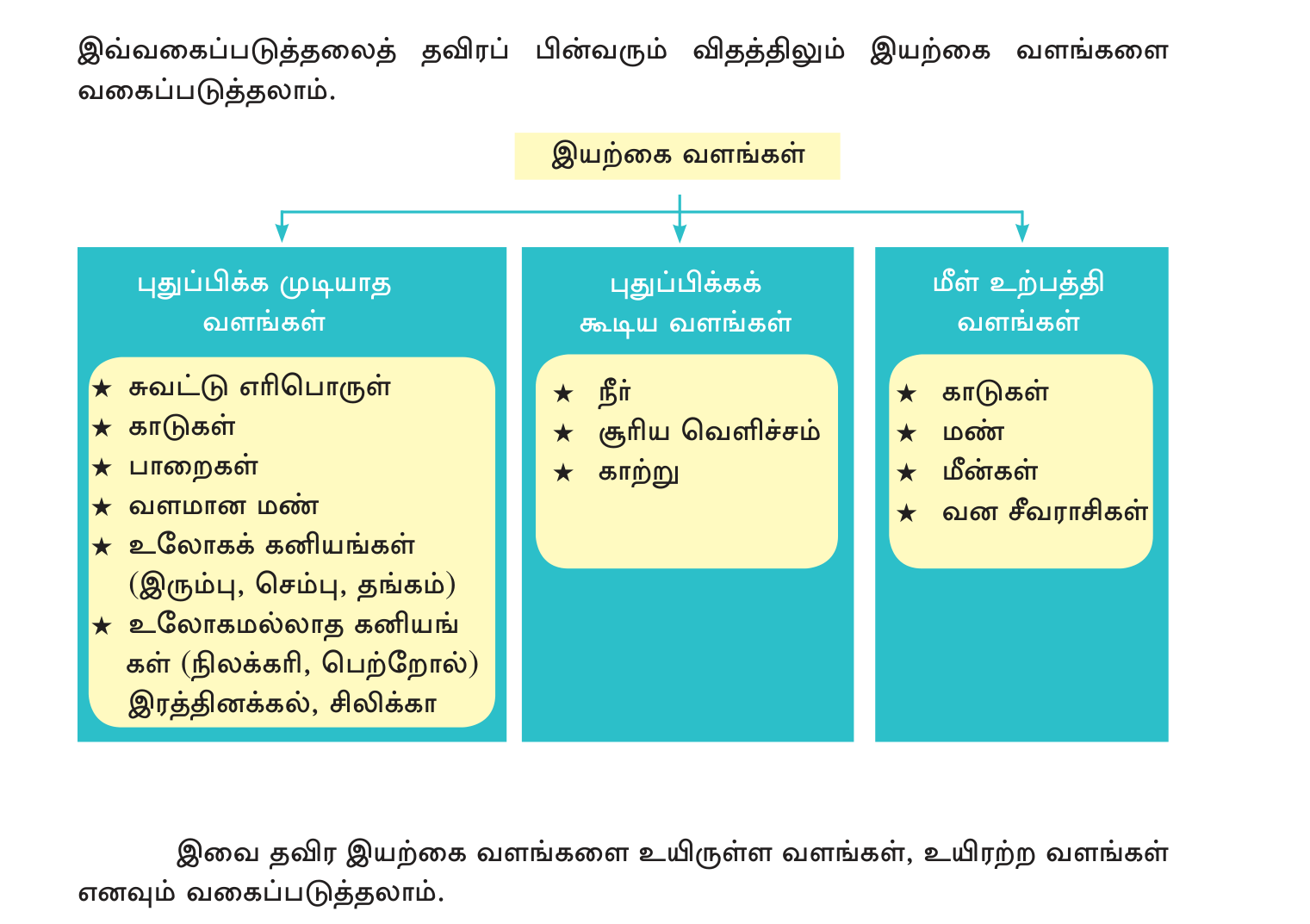
1. இயற்கை வளம் என்றால் என்ன?
இயற்கையிலிருந்து கிடைக்கும், மனிதனுக்குப் பயன்படும் எந்தப் பொருளும் இயற்கை வளம் (natural resource) ஆகும். ஒரு பொருள் இயற்கை வளமாக இருக்க இரண்டு நிபந்தனைகள் நிறைவேற வேண்டும்: (1) அது இயற்கையில் கிடைக்க வேண்டும்; மனிதனால் தயாரிக்கப்பட்டதாக இருக்கக்கூடாது. (2) அது மனிதனுக்குப் பயன்பட வேண்டும்; அதாவது அதற்குத் தேவை இருக்க வேண்டும்.
உதாரணமாக, சகாரா பாலைவனத்தில் மணல் ஆயிரக்கணக்கான ஆண்டுகளாக இருந்து வருகிறது. ஆனால் அது கட்டுமானத்திற்குப் பயன்படுத்தத் தொடங்கப்பட்ட பின்னரே வளமாக மாறியது. அதேபோன்று பெற்றோல் புவியின் கீழ் கோடிக்கணக்கான ஆண்டுகளாக இருந்தது; மனிதன் அதை எரிபொருளாகப் பயன்படுத்தத் தொடங்கிய பின்னரே அது வளமாயிற்று.
2. வளங்களின் வகைப்பாடு — இரண்டு பெரும் வகைகள்
வளங்கள் மீண்டும் கிடைக்கும் தன்மையை அடிப்படையாகக் கொண்டு, அவற்றை இரண்டு பெரும் வகைகளாகப் பிரிக்கலாம்:
(அ) புதுப்பிக்கத்தக்க வளங்கள் (Renewable Resources)
குறிப்பிட்ட காலத்திற்குள் இயற்கை மீண்டும் உருவாக்கித் தரும் வளங்கள் இவையாகும். அதாவது இன்று பயன்படுத்தினாலும், நாளையோ அடுத்த பருவத்திலோ சில ஆண்டுகளுக்குள்ளோ அவை மீண்டும் கிடைக்கும். உதாரணம்:
- நீர்: மழை பெய்வதன் மூலம் தொடர்ந்து புதுப்பிக்கப்படுகிறது; இதுவே நீர்ச் சுழற்சி எனப்படும்.
- காற்று: வளி மண்டலத்தில் எப்போதும் காணப்படுகிறது.
- சூரிய ஒளி: நாள்தோறும் இலவசமாகக் கிடைக்கிறது.
- காடுகள்: மரங்கள் வெட்டப்பட்டாலும் மீண்டும் வளர்க்க முடியும்; அதற்குச் சில தசாப்தங்கள் செல்லும்.
- மீன், கால்நடைகள்: இனப்பெருக்கத்தின் மூலம் தொடர்ந்து பெருகுகின்றன.
- மண்: மிக மெதுவாகவே மீள உருவாகிறது; ஒரு செ.மீ. மண் உருவாக நூற்றுக்கணக்கான ஆண்டுகள் தேவைப்படும்.
(ஆ) புதுப்பிக்க முடியாத வளங்கள் (Non-renewable Resources)
ஒருமுறை பயன்படுத்தித் தீர்ந்துவிட்டால், மனித வாழ்நாளுக்குள் மீண்டும் உருவாக முடியாத வளங்கள் இவையாகும். புவியில் இவை உருவாகக் கோடிக்கணக்கான ஆண்டுகள் தேவைப்படுகின்றன. உதாரணம்:
- புதைபடிவ எரிபொருள்கள் (fossil fuels): நிலக்கரி (coal), பெற்றோல் (petroleum), இயற்கை எரிவாயு (natural gas) ஆகியவை இதில் அடங்கும். தாவர, விலங்குகளின் சேதனப் பொருள்கள் கோடிக்கணக்கான ஆண்டுகள் புதையுண்டதால் இவை உருவாகின.
- உலோகக் கனியங்கள் (metallic minerals): இரும்பு, தாமிரம், அலுமினியம், தங்கம், வெள்ளி என்பன.
- உலோகமற்ற கனியங்கள் (non-metallic minerals): சுண்ணாம்புக் கல், ஜிப்சம், கிராப்பைட், உப்பு, வைரம் என்பன.
- அணு எரிபொருள் (nuclear fuel): யுரேனியமும் தோரியமும் ஆகும்; இவை மிகச் சிறிய அளவிலேயே கிடைக்கின்றன.
3. பாறைகள் (Rocks) — மண்ணின் தாய்
பல வளங்கள், அதாவது கனியங்கள், கட்டுமானக் கல், மண் ஆகியவை பாறைகளிலிருந்தே பிறக்கின்றன. பாறைகள் உருவாகும் முறையின் அடிப்படையில் மூன்று வகையாகப் பிரிக்கப்படுகின்றன:
(அ) தீப்பாறை (Igneous Rocks)
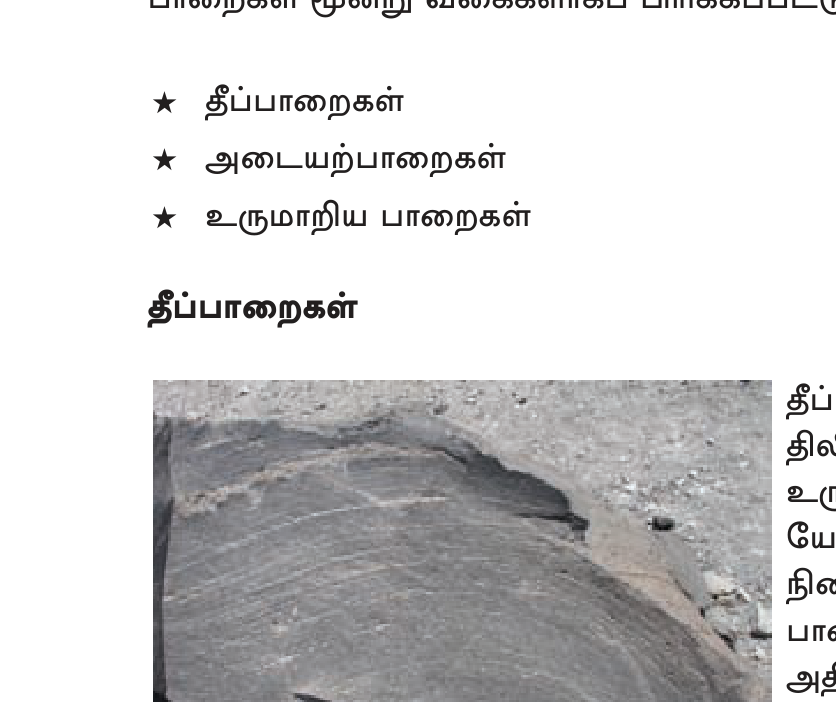
புவியின் உள்ளே உள்ள உருகிய பாறை (magma) அல்லது எரிமலையால் வெளியேற்றப்படும் லாவா குளிர்ந்து கெட்டியாகும்போது தீப்பாறை உருவாகிறது. உதாரணம்: கிரானைட் (granite), இது உருகிய பாறை மெதுவாகக் குளிர்ந்ததால் உருவானது; பசால்ட் (basalt), இது லாவா விரைவாகக் குளிர்ந்ததால் உருவானது. இவை மிகக் கடினமானவையும் நீடித்து நிலைப்பவையும் ஆகும். அதனால் கட்டுமானத்திற்கு ஏற்றவை.
(ஆ) படிவுப் பாறை (Sedimentary Rocks)
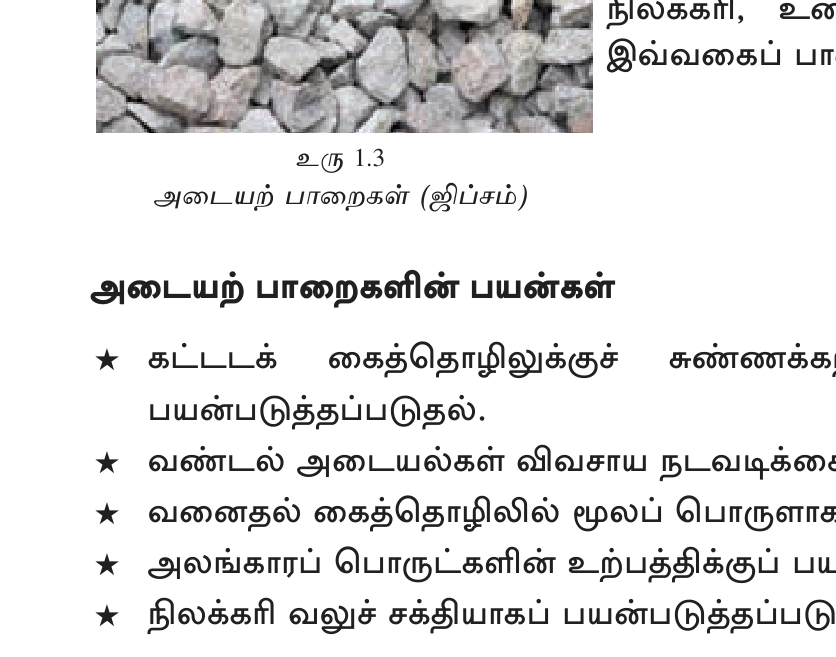
ஆறு, கடல், காற்று ஆகியவை கொண்டுவரும் வண்டல், மணல், களி என்பன பல இலட்சம் ஆண்டுகளாக ஒன்றின் மேல் ஒன்றாகப் படிகின்றன. மேலுள்ள படிவுகளின் அழுத்தத்தால் கீழுள்ளவை இறுகிக் கெட்டியான பாறையாகின்றன. உதாரணம்: சுண்ணாம்புக் கல் (limestone), இது கடல் உயிரினங்களின் ஓடுகளிலிருந்து உருவானது; மணற்கல் (sandstone), இது மணல் படிந்து உருவானது; நிலக்கரி (coal), இது தாவரச் சேதனப் பொருள் புதையுண்டு உருவானது; பெற்றோல் (petroleum), இது கடல் உயிரினங்களின் சேதனப் பொருளிலிருந்து உருவானது.
(இ) உருமாறிய பாறை (Metamorphic Rocks)
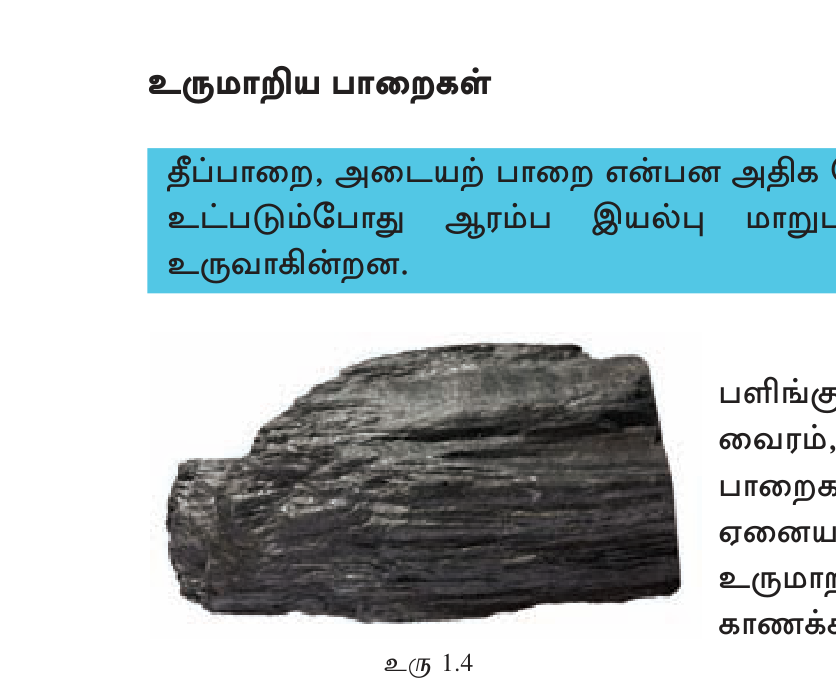
ஏற்கெனவே உள்ள தீப்பாறை அல்லது படிவுப் பாறை புவியின் ஆழமான பகுதிக்குச் செல்லும்போது அதிக வெப்பமும் அழுத்தமும் கிடைக்கின்றன. அவற்றால் அது புதிய பாறையாக மாறுகிறது. உதாரணம்: சுண்ணாம்புக் கல் பளிங்குக் கல்லாகவும் (marble), மணற்கல் குவார்ட்சைட்டாகவும் (quartzite), நிலக்கரி கிராப்பைட்டாகவும் (graphite), களி ஸ்லேட்டாகவும் (slate) மாறுகின்றன.
4. கனியங்கள் (Minerals) — புவியின் கருவூலம்
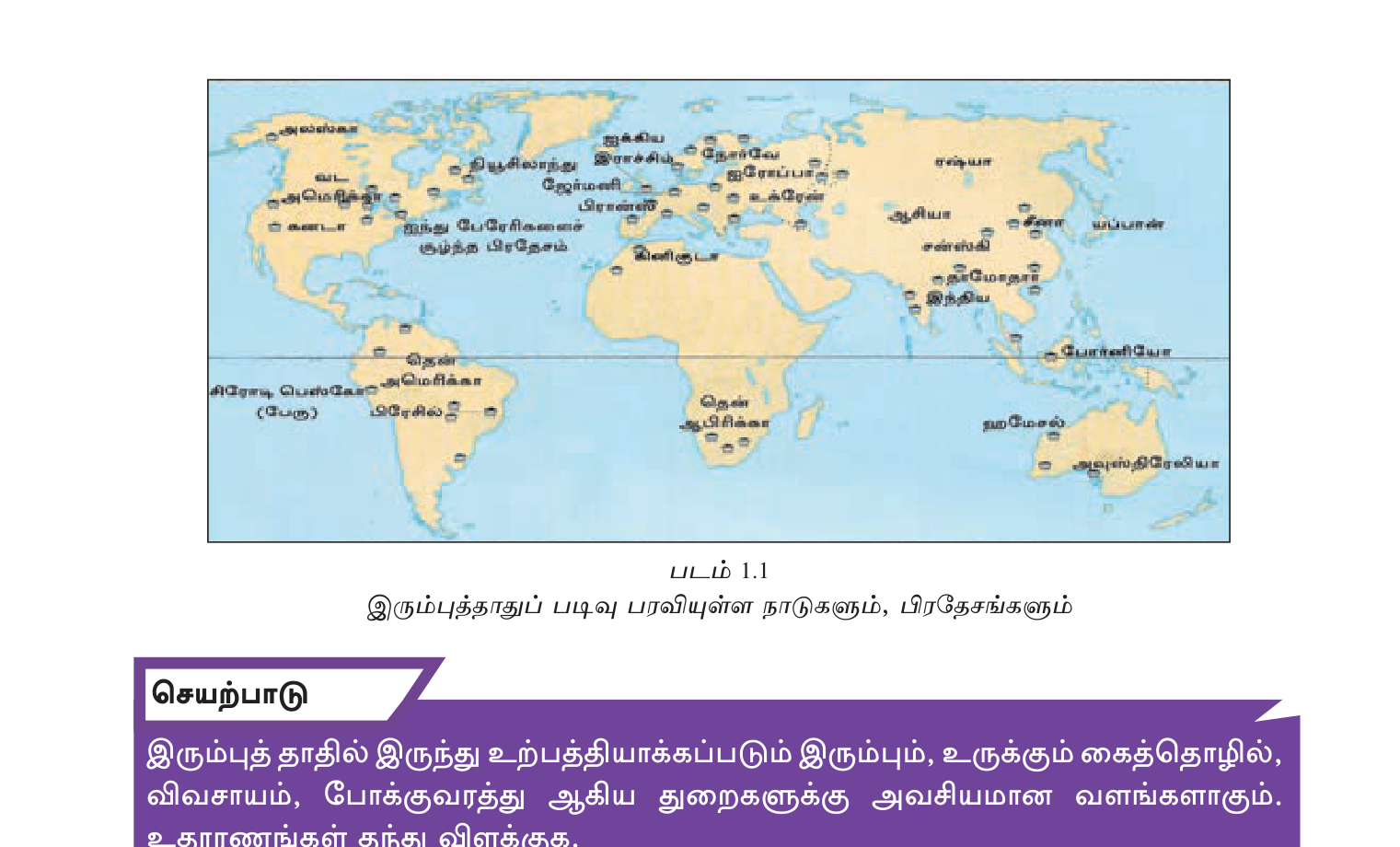
கனியம் (mineral) என்பது குறிப்பிட்ட இரசாயன அமைப்பைக் கொண்ட, இயற்கையாகக் காணப்படும் திடப் பொருளாகும். கனியங்கள் முக்கியமாக இரண்டு வகைப்படும்:
(அ) உலோகக் கனியங்கள் (Metallic Minerals)
- இரும்பு (iron): உருக்கு தயாரிக்கப் பயன்படுகிறது. உலகில் தாது இருப்பு அதிகமுள்ள நாடுகள் வரிசையாக சீனா, ஆஸ்திரேலியா, பிரசில், இந்தியா ஆகும்.
- தாமிரம் (copper): மின்கம்பிகள் செய்யப் பயன்படுகிறது; சிலி, பெரு, சீனா ஆகிய நாடுகளில் காணப்படுகிறது.
- பாக்சைட் (bauxite): அலுமினியம் பெறப்படும் தாதுவாகும்; ஆஸ்திரேலியா, கினியா, பிரசில் ஆகிய நாடுகளில் காணப்படுகிறது.
- தங்கம், வெள்ளி: நகைகளுக்கும் தொழில்நுட்பத்துக்கும் பயன்படுகின்றன; சீனா, ஆஸ்திரேலியா, ருஷ்யா, தென் ஆபிரிக்கா ஆகிய நாடுகளில் கிடைக்கின்றன.
- தகரம் (tin): பற்றாசு (solder) செய்யவும் பொதியிடவும் பயன்படுகிறது; சீனா, இந்தோனேசியா, மியான்மர் ஆகிய நாடுகளில் கிடைக்கிறது.
(ஆ) உலோகமற்ற கனியங்கள் (Non-metallic Minerals)
- சுண்ணாம்புக் கல் (limestone): சிமெண்ட் தயாரிக்கப் பயன்படுகிறது.
- ஜிப்சம் (gypsum): சிமெண்டுடன் சேர்க்கப்படுகிறது; கட்டடங்களிலும் பயன்படுகிறது.
- கிராப்பைட் (graphite): பென்சிலிலும் மின்முனைகளிலும் பயன்படுகிறது; இலங்கையில் உலகின் சிறந்த தரமுள்ள கிராப்பைட் கிடைக்கிறது.
- உப்பு (salt): உணவிலும் தொழில்களிலும் பயன்படுகிறது.
- வைரம் (diamond): நகைகளுக்கும் தொழில்நுட்பத்துக்கும் பயன்படுகிறது; ருஷ்யா, கொங்கோ, ஆஸ்திரேலியா ஆகிய நாடுகளில் கிடைக்கிறது.
- இரத்தினங்கள் (gems): நீலக்கல் (blue sapphire) உற்பத்தியில் இலங்கை உலகில் முதன்மை இடம் வகிக்கிறது.
5. காடுகள் (Forests) — புவியின் நுரையீரல்
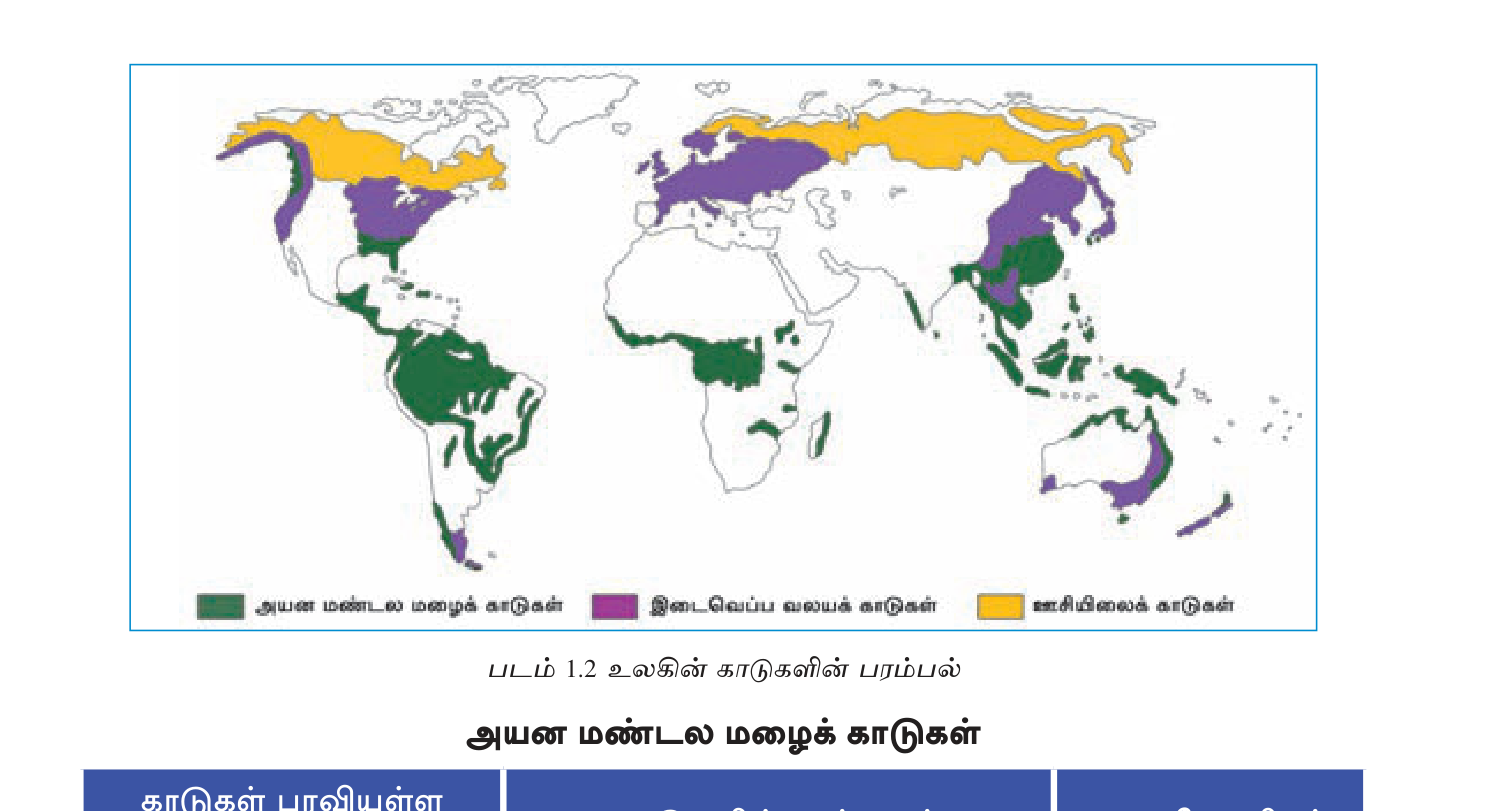
காடுகள் புவியின் நுரையீரல் (lungs) என அழைக்கப்படுகின்றன. இதற்குக் காரணம், அவை CO₂-ஐ உறிஞ்சி O₂ வெளியிட்டு, வளி மண்டலத்தின் சமநிலையைப் பேணுவதேயாகும். காடுகள் மரம் (timber), விறகு, காகிதம், மருந்து, பழங்கள் ஆகியவற்றை வழங்குகின்றன; மேலும் விலங்குகளுக்கு ஆதாரமாகவும் உள்ளன, நீரைப் பாதுகாக்கின்றன, மண் அரிப்பைத் தடுக்கின்றன, பல்லுயிர்களுக்கு இடமளிக்கின்றன.
உலகின் காட்டு வலயங்கள் ஐந்து வகைப்படும்:
- அயன ஈரக் காடு (Tropical Rainforest): அமேசன், கொங்கோ, தென்கிழக்கு ஆசியா ஆகிய பகுதிகளில் காணப்படுகிறது; பல்லுயிர்ப் பெருக்கம் இங்கே மிக அதிகம்.
- அயன சவன்னா (Tropical Savanna): மரங்களும் புல்லும் கலந்து காணப்படும்; ஆபிரிக்கா, தென் அமெரிக்கா ஆகிய பகுதிகளில் உள்ளது.
- இடைவெப்பப் பெருங்காடு (Deciduous): இலையுதிர் காலத்தில் மரங்கள் இலைகளை உதிர்க்கும்; ஐரோப்பா, கிழக்கு USA ஆகிய பகுதிகளில் உள்ளது.
- ஊசியிலைக் காடு (Coniferous, Taiga): மிகக் குளிரான பகுதிகளில் காணப்படுகிறது; கனடா, ருஷ்யா, ஸ்காண்டிநேவியா ஆகிய பகுதிகளில் உள்ளது.
- டண்ட்ரா (பனிக் காடு): ஆர்க்டிக் (Arctic) பகுதிகளில் உள்ளது; இங்கு பாசி (moss), lichen வகைத் தாவரங்கள் மட்டுமே வளர்கின்றன.
6. மண் (Soil) — விவசாயத்தின் அடித்தளம்
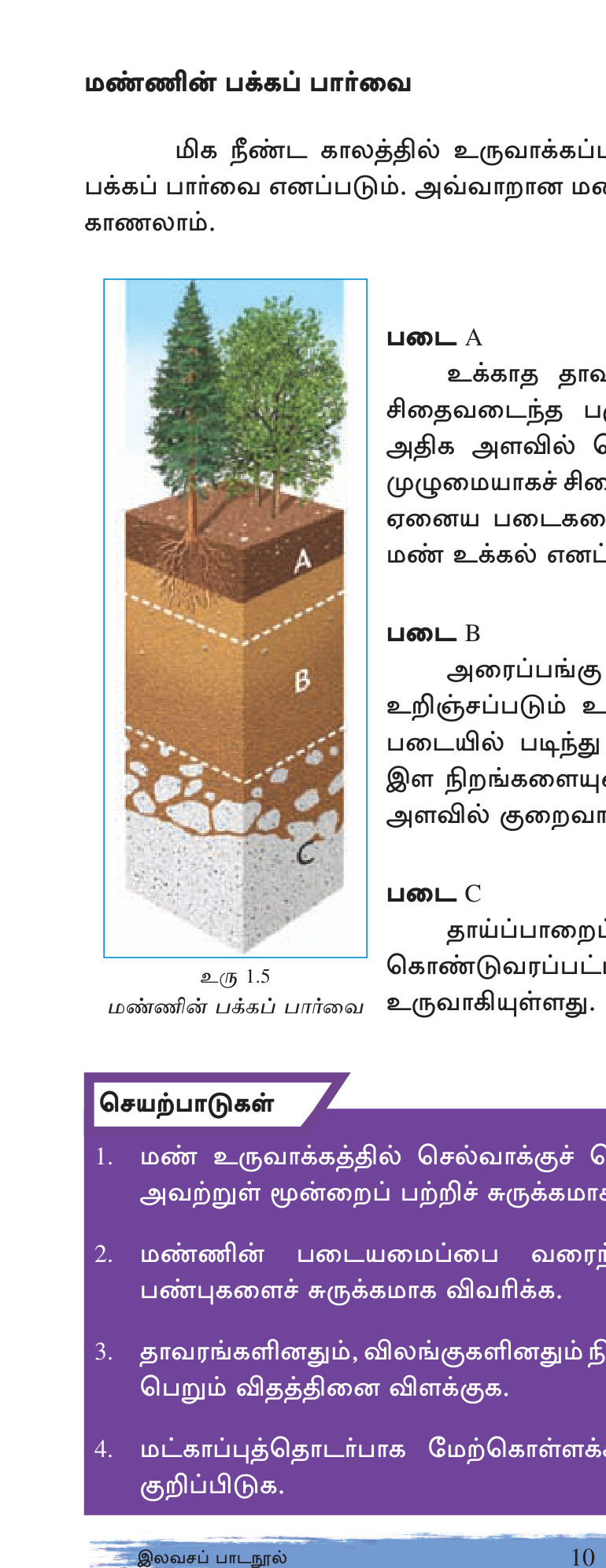
மண் என்பது பாறைத் துணிக்கைகள், சேதனப் பொருள், நீர், காற்று, நுண்ணுயிர்கள் ஆகிய ஐந்தும் சேர்ந்த ஒரு வாழும் அமைப்பாகும். பாறை சிதைவடைந்து (weathering) நூற்றுக்கணக்கான ஆண்டுகளில் ஒரு செ.மீ. மண் மட்டுமே உருவாகிறது. அதனால் மண் மெதுவாகப் புதுப்பிக்கப்படும் வளம் எனப்படுகிறது.
மண் பகுதி (soil profile) ஐந்து அடுக்குகளைக் கொண்டுள்ளது:
- O: Organic horizon. இது மேலுள்ள சேதன அடுக்காகும்; இலைகளும் தாவரக் கழிவுகளும் இங்கு காணப்படும்.
- A: Topsoil. சேதனப் பொருள் அதிகமுள்ள, பயிர்களுக்கு அதிக ஊட்டம் தரும் அடுக்காகும்.
- B: Subsoil. இங்கு இரும்பு உப்புகள் அதிகம் காணப்படும்.
- C: Weathered rock. பகுதியளவில் சிதைவடைந்த பாறை இங்கு காணப்படும்.
- R: Bedrock. இது அடியிலுள்ள தாய்ப் பாறையாகும்.
உலக மண் வகைகள்: செஞ்சாய மண் (laterite) அயன ஈரப் பகுதிகளில் காணப்படுகிறது; கருமண் (regur) தென் இந்தியாவில் காணப்படுகிறது; பாலிய மண் (chernozem) ருஷ்யா, USA, அர்ஜெண்டினா ஆகிய நாடுகளில் காணப்படும் மிக வளமான கோதுமை மண்ணாகும். இவற்றோடு பாலைவன மண், டண்ட்ரா மண், மலை மண் என்பனவும் உள்ளன.
7. நீர் (Water) — வாழ்வின் மூலம்
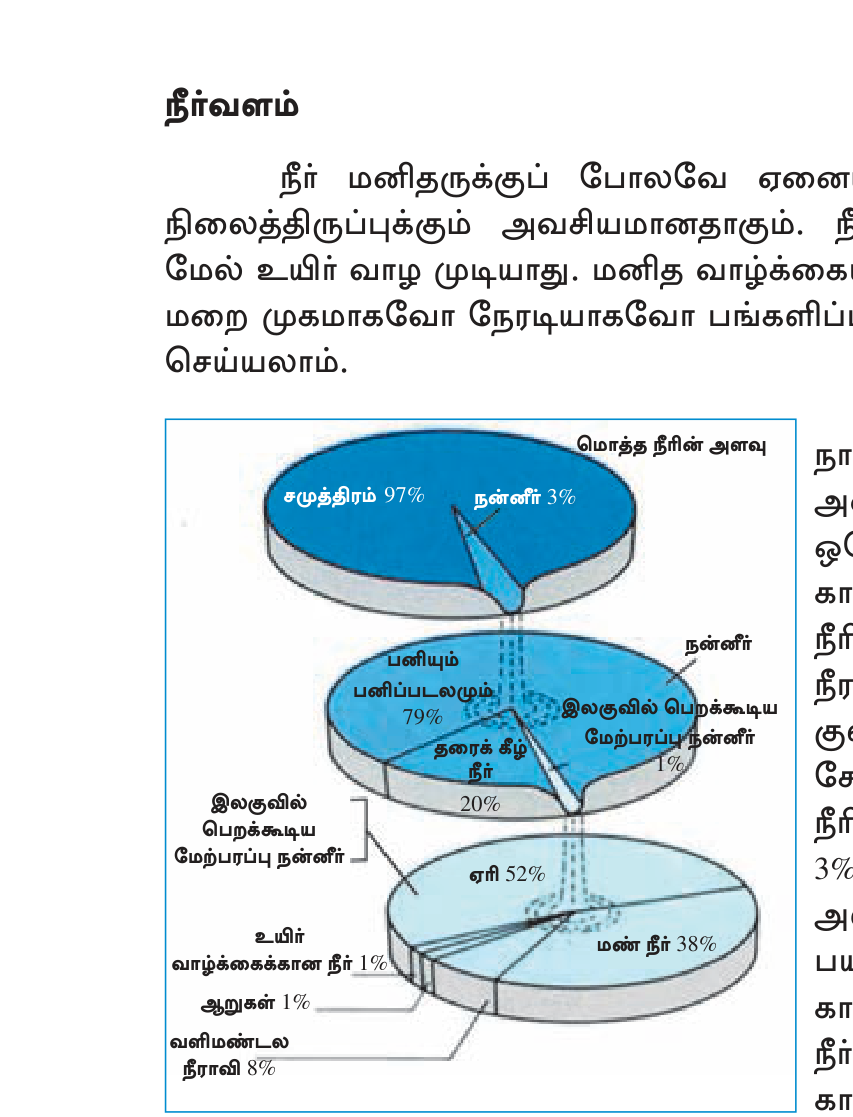
புவியின் மொத்த நீரில் 97.5% உப்பு நீர் (கடல், சமுத்திரம்) — பருகவோ விவசாயத்திற்கோ பயனற்றது. எஞ்சிய 2.5% மட்டுமே நன்னீர் (fresh water). ஆனால் இதிலும் பெரும்பகுதி (~70%) பனிப்படலங்களில் (ice caps, glaciers; அண்டார்ட்டிக்கா, கிரீன்லாந்து) உறைந்த நிலையில் உள்ளது. மீதமுள்ள 0.7% மட்டுமே நிலத்தடி நீர், ஏரி, ஆறு, வளி மண்டல ஈரப்பதம் ஆகியவற்றில் உள்ளது. இதுவே மனிதன் உடனடியாகப் பயன்படுத்தக்கூடிய நீராகும்.
நீர்ச் சுழற்சி (Hydrological Cycle / Water Cycle)
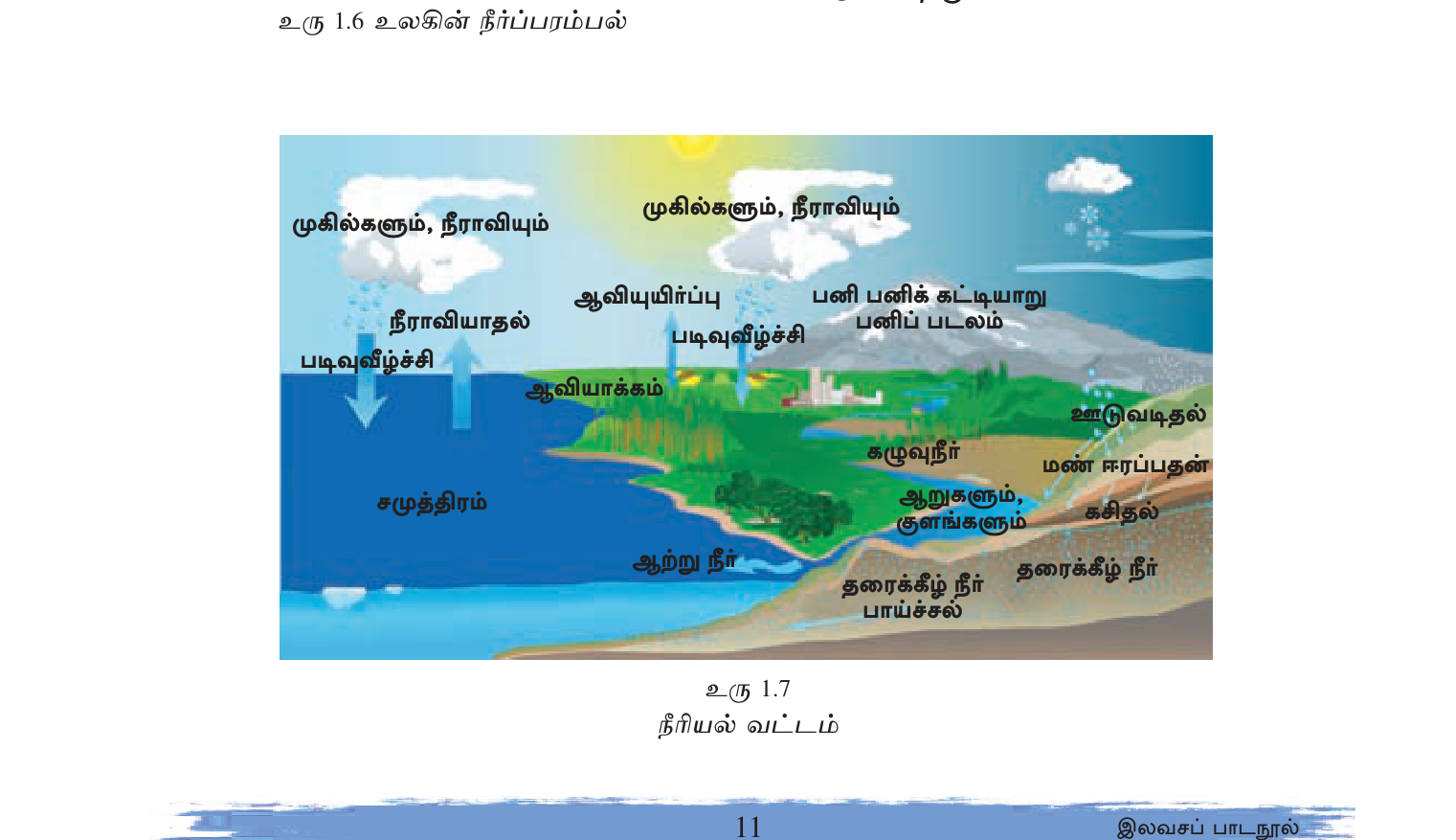
நீர் கடலிலிருந்து வளி மண்டலத்துக்கும், அங்கிருந்து நிலத்துக்கும், பின்னர் மீண்டும் கடலுக்கும் என ஒரு சுழற்சியில் இடைவிடாமல் நகர்கிறது:
- ஆவியாதல் (Evaporation): சூரிய வெப்பத்தால் கடல், ஏரி ஆகியவற்றின் நீர் ஆவியாக மாறுகிறது.
- கசிவாதல் (Transpiration): தாவரங்கள் வழியாக நீர் வளி மண்டலத்தைச் சென்றடைகிறது.
- குளிர்தலும் திரட்சியும் (Condensation): ஆவி குளிர்ந்து சிறு நீர்த்துளிகளாகி மேகங்கள் உருவாகின்றன.
- மழை (Precipitation): மேகங்களிலிருந்து மழை, பனி, பனிக்கட்டி ஆகிய வடிவங்களில் நீர் பூமியை வந்தடைகிறது.
- பாய்தலும் கசிதலும்: மழை நீர் ஆறுகள் வழியாகக் கடலைச் சேர்கிறது; அல்லது நிலத்தினுள் இறங்கி நிலத்தடி நீராகிறது.
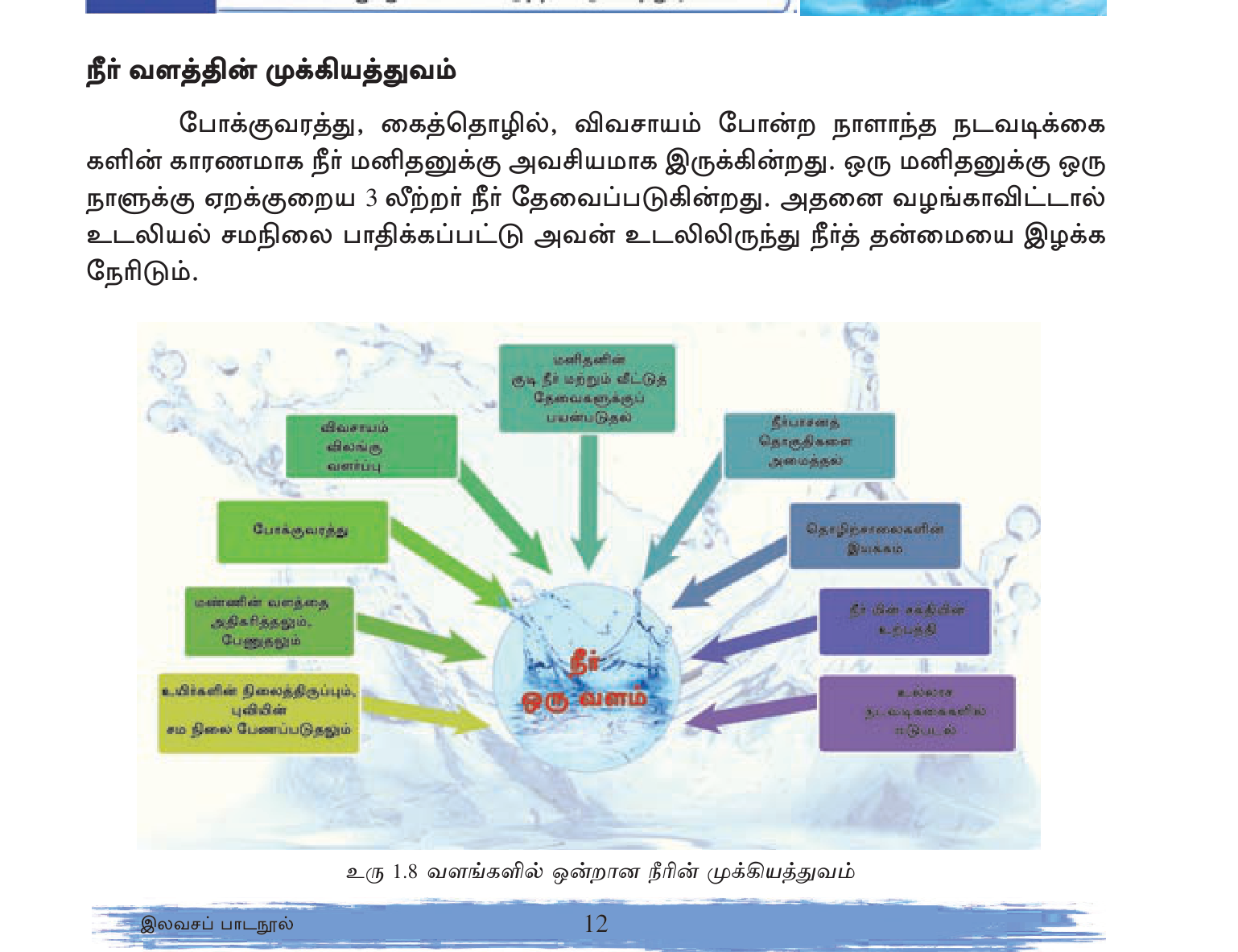
நீரின் பயன்பாடு
- உள்நாட்டுப் பயன்பாடு (Domestic): பருகுதல், சமைத்தல், குளித்தல், சுத்தம் செய்தல் ஆகியவற்றுக்காகப் பயன்படுகிறது (உலகப் பயன்பாட்டில் ~10%).
- விவசாயம் (Agriculture): பாசனத்துக்கும் கால்நடைகளுக்கும் பயன்படுகிறது; இதுவே மிகப் பெரும் பகுதியாகும் (~70%).
- கைத்தொழில் (Industry): சக்தி உற்பத்தி, குளிரூட்டல், சுத்தம் செய்தல் ஆகியவற்றுக்குப் பயன்படுகிறது (~20%).
- நீர்மின்சாரம் (Hydropower): அணையில் தேக்கிய நீரால் விசையாழியை (turbine) இயக்கி மின்சாரம் பெறப்படுகிறது.
- போக்குவரத்து: கப்பல்களும் படகுகளும் நீர்வழியாகப் பயணிக்கின்றன.
- சுற்றுலாவும் பொழுதுபோக்கும்: கடற்கரை, ஆறு, ஏரி ஆகியவற்றில் நடைபெறுகின்றன.
8. வளங்களை எதிர்நோக்கும் சவால்களும் பாதுகாப்பும்
உலக சனத்தொகை வளர்ச்சி, நகரமயமாதல், தொழில் வளர்ச்சி ஆகியவற்றின் காரணமாக இயற்கை வளங்கள் வேகமாகச் சுரண்டப்படுகின்றன. இதனால் எழும் முக்கிய சவால்கள் பின்வருமாறு:
- புதைபடிவ எரிபொருள் தீர்ந்து வருகிறது: பெற்றோல், நிலக்கரி ஆகியவற்றின் இருப்பு 50-100 ஆண்டுகளில் தீர்ந்துவிடக்கூடும்.
- காடழிப்பு (Deforestation): அமேசன், இந்தோனேசிய ஈரக் காடுகள் வேகமாக அழிக்கப்படுகின்றன.
- நீர்ப் பற்றாக்குறை: கேப் டவுன் (Cape Town, 2018), சென்னை (Chennai, 2019) போன்ற நகரங்கள் நீர் முற்றாகத் தீர்ந்துவிடும் "Day Zero" நிலையை நெருங்கின.
- மண் அரிப்பும் மாசடைதலும்: இவற்றால் பயிர்செய்யும் நிலம் இழக்கப்படுகிறது.
- உலோகக் கனிய இருப்பு குறைதல்: அரிய மண் மூலகங்களுக்காக (rare earth elements) நாடுகளிடையே போட்டி நிலவுகிறது.
- காலநிலை மாற்றம்: பசுமை இல்ல வாயுக்கள் (GHG) வெளியேறுவதால் புவி வெப்பமடைதல் (global warming) ஏற்படுகிறது.
பாதுகாப்பு உத்திகள்
- புதுப்பிக்கத்தக்க சக்தி (renewable energy): சூரியன், காற்று, நீர்மின்சாரம், அலை, புவிவெப்பம் (geothermal) ஆகியவற்றிலிருந்து சக்தியைப் பெறுதல்.
- 3R கொள்கை: பயன்பாட்டைக் குறைத்தல் (Reduce), மீளப் பயன்படுத்தல் (Reuse), மறுசுழற்சி செய்தல் (Recycle).
- மறுசுழற்சித் தொழில்கள்: பழைய பிளாஸ்டிக், கண்ணாடி, காகிதம், உலோகம் ஆகியவற்றை மீண்டும் பயன்படுத்துதல்.
- காடு வளர்ப்பு (Reforestation, Afforestation): அழிந்த இடங்களில் மீண்டும் காடு வளர்த்தலும், காடில்லாத இடங்களில் புதிதாகக் காடு உருவாக்குதலும்.
- நீர் சேமிப்பு: மழைநீர் சேகரிப்பு (rainwater harvesting), சொட்டு நீர்ப்பாசனம் (drip irrigation).
- சர்வதேச ஒப்பந்தங்கள்: Paris Agreement 2015 (காலநிலை), CITES (வனவிலங்குகள்), Ramsar (ஈர நிலங்கள்).
- Sustainable Development Goals (SDG 6, 7, 13, 14, 15) — UN 2030 target.
- Resource = Nature + Utility. இரண்டுமே இருக்க வேண்டும்.
- 2 வகை: புதுப்பிக்கத்தக்கவை (Renewable: நீர், காற்று, சூரியன், காடு), புதுப்பிக்க முடியாதவை (Non-renewable: நிலக்கரி, எண்ணெய், உலோகம், யுரேனியம்).
- 3 பாறை வகைகள்: தீப்பாறை (igneous — granite/basalt) · படிவுப்பாறை (sedimentary — limestone/sandstone/coal) · உருமாறிய (metamorphic — marble/quartzite/graphite/slate).
- உலோகக் கனியங்கள்: இரும்பு (சீனா, ஆஸ்திரேலியா, பிரசில், இந்தியா), தாமிரம் (சிலி, பெரு), பாக்சைட் (ஆஸ்திரேலியா, கினியா), தங்கம் (சீனா, ஆஸ்திரேலியா, ருஷ்யா).
- உலோகமற்ற கனியங்கள்: சுண்ணாம்புக் கல், ஜிப்சம், கிராப்பைட் (இலங்கையில் உலகின் சிறந்த தரம்), உப்பு, வைரம்.
- 5 காட்டு வலயங்கள்: அயன ஈரக் காடு (Amazon) · சவன்னா · இடைவெப்பப் பெருங்காடு (Deciduous) · ஊசியிலைக் காடு (Taiga: ருஷ்யா, கனடா) · டண்ட்ரா.
- மண் பகுதியின் 5 அடுக்குகள்: O · A (topsoil) · B (subsoil) · C (weathered rock) · R (bedrock).
- நீர்ப் பகிர்வு: 97.5% உப்பு நீர்; 2.5% நன்னீர் (இதில் 70% பனி). பயன்படுத்தத்தக்கது 0.7% மட்டுமே.
- நீர்ச் சுழற்சியின் 5 படிகள்: ஆவியாதல் (Evaporation) · கசிவாதல் (Transpiration) · குளிர்தலும் திரட்சியும் (Condensation) · மழை (Precipitation) · பாய்தல் (Runoff).
- நீர்ப் பயன்பாட்டு வீதம்: விவசாயம் 70% · கைத்தொழில் 20% · உள்நாட்டுப் பயன்பாடு 10%.
- பாதுகாப்பு: 3R (Reduce, Reuse, Recycle), புதுப்பிக்கத்தக்க சக்தி, காடு வளர்ப்பு, Paris 2015, SDG ஆகியவை.
- "இயற்கையில் உள்ளவை எல்லாம் வளம்" என்பது தவறு. பயன்பாடு (Utility) இருந்தால் மட்டுமே அது வளமாகும்; சகாரா மணல் ஆரம்பத்தில் வளமாக இருக்கவில்லை.
- "காடு புதுப்பிக்கத்தக்கது; ஆனால் அளவுக்கு மிஞ்சி வெட்டினால் புதுப்பிக்க முடியாததாகிவிடும்" என்பதை நினைவிற்கொள். அளவுக்கு மீறிய சுரண்டல் (over-exploitation) வளத்தைத் தீர்த்துவிடும்.
- 3 பாறை வகைகளின் தோற்றத்தைக் குழப்பிக்கொள்ளுதல். தீப்பாறை magma அல்லது lava குளிர்ந்து உருவாகிறது; படிவுப்பாறை படிவுகள் அழுத்தத்தால் இறுகி உருவாகிறது; உருமாறிய பாறை ஏற்கெனவே உள்ள பாறை வெப்பத்தையும் அழுத்தத்தையும் பெற்று உருவாகிறது.
- நீரில் 97.5% உப்பு நீர்; அது 50%, 50% என்று பகிரப்பட்டிருக்கவில்லை. இதைக் குழப்பிக்கொள்ளாதே.
- இலங்கையின் கிராப்பைட் உலகின் சிறந்த தரமுடையது (Bogala, Kahatagaha சுரங்கங்கள்). அளவில் சீனாவும் இந்தியாவும் முதலிடத்தில் உள்ளன; ஆனால் தரத்தில் இலங்கையே முன்னணி.
- Amazon, Taiga ஆகியவை வேறுபட்டவை. Amazon அயன ஈரக் காடு; Taiga ஊசியிலைக் காடு (boreal forest).
- மண்ணின் A அடுக்கு (Topsoil) மிகவும் வளமானது; B அடுக்கு (Subsoil) வேறானது. இரண்டையும் குழப்பிக்கொள்ளாதே.
- "மறுசுழற்சியே கழிவு முகாமைத்துவம்" என்பது தவறு. மறுசுழற்சி வளப் பாதுகாப்பின் ஒரு பகுதி மட்டுமே; அது முழுமையான தீர்வல்ல. முக்கியத்துவம் Reduce, Reuse, Recycle என்ற வரிசையில் குறைந்து செல்கிறது.
✅ விரைவுச் சோதனை
முக்கியக் கருத்துக்களை உறுதிப்படுத்துங்கள். தவறான விடைகள் உங்கள் தவறுக் குறிப்பேட்டில் சேமிக்கப்படும்.
🖊 கட்டுரை வினாக்கள் (பகுதி II)
பரீட்சை வடிவில் கட்டமைப்பு வினாக்கள். முதலில் நீங்களே எழுதுங்கள்; பின்னர் மாதிரி விடையைத் திறந்து சரிபாருங்கள்.
விடைத் திட்டம் — சேர்க்க வேண்டிய புள்ளிகள்:
- Resource = Nature + Utility
- Renewable = within human time
- Non-renewable = millions of years
- Renewable examples: water, wind, sun, forest, fish
- Non-renewable: coal, oil, gas, metals, uranium
- Forest can become non-renewable if over-exploited
- Sustainable yield = use ≤ regeneration
**(அ) புதுப்பிக்கத்தக்க வளங்கள் (Renewable):** குறிப்பிட்ட காலத்தில் இயற்கை மீள் உருவாக்கும். எடுத்துக்காட்டு — நீர் (மழை + நீர்ச் சுழற்சி), காற்று, சூரிய ஒளி, காடு (சில தசாப்தங்களில் மீள் வளர்ப்பு), மீன் (இனப்பெருக்கம்), மண் (மிக மெதுவாக — நூற்றுக்கணக்கான ஆண்டு / cm).
**(ஆ) புதுப்பிக்க முடியாத வளங்கள் (Non-renewable):** உருவாக கோடிக்கணக்கான ஆண்டு ஆகும்; ஒரு முறை தீர்ந்தால் மீள முடியாது. எடுத்துக்காட்டு — புதைபடிவ எரிபொருள் (நிலக்கரி, பெற்றோல், இயற்கை எரிவாயு), உலோக கனியங்கள் (இரும்பு, தாமிரம், அலுமினியம், தங்கம், வெள்ளி), உலோகமற்ற கனியங்கள் (சுண்ணாம்புக் கல், கிராப்பைட், உப்பு, வைரம்), அணு எரிபொருள் (யுரேனியம், தோரியம்).
**முக்கிய அவதானிப்பு:** Renewable என்றாலும் — காடு போன்ற வளம் — அதிக சுரண்டலால் non-renewable-ஆகவே மாறி விடும். அமேசன் / இந்தோனேசிய காடுகள் வேகமாக அழிக்கப்படுகின்றன — இனப்பெருக்க வேகத்தை விட சுரண்டல் வேகம் அதிகம். அதனாலேயே 'sustainable yield' (use ≤ regeneration rate) கொள்கை அவசியம்.
நீர் — renewable ஆனாலும் — சில பகுதிகளில் (Saudi, North Africa fossil aquifers) கடந்த கால geological-time-இல் சேமிக்கப்பட்ட நிலத்தடி நீர் ஒரு முறை எடுத்தால் மீள் நிரம்பாது.
விடைத் திட்டம் — சேர்க்க வேண்டிய புள்ளிகள்:
- Igneous: magma/lava cooling — granite, basalt
- Sedimentary: sediments + pressure over time — limestone, sandstone, coal, oil
- Metamorphic: existing rock + heat + pressure — marble (from limestone), quartzite (from sandstone), graphite (from coal), slate (from clay)
- Rock cycle — interconvertible
- பயன்: construction (granite), cement (limestone), fuel (coal), nuclear, etc.
**(அ) தீப்பாறை (Igneous Rocks).** புவியின் உள்ளே உள்ள உருகிய magma அல்லது எரிமலையால் வெளியேற்றப்படும் lava குளிர்ந்து கெட்டியாகும். குளிர்தலின் வேகத்தைப் பொறுத்து — magma மெதுவாக ஆழத்தில் குளிர்ந்தால் large crystals (granite — beach buildings, monuments); lava விரைவாக surface-இல் குளிர்ந்தால் fine grains (basalt — road metal, volcanic plains). தீப்பாறைகள் கடினமாகவும் அதிக durable-ஆகவும் இருப்பதால் கட்டுமானத்திற்கு உகந்தவை.
**(ஆ) படிவுப்பாறை (Sedimentary Rocks).** ஆறு, கடல், காற்று கொண்டு வரும் வண்டல், மணல், களி பல லட்சம் ஆண்டுகள் ஒன்றின் மேல் ஒன்று படிய — அழுத்தத்தால் கெட்டி பாறையாகின்றன. எடுத்துக்காட்டு: சுண்ணாம்புக் கல் (limestone — கடல் உயிரின ஓட்டுகள், coral, shells; சிமெண்ட் primary raw), மணற்கல் (sandstone — மணல் cemented; கட்டுமானம்), நிலக்கரி (coal — தாவர சேதனம் millions of years புதைந்தது), பெற்றோல் (petroleum — கடல் microorganisms decay), shale (களி), conglomerate (கூழாங்கல்).
**(இ) உருமாறிய பாறை (Metamorphic Rocks).** ஏற்கனவே இருக்கும் தீப்பாறை அல்லது படிவுப்பாறை, புவியின் ஆழமான பகுதிக்கு செல்லும் போது அதிக வெப்பம் (>200°C) + அதிக அழுத்தம் கிடைத்து புதிய molecular arrangement-உடன் புதிய பாறையாக மாறும் (re-crystallization). எடுத்துக்காட்டு:
- சுண்ணாம்புக் கல் → பளிங்குக் கல் (marble — sculpture, decorative)
- மணற்கல் → குவார்ட்சைட் (quartzite — extreme hardness, road metal)
- நிலக்கரி → கிராப்பைட் (graphite — பென்சில், electrode; இலங்கை Bogala, Kahatagaha mines உலகின் சிறந்த தர)
- களி → ஸ்லேட் (slate — roofing tiles, traditional school slate)
- ஒன்றோடொன்று மறு உருமாற்றமும் சாத்தியம் (rock cycle).
**Rock Cycle:** இவை isolated அல்ல — ஒரு வகை பாறை geological processes மூலம் மற்றொன்றாக மாறக்கூடியது. Igneous weathered + transported = sediments → sedimentary rock. Sedimentary deeply buried = metamorphic. Metamorphic deeper still = melted to magma → again igneous. ஒரு endless cycle.
**பயன்கள்:** கட்டுமானம் (granite, marble, sandstone), சிமெண்ட் (limestone), எரிபொருள் (coal, oil), நகை (gems formed in metamorphic conditions), industrial (graphite, slate), நீர் reservoirs (sandstone, limestone aquifers).
விடைத் திட்டம் — சேர்க்க வேண்டிய புள்ளிகள்:
- Metallic: iron (China/Australia/Brazil/India), copper (Chile/Peru), bauxite (Australia/Guinea), gold (China/Australia/Russia/USA), tin, silver, uranium
- Non-metallic: limestone, gypsum, graphite (SL world's best), salt, gypsum, diamond (Russia/DRC/Australia/Botswana), gems (SL sapphire)
- Industrial vs precious vs construction use
- World demand growing; recycling important
**(அ) உலோக கனியங்கள் (Metallic Minerals):**
1. **இரும்பு (Iron Ore — Hematite, Magnetite):** உலகின் மிக முக்கிய உலோகம், உருக்கு production-க்கு. முதன்மை நாடுகள் — சீனா (~50% உலகம், Anshan/Magnitogorsk), ஆஸ்திரேலியா (Pilbara), பிரசில் (Carajás), இந்தியா (Jharkhand), ருஷ்யா (Kursk). 'Mother industry' (steel) raw material.
2. **தாமிரம் (Copper):** மின்சாரம் கம்பி, electronics. சிலி (Chuquicamata — world's largest), பெரு, சீனா, USA, ருஷ்யா.
3. **பாக்சைட் (Bauxite → Aluminium):** Aircraft, packaging, construction. ஆஸ்திரேலியா, கினியா (Guinea), பிரசில், சீனா, இந்தியா. Aluminium = energy-intensive smelting (Norway, Iceland with hydropower).
4. **தங்கம் (Gold):** நகை + electronics + central bank reserves. சீனா, ஆஸ்திரேலியா, ருஷ்யா, USA, கனடா, தென் ஆபிரிக்கா (Witwatersrand — historic).
5. **வெள்ளி (Silver):** நகை, electronics, photography. மெக்சிகோ, பெரு, சீனா, ருஷ்யா.
6. **யுரேனியம் (Uranium):** Nuclear fuel. கசக்ஸ்தான் (#1), கனடா, ஆஸ்திரேலியா, நைஜர்.
7. **தகரம் (Tin):** Solder, packaging. சீனா, இந்தோனேசியா, பெரு, மியான்மர்.
**(ஆ) உலோகமற்ற கனியங்கள் (Non-metallic Minerals):**
1. **சுண்ணாம்புக் கல் (Limestone):** சிமெண்ட் primary raw. எல்லா நாடுகளிலும் கிடைக்கும்; சீனா + இந்தியா + USA முக்கிய சிமெண்ட் producer.
2. **ஜிப்சம் (Gypsum):** சிமெண்ட் setting controller, drywall (plasterboard). சீனா, ஈரான், USA.
3. **கிராப்பைட் (Graphite):** பென்சில், batteries (lithium-ion anodes!), industrial electrodes, lubricant. சீனா (60%+ world production), மொசாம்பிக், பிரசில். **இலங்கை** = அளவில் சிறிது ஆனால் **உலகின் சிறந்த தர** (vein graphite, 95%+ pure) — Bogala, Kahatagaha, Ragedara mines.
4. **உப்பு (Salt):** உணவு, இரசாயன தொழில் (chlor-alkali, soda ash). சீனா, USA, இந்தியா.
5. **வைரம் (Diamond):** Jewellery + industrial cutting. ருஷ்யா, கொங்கோ (DRC), ஆஸ்திரேலியா, பொட்சுவானா, கனடா.
6. **இரத்தினங்கள் (Gemstones):** **இலங்கை = blue sapphire உலக முதன்மை** (Ratnapura — 'Gem City'). பிற: ruby, cat's eye, alexandrite, garnet, topaz. Tanzanite — only Tanzania. Emerald — கொலம்பியா, ஜாம்பியா.
7. **பெட்ரோலியம் & இயற்கை எரிவாயு (Petroleum, Natural Gas):** Saudi Arabia, USA, ருஷ்யா, ஈரான், கனடா. Middle East-இல் சுமார் 50% world reserves.
8. **நிலக்கரி (Coal):** சீனா (#1 producer + #1 consumer), இந்தியா, USA, ஆஸ்திரேலியா, ருஷ்யா.
**Industrial significance:** Modern technology — smartphones, EVs, semiconductors, satellites — depends on dozens of minerals (lithium, cobalt, rare earths, niobium, tantalum). "Battery minerals" (lithium — Chile/Australia/China, cobalt — DRC 70%+) தற்போது geopolitically critical.
**Sustainability:** உலோக கனிய இருப்பு குறைந்து வருகிறது. Recycling (e-waste mining, scrap steel) எதிர்காலத்திற்கு கட்டாயம். Deep sea mining, asteroid mining சில speculative options.
விடைத் திட்டம் — சேர்க்க வேண்டிய புள்ளிகள்:
- Forests = Earth's lungs (O2 production)
- Resources: timber, fuelwood, paper, medicine, fruits, wildlife
- Services: water cycle, soil erosion prevention, climate regulation, biodiversity
- 5 zones: Tropical rainforest (Amazon, Congo, SEA) · Savanna · Deciduous · Coniferous/Taiga · Tundra
- Deforestation crisis: Amazon, Indonesia
- Conservation: reforestation, sustainable forestry
**வளங்கள் (Direct Resources):** மரம் (timber — கட்டுமானம், மரப்பணி), விறகு (fuelwood — வளரும் நாடுகளில் primary cooking fuel), காகிதம் (paper + pulp), மருந்து (75%+ traditional medicines plant-based; aspirin from willow, taxol from yew, quinine from cinchona), பழம் + கொட்டை, இறப்பர் latex, கம்பு, தேன் (honey), சமூக habitat for forest-dwelling communities, விலங்கு ஆதாரம் (game, bushmeat — legal in some).
**சேவைகள் (Ecosystem Services):** நீர்ச் சுழற்சி பேணுதல் (transpiration → cloud formation → rainfall), மண் அரிப்பு தடுப்பு (roots hold soil), நிலச்சரிவு prevention, காலநிலை சீராக்கம் (microclimate cooling, carbon sequestration), பல்லுயிர் (biodiversity — 80% terrestrial species in forests), tourism + recreation.
**உலகின் 5 முக்கிய காட்டு வலயங்கள்:**
**(1) அயன ஈரக் காடு (Tropical Rainforest)** — நிலநடுக் கோட்டு 10° N/S, ஆண்டு வெப்பம் 25-27°C, மழை 2000-4000 mm. பெரிய பகுதிகள்: Amazon (Brazil + Peru + Colombia — world's largest, 5.5M km²), Congo Basin (DRC + Cameroon — 2nd largest), Southeast Asia (Indonesia + Malaysia + Borneo + Papua New Guinea). பல்லுயிர் உச்சம் — Amazon-இல் மட்டும் 40,000 plant species, 16,000 tree species, 2.5 million insect species.
**(2) அயன சவன்னா (Tropical Savanna)** — மரம் + புல் கலந்த open landscape. ஆபிரிக்காவின் Serengeti, Maasai Mara; தென் அமெரிக்காவின் Cerrado, Llanos; ஆஸ்திரேலியாவின் north. Wet + dry seasons; bushfires natural. African Big Five (lion, elephant, leopard, rhino, buffalo) habitat.
**(3) இடைவெப்ப பெருங்காடு / Deciduous Forest** — Temperate climate; warm summer + cold winter; trees lose leaves in autumn (deciduous). ஐரோப்பா (Germany Black Forest, Britain), கிழக்கு USA (New England), சீனா, ஜப்பான், Chile. Oak, maple, beech, birch. Autumn foliage tourism.
**(4) ஊசியிலை காடு (Coniferous Forest / Taiga / Boreal)** — அதிக குளிர் (60-65°N belt); ஊசியிலை evergreen trees (pine, spruce, fir, larch). ருஷ்யா + கனடா + Scandinavia + Alaska — Taiga belt உலகின் மிக பெரிய continuous forest. Timber + paper industry-க்கு muthn primary source.
**(5) டண்ட்ரா / Tundra** — Arctic + Antarctic; permafrost (permanently frozen ground); too cold for trees; moss + lichen + shrubs only. Reindeer, polar bear, snowy owl. Inuit, Sami indigenous people.
**Deforestation Crisis:** Amazon வேகமாக அழிக்கப்படுகிறது — 10,000+ km²/year (Bolsonaro era 2019-22 spike). காரணம்: cattle ranching, soy farming, illegal logging, mining, dams. Indonesian rainforest — palm oil plantation conversion. Africa — fuelwood + agricultural expansion. Forest area lost since 1990 ~420 million hectares (10x Germany area).
**Conservation:** Reforestation (replant lost forest), Afforestation (plant new forest where none was — China's Great Green Wall against Gobi Desert), sustainable forestry certification (FSC — Forest Stewardship Council), Indigenous community land rights, REDD+ (UN Reducing Emissions from Deforestation), national parks + biosphere reserves, eco-tourism, Paris Agreement carbon credits.
விடைத் திட்டம் — சேர்க்க வேண்டிய புள்ளிகள்:
- 97.5% salt + 2.5% fresh; 70% of fresh = ice; 0.7% usable
- Water cycle: Evaporation → Transpiration → Condensation → Precipitation → Runoff
- Uses: Agriculture 70% · Industry 20% · Domestic 10%
- Scarcity: Cape Town 2018, Chennai 2019
- Causes: population growth, irrigation, climate change
- Solutions: rainwater harvesting, drip irrigation, desalination, water recycling
**புவியின் நீர் பகிர்வு:**
- **97.5% உப்பு நீர் (salt water)** — கடல், சமுத்திரம். பருகவோ விவசாயத்திற்கோ நேரடியாக பயனற்றது (desalination expensive).
- **2.5% இனிப்பு நீர் (fresh water)** — இதிலும் பெரும்பகுதி (~70%) Antarctic + Greenland + glacier ice caps-இல் freeze. மீதம் ~29.3% நிலத்தடி நீர் (groundwater). வெறும் **~0.7% மட்டுமே** ஆறு, ஏரி, சதுப்பு, வளி மண்டல ஈரப்பதம் — மனிதனின் immediate accessible fresh water.
இதனாலேயே பல நாடுகளில் fresh water 'blue gold' என அழைக்கப்படுகிறது.
**நீர்ச் சுழற்சி (Hydrological Cycle):** புவியின் நீர் தொடர்ந்து கடல் → வளி மண்டலம் → நிலம் → கடல் என ஒரு endless cycle-இல் சுழல்கிறது:
1. **ஆவியாதல் (Evaporation):** சூரிய வெப்பத்தால் கடல் / ஏரி / ஆற்று நீர் ஆவியாக மாறுதல்.
2. **கசிவாதல் (Transpiration):** தாவர இலை stomata வழியே நீர் வளி மண்டலத்திற்கு. Forest = major source.
3. **திரட்சி (Condensation):** உயரத்தில் ஆவி குளிர்ந்து சிறு துளியாக → மேகம்.
4. **மழை (Precipitation):** மேகம் saturate ஆனால் மழை / பனி / பனிக்கட்டியாக கீழே.
5. **பாய்தல் (Runoff) + கசிதல் (Infiltration):** மழை நீர் ஆற்று → கடல், அல்லது நிலத்தடி aquifer-க்கு.
சூரியன் = primary energy driver of water cycle.
**பயன்பாடு (Water Use Distribution):**
- **விவசாயம் (Agriculture) ~70%** — paddy, wheat, irrigation, livestock. மிகப் பெரும் பகுதி.
- **கைத்தொழில் (Industry) ~20%** — power generation cooling, steel, cement, paper, textile dyeing.
- **உள்நாட்டு (Domestic) ~10%** — drinking, cooking, bathing, sanitation.
- + Hydropower (passive use), transportation, tourism, recreation.
**நீர் பற்றாக்குறை (Water Scarcity):**
- **Cape Town 'Day Zero' 2018** — மூன்று ஆண்டு வறட்சி + over-extraction; கட்டாயப் கடுமையான ration அறிமுகம் (50 L/person/day).
- **Chennai 2019** — நான்கு reservoirs வற்றி, water tankers; rich-poor inequality.
- **MENA region (Saudi, Yemen, Jordan, Iraq)** — chronic stress.
- **இந்தியா + China northern aquifers** — over-extraction; Ganga + Yellow River declining flow.
- **காரணம்:** சனத்தொகை வளர்ச்சி, urbanization, irrigation expansion, climate change (monsoon disruption), pollution.
**தீர்வுகள்:**
- **Rainwater harvesting** — Singapore 'NEWater', Israel 'cisterns'.
- **Drip irrigation** — Israel innovation; 30-50% water saving vs flood irrigation.
- **Desalination** — Middle East; energy-intensive but viable with renewable power.
- **Water recycling + reuse** — Singapore NEWater (toilet → tap via reverse osmosis).
- **River basin management** — IWRM (Integrated Water Resources Management).
- **Water pricing reform** — flat subsidy → tiered pricing.
- **International treaties** — Indus Waters Treaty (India-Pakistan), Mekong River Commission.
- **SDG 6** — Clean Water and Sanitation for all by 2030.
விடைத் திட்டம் — சேர்க்க வேண்டிய புள்ளிகள்:
- Soil = rock + organic + water + air + microorganisms
- Formed by weathering (physical/chemical/biological) — 100-400 years per cm
- 5 horizons: O (organic) · A (topsoil) · B (subsoil) · C (weathered rock) · R (bedrock)
- Major types: Chernozem (steppes — fertile), Laterite (tropical wet), Regur (Deccan black), Desert sandy, Mountain, Tundra (permafrost)
- Importance: agriculture, vegetation, water filtration, carbon storage
- Threats: erosion, salinity, contamination, paving
**மண் உருவாக்கம் (Soil Formation):** Bedrock (மூலப் பாறை) சுமார் நூற்றுக்கணக்கான ஆண்டுகளில் weathering (சிதிலமாதல்) வழியே மண்ணாக மாறுகிறது. Weathering மூன்று வகை:
1. **Physical / Mechanical weathering** — வெப்ப மாற்றம், பனிக் கட்டி வெளியேற்றம், காற்று + நீர் abrasion → பாறை சிறு துண்டுகளாகச் சிதைதல்.
2. **Chemical weathering** — மழை நீர் + CO₂ = weak carbonic acid; உலோக ஆக்சைடுகள், carbonates dissolve; iron rusts. Limestone caves chemical weathering result.
3. **Biological weathering** — Roots cracking rocks, lichens secreting acids, burrowing animals, bacterial actions.
இச் சிதிலமான பாறை + decaying organic matter (leaves, dead organisms) + microbial activity = mature soil. வேகம் வேறுபடும் — tropical wet 50 years/cm; arctic 1000+ years/cm. சராசரியாக ~100-400 years/cm of topsoil = மிக மெதுவான renewable.
**மண் profile — 5 அடுக்குகள் (Soil Horizons):**
- **O — Organic Horizon (மேல் சேதன அடுக்கு)** — recently fallen leaves, twigs, dead insects + partially decomposed humus. Top few cm. Forest soils thick O; agricultural soils thin/absent.
- **A — Topsoil** — dark brown/black, rich in humus + biological activity + plant roots + earthworms. Most fertile layer; primary agricultural zone. Typically 10-30 cm thick.
- **B — Subsoil** — lighter brown/red color; clay + iron + aluminium oxides accumulated (leached down from A). Less organic; root penetration zone for deep trees.
- **C — Weathered rock (Regolith)** — partially weathered parent rock fragments + clay. Few roots reach here.
- **R — Bedrock** — unweathered parent rock. The original source.
Soil scientists use this profile (கையால் hand-dug soil pit + observation) to classify soil + assess agricultural potential.
**உலக மண் வகைகள் (Major Soil Types):**
1. **Chernozem (கருமண் — "Black Earth")** — Russia + Ukraine + Argentine pampas + USA Great Plains steppes. World's most fertile soil; thick A horizon; ideal for wheat. Grass leaf decay → rich humus.
2. **Laterite (செஞ்சாய மண்)** — Tropical wet zones (India south, SL, Africa, Indonesia). Iron-rich; leached red color; less fertile but used for bricks/laterite blocks.
3. **Regur (கருப்பு / Black Cotton Soil)** — Deccan Plateau India (Maharashtra, Gujarat). Volcanic origin; ideal for cotton; cracks when dry, sticky when wet.
4. **Desert soil (Sandy / Aridisol)** — Sahara, Arabia, Australia. Low organic; high salt; poor agriculture without irrigation.
5. **Tundra soil (Permafrost / Gelisol)** — Arctic + Antarctic. Permanently frozen below; only top thaws in summer; very thin O+A.
6. **Mountain soil (Lithosol)** — Steep slopes, Himalaya, Andes. Thin, rocky; quick erosion.
7. **Alluvial (வண்டல் மண்)** — River floodplains: Ganges-Brahmaputra, Nile, Yangtze. Highly fertile; rice + wheat belts. SL = Mahaweli basin alluvium.
8. **Forest soil (Brown Earth, Podzol)** — Temperate forest regions; moderate fertility.
**முக்கியத்துவம்:** Agriculture (food security), vegetation support, water filtration + storage (aquifer recharge), carbon sequestration (soil holds 3x atmospheric carbon!), foundation for built environment.
**சவால்கள்:** Soil erosion (deforestation + overgrazing — 24 billion tons lost annually), salinity (over-irrigation), contamination (pesticides + heavy metals + plastic), urbanization (paving permanent soil loss). **பாதுகாப்பு:** Terracing, contour ploughing, crop rotation, cover crops, organic farming, urban green spaces, agroforestry.
விடைத் திட்டம் — சேர்க்க வேண்டிய புள்ளிகள்:
- Fossil fuels = millions of years to form; current extraction = unsustainable
- Coal reserves ~150 years; oil ~50; gas ~50
- Causes of depletion: population growth, industrialization, transport, electricity
- Effects: peak oil, price volatility, geopolitical tension (Russia-Ukraine), climate change
- Renewable alternatives: solar, wind, hydro, geothermal, biomass, hydrogen, nuclear
- Examples: Iceland geothermal, Denmark wind, Norway hydro, Germany Energiewende
ஆனால் கடினமான reality: இவை உருவாக கோடிக்கணக்கான ஆண்டுகள் (millions to hundreds of millions) ஆகின. நாம் தற்போது 200 ஆண்டுகளில் கிட்டத்தட்ட எல்லாவற்றையும் எரிக்கிறோம். Geological timescale-இல், மனிதன் ஒரு millisecond-இல் fossil reservoir-ஐ காலி செய்கிறான்.
**தீரும் வேகம் (Current Estimates):**
- **Coal:** சுமார் 150 ஆண்டுகள் reserves (current consumption rate). சீனா + USA + India + Russia மீது அதிக dependence.
- **Oil:** சுமார் 50 ஆண்டுகள் (conventional reserves). Saudi + Russia + USA + Iran + Iraq + UAE = 60%+ world reserves. Shale oil (US fracking) extended timeline somewhat.
- **Natural Gas:** சுமார் 50 ஆண்டுகள். Qatar, USA, Russia, Iran முக்கிய exporters.
- 'Peak Oil' debate — production peak கடந்து கொள்ளப்பட்டது vs technology-driven new reserves.
**தீர்வுக்கான காரணிகள்:**
- **உலக சனத்தொகை வளர்ச்சி** — 1900-இல் 1.6B, 2024-இல் 8B; 5x increase = 5x energy demand.
- **Industrialization** — China + India + Vietnam + Africa rising energy needs.
- **Transport** — 1.4 billion vehicles globally; aviation; shipping.
- **Electricity** — air conditioning, IT data centres, EVs (ironic — electricity from coal!).
- **Petrochemicals** — plastics, fertilizers, pharmaceuticals — oil-derived.
**விளைவுகள் (Consequences):**
1. **Price volatility** — Oil $20 (2020 COVID crash) → $130 (2022 Russia-Ukraine war). Energy poverty for poor countries.
2. **Geopolitical tension** — Middle East wars (Iraq, Syria, Yemen), Russia gas pipeline politics (Nord Stream), South China Sea oil claims.
3. **Climate change** — fossil fuel combustion = 75%+ of global CO₂ emissions. Global temperature rise 1.1°C since pre-industrial; on track for 2.5-3°C by 2100 without action.
4. **Air pollution** — particulates, SO₂, NOx; millions of premature deaths annually (WHO estimates 7 million/year).
5. **Ocean acidification** — CO₂ dissolved in seawater = carbonic acid; coral reef bleaching, fishery decline.
6. **Stranded assets** — companies (Exxon, Shell, BP) facing valuation collapse as world transitions.
**மாற்றுகள் (Renewable + Low-carbon Alternatives):**
1. **Solar (PV + thermal)** — Sun's energy converted to electricity. Cost dropped 90% since 2010; now cheapest electricity source. சீனா world #1 solar (350+ GW installed).
2. **Wind (onshore + offshore)** — Wind turbines. சீனா > USA > Germany > India. Offshore (North Sea) growing rapidly.
3. **Hydroelectric** — Dam + falling water + turbine. China Three Gorges (22 GW) world's largest. Brazil + Canada + Russia.
4. **Geothermal** — Earth's internal heat. Iceland (~30% electricity from geothermal!), New Zealand, Philippines, Indonesia.
5. **Biomass** — Plant matter (wood, ethanol from sugarcane, biogas from waste). Brazil ethanol cars; Sweden waste-to-energy.
6. **Nuclear** — Uranium fission. Low-carbon but waste + accident risk (Chernobyl 1986, Fukushima 2011). France 70% nuclear.
7. **Tidal + Wave** — Ocean energy. South Korea, UK pilots.
8. **Hydrogen** — Green hydrogen (electrolysis using renewable electricity) for shipping, steel, aviation.
**Country examples:**
- **Iceland** — 85% renewable energy (geothermal + hydro); aluminium smelting using cheap green electricity.
- **Denmark** — 50%+ wind electricity; aims 100% renewable by 2030.
- **Norway** — 95%+ hydropower; world leader in EV adoption (80%+ new car sales electric).
- **Germany** — "Energiewende" — nuclear phase-out + renewable expansion + coal phase-out by 2038.
- **China** — World's largest installer of solar + wind, but also largest coal consumer (transition slowly).
**Future:** Net-zero by 2050 (Paris Agreement target). EU + UK + USA + Japan + China (2060) committed. Achieving requires: massive renewable scaling + EV transition + green hydrogen + grid storage (batteries) + carbon capture + behavioural change.
விடைத் திட்டம் — சேர்க்க வேண்டிய புள்ளிகள்:
- Sustainable Development (Brundtland 1987): meet today's needs without compromising future
- 3 pillars: Economic + Social + Environmental
- 3R: Reduce > Reuse > Recycle
- Reduce = consume less; Reuse = use again; Recycle = process into new product
- Paris Agreement 2015 (COP21): limit warming to 1.5°C
- SDGs 6 (water), 7 (energy), 13 (climate), 14 (marine), 15 (land)
- Examples: Sweden recycling 99%, Costa Rica renewable energy 99%, Bhutan carbon negative
**1. Sustainable Development (நிலையான அபிவிருத்தி)**
1987-இல் UN-ன் Brundtland Commission (Norwegian PM Gro Harlem Brundtland தலைமை) வெளியிட்ட 'Our Common Future' அறிக்கையில் classic definition:
> 'Development that meets the needs of the present without compromising the ability of future generations to meet their own needs.'
இதன் அடிப்படை: இன்றைய வளர்ச்சி, நாளைய பெண் சந்ததிகளின் வாழ்வாதாரத்தை அழிக்கக்கூடாது. **மூன்று தூண்கள் (Triple Bottom Line):**
- **Economic** — பொருளாதார வளர்ச்சி, வேலைவாய்ப்பு, வருமானம்.
- **Social** — சமூக சமத்துவம், கல்வி, சுகாதாரம், பால் equality.
- **Environmental** — இயற்கை வளப் பாதுகாப்பு, பல்லுயிர், காலநிலை.
மூன்றும் ஒருசேர balance ஆக வேண்டும். ஒன்றை அதிகமாக நாட எடுத்தால் (e.g. unchecked growth = environmental destruction) sustainable அல்ல.
**Sustainable Development Goals (SDGs) 2015-2030:** UN-ன் 17 universal goals. வளம் சம்பந்தப்பட்டவை — SDG 6 (Clean Water + Sanitation), SDG 7 (Affordable + Clean Energy), SDG 12 (Responsible Consumption + Production), SDG 13 (Climate Action), SDG 14 (Life Below Water), SDG 15 (Life On Land).
**2. 3R கொள்கை (Reduce, Reuse, Recycle)**
இயற்கை வளப் பயன்பாட்டை தாங்கக்கூடியதாக மாற்ற operational principle. Hierarchy (priority order):
- **(1) REDUCE** — மிக முக்கியம். ஆரம்பத்திலேயே நுகர்வை குறை. "Do I really need this?" Buy less. Energy-efficient appliances. Shorter showers. Public transport. Less meat (high water + carbon footprint). Repair instead of buy new. Digital documents instead of paper.
- **(2) REUSE** — Existing products மீள் பயன்படுத்து. Glass bottles refill, cloth bag instead of plastic, hand-me-down clothes, second-hand shops, library books, sharing economy (Uber, Airbnb), tool libraries.
- **(3) RECYCLE** — Materials process செய்து புதிய products. Paper + cardboard, aluminium cans, glass, plastic bottles, e-waste (lead, copper, gold extraction), steel scrap, organic compost.
**Order matters:** Recycling இரசாயன / energy intensive — better to never produce waste. Reduce + Reuse always preferred.
**Examples:**
- **Sweden** — 99% household waste recycled or energy-recovered; near-zero landfill. Imports waste from neighbours to fuel waste-to-energy plants.
- **Germany** — Deposit-refund system (Pfand) on bottles + cans = 98% return rate.
- **Japan** — Strict sorting (40+ categories in some towns); resource-poor nation prioritises recycling.
- **Singapore** — NEWater (recycled wastewater for drinking + industry).
**3. Paris Agreement (2015, COP21)**
COP (Conference of Parties) = UN Framework Convention on Climate Change (UNFCCC, 1992) yearly meeting. COP21 = 2015 Paris.
**Core commitments:**
- Limit global warming to **"well below 2°C"** above pre-industrial levels.
- **Pursue efforts to limit to 1.5°C** — small island states, vulnerable nations push.
- Each country submits **Nationally Determined Contributions (NDCs)** — voluntary emission reduction targets, updated every 5 years.
- Developed countries to provide **$100 billion/year climate finance** to developing countries.
- Reach **net-zero emissions** by mid-century (2050 for developed; 2060-2070 for developing).
**Signatories:** 196 parties (essentially all nations). USA briefly withdrew under Trump (2017-21), rejoined under Biden.
**Progress:** As of 2024, current NDCs put world on ~2.5-2.8°C warming path — insufficient. IPCC reports stress urgency. COP28 (Dubai 2023) — "transitioning away from fossil fuels" first explicit COP language.
**Country examples:**
- **Costa Rica** — 99% electricity from renewables; aims net-zero by 2050.
- **Bhutan** — World's first carbon-negative nation (forests absorb more CO₂ than nation emits).
- **Denmark** — World leader in wind energy.
- **Norway** — 80%+ new car sales EVs.
- **China** — World's largest renewable investor BUT also largest coal consumer (paradox).
- **Sri Lanka** — committed to 70% renewable electricity by 2030 (current ~50%); challenges in execution.
**Other key conventions:**
- **Kyoto Protocol 1997** — earlier climate treaty, binding for developed countries only.
- **CITES 1973** — wildlife trade regulation.
- **Ramsar 1971** — wetlands conservation; SL has 6 sites (Bundala, Anavilundawa, Madu Ganga, Vankalai, Wilpattu).
- **UNCLOS 1982** — Law of the Sea.
- **Montreal Protocol 1987** — ozone layer (CFC ban); most successful environmental treaty (ozone layer recovering).
- **Convention on Biological Diversity (CBD) 1992** — biodiversity protection.
🔥 மீட்டல் மையம்
பரீட்சைக்கு முன் இறுதி ஒரு நிமிடம் — மறக்கக்கூடாதவை மட்டும்.
- <b>Resource = Nature + Utility.</b> இரண்டுமே வேண்டும்.
- <b>2 வகை:</b> Renewable (நீர், காற்று, சூரியன், காடு) vs Non-renewable (coal, oil, metal, uranium).
- <b>3 பாறை வகை:</b> தீப்பாறை (igneous — granite/basalt) · படிவுப்பாறை (sedimentary — limestone/sandstone/coal/oil) · உருமாறிய (metamorphic — marble/quartzite/graphite/slate).
- <b>உலோக கனியம்:</b> iron (China #1), copper (Chile), bauxite (Australia), gold (China), tin, silver, uranium.
- <b>உலோகமற்ற கனியம்:</b> limestone, gypsum, graphite (<b>SL வேய்ன் graphite உலகின் சிறந்த தர</b>), salt, diamond, gems (<b>SL blue sapphire</b>).
- <b>5 காட்டு வலயம்:</b> Tropical rainforest (Amazon — largest) · Savanna · Deciduous · Coniferous/Taiga (Russia+Canada) · Tundra.
- <b>மண் 5 அடுக்கு:</b> O (organic) · A (topsoil — most fertile) · B (subsoil) · C (weathered rock) · R (bedrock).
- <b>நீர் பகிர்வு:</b> 97.5% உப்பு + 2.5% இனிப்பு (70% ice). வெறும் 0.7% usable.
- <b>நீர்ச் சுழற்சி 5 step:</b> Evaporation → Transpiration → Condensation → Precipitation → Runoff. Sun = energy driver.
- <b>நீர் பயன் %:</b> Agriculture 70% · Industry 20% · Domestic 10%.
- <b>பாதுகாப்பு:</b> Sustainable Development (Brundtland 1987) + 3R (Reduce > Reuse > Recycle) + Paris Agreement 2015 (1.5°C) + SDGs (6/7/13/14/15).
அலகின் முதுகெலும்பு — கருத்துக்களும் தொடர்புகளும்.
- <b>Resource definition — விரிவாக:</b> இயற்கையில் கிடைக்கும் + மனிதனுக்கு utility இருக்க வேண்டும். Sahara sand = construction-க்கு பயன்பட்டபோதே வளம். Petroleum — fuel utility தோன்றியதிலிருந்தே வளம்.
- <b>Renewable vs Non-renewable — விரிவாக:</b> Renewable = water/wind/sun/forest/fish/soil (மிக மெதுவாக). Non-renewable = fossil fuels (millions of years; oil ~50, coal ~150 reserves), metals, uranium. Forest over-exploited → effectively non-renewable. Sustainable yield = use ≤ regeneration.
- <b>பாறை — விரிவாக:</b> Igneous = magma/lava cooling; granite (slow, large crystals) vs basalt (fast, fine). Sedimentary = sediments + pressure; limestone (cement), sandstone, coal, oil. Metamorphic = heat + pressure on existing; limestone→marble, sandstone→quartzite, coal→graphite, clay→slate. Rock cycle — interconvertible.
- <b>கனியம் — விரிவாக:</b> Iron (China/Australia/Brazil/India), Copper (Chile/Peru), Bauxite (Australia/Guinea), Gold (China/Australia/Russia), Diamond (Russia/DRC/Botswana/Australia), Coal (China/India/USA), Oil (Saudi/USA/Russia), Graphite (China + SL highest purity), Sapphire (SL Ratnapura world-famous). Battery minerals (lithium-Chile/Australia/China, cobalt-DRC 70%) tech-critical.
- <b>காடு — விரிவாக:</b> Tropical rainforest (Amazon 5.5M km² + Congo + SEA — biodiversity hotspot). Savanna (Africa Serengeti). Deciduous (Europe + E.USA + China — autumn). Coniferous/Taiga (Russia + Canada + Scandinavia — world's largest continuous forest). Tundra (Arctic + Antarctic — permafrost). Deforestation Amazon 10,000+ km²/yr, Indonesia palm oil expansion.
- <b>மண் profile — விரிவாக:</b> 100-400 yrs/cm formation (slow renewable). O (recent dead leaves) → A (humus-rich topsoil, agricultural zone) → B (clay + iron oxides subsoil) → C (weathered rock) → R (bedrock). வகைகள்: Chernozem (Russia/Ukraine steppes — world's most fertile, wheat), Laterite (tropical SL/India — red), Regur (Deccan — black, cotton), Desert sandy, Tundra permafrost, Mountain lithosol, Alluvial (Ganges/Mahaweli — fertile rice/wheat).
- <b>நீர் — விரிவாக:</b> 97.5% salt + 2.5% fresh (70% ice in Antarctic/Greenland; 29.3% groundwater; 0.7% surface usable). Water cycle 5-step driven by Sun. Uses Agri 70% + Ind 20% + Dom 10%. Scarcity: Cape Town 2018 \"Day Zero\", Chennai 2019, MENA chronic. Solutions: rainwater harvesting (Singapore NEWater), drip irrigation (Israel), desalination (UAE).
- <b>Fossil fuels — விரிவாக:</b> Coal 150 yrs + Oil 50 yrs + Gas 50 yrs reserves. Causes depletion: population, industrialization, transport, petrochemicals. Effects: climate change (75%+ CO₂), air pollution (7M deaths/yr WHO), geopolitics (Russia-Ukraine 2022 oil $130/barrel). Alternatives: Solar (China #1), Wind (China #1), Hydro (China Three Gorges 22 GW), Geothermal (Iceland 30%), Nuclear (France 70%), Biomass, Tidal, Green Hydrogen.
- <b>3R — விரிவாக:</b> Reduce (highest priority — consume less) > Reuse (existing items again) > Recycle (process into new — energy-intensive). Sweden 99% waste recycled/energy-recovered. Germany Pfand bottle deposit 98% return. Japan strict sorting.
- <b>Sustainable Development — விரிவாக:</b> Brundtland 1987 \"Our Common Future\". 3 pillars: Economic + Social + Environmental. SDGs 2015-2030 (17 goals). SDG 6 Water, 7 Energy, 12 Consumption, 13 Climate, 14 Marine, 15 Land. Examples: Costa Rica 99% renewable, Bhutan carbon-negative, Norway 80%+ EV.
- <b>Paris Agreement — விரிவாக:</b> 2015 COP21. Limit warming to 1.5°C; NDCs every 5 yrs; $100B climate finance; net-zero 2050 developed / 2060-70 developing. 196 parties. Current trajectory ~2.5-2.8°C → insufficient. COP28 (2023 Dubai) — \"transition away from fossil fuels\" first time. Other treaties: Kyoto 1997, CITES 1973 (wildlife), Ramsar 1971 (wetlands — SL 6 sites), Montreal 1987 (ozone — recovering).
பரீட்சைக்கு முந்தின இரவு முழு அலகையும் ஓட்டிப் பார்.
- <b>அலகின் வரிசை:</b> Resource definition → 2 types (renewable/non-renewable) → 3 rock types → minerals (metallic + non-metallic) → 5 forest zones → soil (formation + profile + types) → water (distribution + cycle + uses + scarcity) → conservation (3R + SD + Paris).
- <b>மறக்காத %:</b> நீர் 97.5% salt + 2.5% fresh (70% ice; 0.7% usable). Use: Agri 70% / Ind 20% / Dom 10%. China iron 50% world, Saudi+UAE+Russia oil exporters. Fossil fuels = 75% global CO₂.
- <b>மறக்காத பெயர்கள் + ஆண்டுகள்:</b> Brundtland 1987 (sustainable dev) · Paris 2015 (1.5°C) · Kyoto 1997 · CITES 1973 · Ramsar 1971 (SL has 6 sites) · Montreal 1987 (ozone). SDG 2015-2030.
- <b>SL-specific:</b> Graphite Bogala/Kahatagaha/Ragedara — world's highest purity (vein 95%+). Blue sapphire Ratnapura world #1. 6 Ramsar wetlands (Bundala, Anavilundawa, Madu Ganga, Vankalai, Wilpattu, Annaiwilundawa). Mahaweli alluvium fertile rice belt.
- <b>எளிதில் தவறும் ஜோடிகள்:</b> (1) Resource = Nature + Utility (இரண்டுமே). (2) Coal/oil = sedimentary, NOT igneous. (3) Marble = metamorphic (limestone transformed). (4) Amazon = rainforest; Taiga = coniferous. (5) A = topsoil (most fertile), B = subsoil. (6) நீர் 2.5% fresh BUT 0.7% usable. (7) Bauxite → aluminium (NOT iron). (8) 3R order: Reduce > Reuse > Recycle (NOT alphabetical).
- <b>கட்டுரைக்குத் தயார்:</b> (1) Resource definition + renewable vs non-renewable. (2) 3 rock types + examples. (3) World minerals (metallic + non-metallic). (4) 5 forest zones + importance. (5) Water cycle + distribution + uses + scarcity + solutions. (6) Soil formation + 5-horizon profile + types. (7) Fossil fuels depleting + alternatives. (8) Sustainable Development + 3R + Paris Agreement.
- <b>புதிய போக்குகள்:</b> Solar electricity cheapest globally. EV revolution (Norway 80%, China #1 producer). Green hydrogen for shipping/steel. Circular economy. Carbon capture. Geothermal expansion. Battery minerals geopolitics. Climate finance ($100B/yr commitment, often unmet).