அமிலம், மூலம், உப்பு
எலுமிச்சை சாறு ஏன் புளிக்கிறது? சுண்ணாம்பு ஏன் கசக்கிறது? குளிர்சாதனப் பெட்டியில் வைத்த பூக்கோசுக் கறி ஒரு வாரம் கழித்தும் கெட்டுப்போகாமல் இருப்பது எப்படி? சீனியும் உப்பும் படிகங்களாகக் கிடைப்பது எவ்வாறு? இவை எல்லாமே அமிலம் (acid), மூலம் (base), உப்பு (salt) என்னும் மூன்று வகைச் சேர்வைகளின் இரசாயனப் பண்புகளுடன் தொடர்புடையவை. இந்த அலகில் அவற்றின் தனிப்பண்புகள் (சுவை, காட்டிகள், pH), வலிமை வேறுபாடு (வன்மை, மென்மை), நடுநிலையாக்கல் (neutralisation), உப்புகளின் வகைகள், பயன்பாடுகள் ஆகியவற்றைக் கற்போம்.
1. அமிலம் (Acid)
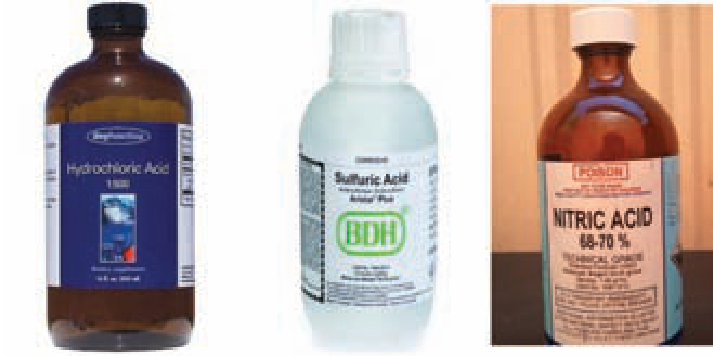
நீர்க்கரைசலில் ஐதரசன் அயன்களை (H⁺ அல்லது H₃O⁺) வெளியிடும் சேர்வைகள் அமிலம் எனப்படும். ஒரு கரண்டி வினிகரை நீரில் கரைத்தால் அது அயன்களாகப் பிரிகின்றது: CH₃COOH → CH₃COO⁻ + H⁺.
1.1 அமிலங்களின் தனிப்பண்புகள்
- புளிப்புச் சுவை. (உணவில் உள்ள மென்மையான அமிலங்களை மட்டுமே சுவைக்கலாம்; வன்னமிலங்களை ஒருபோதும் சுவைக்கக்கூடாது.)
- நீல லிட்மஸ் (litmus) தாளைச் சிவப்பாக மாற்றும்.
- உலோகங்களுடன் தாக்கமடைந்து ஐதரசன் வாயுவை வெளியேற்றும்: Zn + 2HCl → ZnCl₂ + H₂↑.
- காபனேற்றுகளுடன் தாக்கமடைந்து CO₂ வெளியேற்றும்: CaCO₃ + 2HCl → CaCl₂ + H₂O + CO₂↑.
- மூலங்களுடன் நடுநிலையாக்கல் நடைபெற்று உப்பையும் நீரையும் உருவாக்கும்.
- pH < 7 (acidic).
1.2 அமிலங்களின் வகைகள் — மூலத்தின் அடிப்படையில்
| வகை | உதாரணம் | பயன்பாடு |
|---|---|---|
| கனிய அமிலம் (mineral acid) | HCl, H₂SO₄, HNO₃ | தொழிற்சாலை, ஆய்வுகூடம் |
| இயற்கை அல்லது சேதன அமிலம் (organic acid) | CH₃COOH (வினிகர்), சிட்ரிக் அமிலம் (எலுமிச்சை), இலக்டிக் அமிலம் (தயிர்) | உணவு, சமையல் |
1.3 வலிமையின் அடிப்படையில் — வன்னமிலம், மென்னமிலம்
வன்னமிலம் (strong acid): நீரில் முழுமையாக அயன்களாகப் பிரிகின்றது. எடுத்துக்காட்டுகள்: HCl, H₂SO₄, HNO₃. எனவே இக்கரைசலில் பிரிகையடையாத மூலக்கூறுகள் எஞ்சுவதில்லை. பிரிகை இவ்வாறு நடைபெறும்: HCl(aq) → H⁺(aq) + Cl⁻(aq) — 100% completion.
மென்னமிலம் (weak acid): நீரில் பகுதியளவே அயன்களாகப் பிரிகின்றது. எடுத்துக்காட்டுகள்: CH₃COOH (வினிகர்), சிட்ரிக் அமிலம், carbonic acid (H₂CO₃ in soda). CH₃COOH ⇌ CH₃COO⁻ + H⁺ — equilibrium.
⚠ நினைவில் வன்மை (strong) என்பது செறிவு (concentrated) அல்ல. வன்மை என்பது அமிலம் எந்த அளவுக்கு அயன்களாகப் பிரிகின்றது என்பதைக் குறிக்கும்; செறிவு என்பது ஒரு கனவளவில் எவ்வளவு அமிலம் உள்ளது என்பதைக் குறிக்கும். மிகச் சிறிதளவு HCl ஐ நீரில் கரைத்தாலும் அது வன்னமிலமே; ஏனெனில் அது முழுமையாகப் பிரிகின்றது.
2. மூலம் (Base)
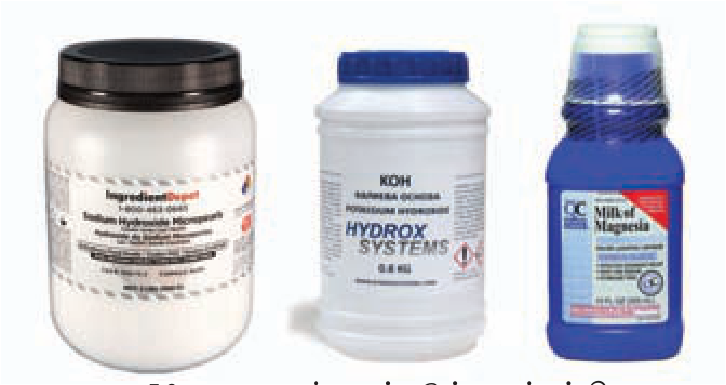
நீர்க்கரைசலில் OH⁻ (ஐதரொட்சைட்டு) அயன்களை வெளியிடும் சேர்வைகள் மூலங்கள் எனப்படும். நீரில் கரையும் மூலம் காரம் (alkali) எனப்படும்.
2.1 மூலங்களின் தனிப்பண்புகள்
- கசப்புச் சுவை. (இங்கும் வன்மூலங்களைச் சுவைக்கக்கூடாது.)
- சவர்க்காரம் போன்ற வழுவழுப்பான தொடுகை; இதனால் வீட்டில் பயன்படும் துப்புரவுப் பொருள்களை ஒத்திருக்கும்.
- சிவப்பு லிட்மஸ் தாளை நீலமாக மாற்றும்.
- அமிலத்துடன் தாக்கமடைந்து நடுநிலையாக்கப்பட்டு உப்பையும் நீரையும் தரும்.
- pH > 7 (alkaline).
2.2 மூலங்களின் ionisation
வன்மூலம் நீரில் முழுமையாகவும், மென்மூலம் பகுதியளவிலும் அயன்களாகப் பிரிகின்றன.
NaOH(aq) → Na⁺(aq) + OH⁻(aq) — strong base, full dissociation.
NH₃ + H₂O ⇌ NH₄⁺ + OH⁻ — weak base, partial.
எடுத்துக்காட்டுகள்: NaOH (எரிசோடா), KOH, Ca(OH)₂ (நீற்றிய சுண்ணாம்பு), NH₃ கரைசல் (அமோனியா).
3. pH அளவுத்திட்டம் (pH Scale)
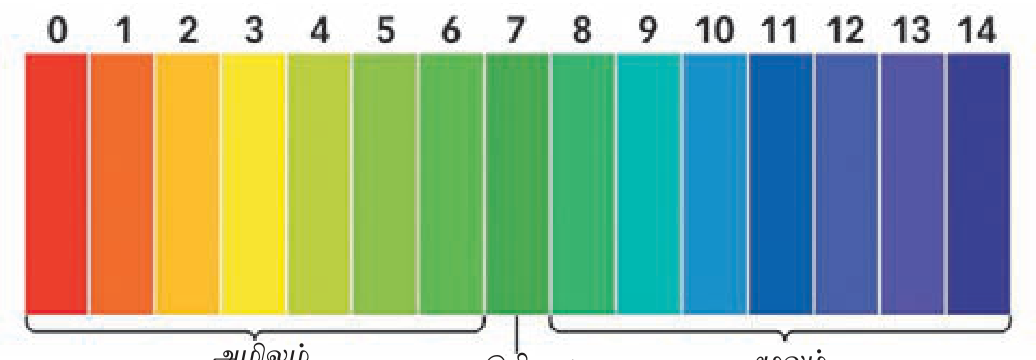
ஒரு கரைசல் அமிலத்தன்மையுடையதா அல்லது மூலத்தன்மையுடையதா என்பதை 0 – 14 வரையான அளவுத்திட்டத்தில் அளக்கின்றோம். pH = −log[H⁺]. pH குறைவாக இருந்தால் கரைசல் மிகுந்த அமிலத்தன்மையுடையது; pH கூடுதலாக இருந்தால் மிகுந்த மூலத்தன்மையுடையது.
- pH < 7: Acidic. Lower = more acidic. Gastric acid pH ~1.
- pH = 7: Neutral. Pure water.
- pH > 7: Basic. Higher = more basic. Lye/NaOH ~14.
3.1 சில அன்றாட கரைசல்களின் pH
| கரைசல் | pH |
|---|---|
| இரைப்பை அமிலம் | 1-2 |
| எலுமிச்சை சாறு | 2-3 |
| vinegar | ~3 |
| தக்காளி | 4 |
| தோல் | 5.5 |
| தூய நீர் / இரத்தம் | 7 / 7.4 |
| சோப்பு | 9-10 |
| NaOH 1 M | 14 |
3.2 காட்டிகள் (Indicators)
கரைசலின் தன்மையை நிறமாற்றத்தின் மூலம் காட்டும் பொருள்கள் காட்டிகள் எனப்படும். பொதுவான காட்டிகள் பின்வருமாறு.
- Litmus: Red/blue colour change. Simple — strong/weak distinguish not.
- Phenolphthalein: Colourless (acidic + neutral); pink (basic, pH >8).
- Methyl orange: Red (acidic); yellow (basic, pH >4.4).
- Universal indicator: Mix of dyes → rainbow colour matching pH chart.
- pH paper: Universal indicator impregnated paper.
- pH meter: Electronic, highest accuracy.
4. நடுநிலையாக்கம் (Neutralisation)
அமிலமும் மூலமும் தாக்கமடையும்போது உப்பும் நீரும் உருவாகின்றன. அமிலத்தின் பண்பையும் மூலத்தின் பண்பையும் அவை ஒன்றையொன்று இல்லாமல் ஆக்குவதால் கரைசல் நடுநிலையை அடைகின்றது.
HCl(aq) + NaOH(aq) → NaCl(aq) + H₂O(l)
தூய அயன்சமன்பாடு: H⁺ + OH⁻ → H₂O. எல்லா நடுநிலையாக்கத் தாக்கங்களுக்கும் அடிப்படை இதுவே.
4.1 அன்றாட உதாரணங்கள்
- இரைப்பை அமிலத்தைக் குறைக்கும் மருந்துகள் (antacids): Mg(OH)₂ அல்லது Al(OH)₃ மாத்திரை இரைப்பையிலுள்ள HCl ஐ நடுநிலையாக்கி உப்பாக மாற்றுகின்றது. இதனால் பாதிக்கப்பட்ட இரைப்பைச் சுவர் குணமடைய வாய்ப்புக் கிடைக்கின்றது.
- தேனீ கடி: தேனீ கடிக்கும்போது ஃபோமிக் அமிலம் (மென்னமிலம்) உடலுக்குள் செலுத்தப்படுகின்றது. சோடியம் இருகாபனேற்றுக் கரைசல் அல்லது சவர்க்காரக் கரைசலைத் தடவ வேண்டும். சுருக்கமாக: (mild base) application → neutralise → pain relief.
- குளவி கடி: குளவியின் நஞ்சு மூலத்தன்மையுடையது; எனவே வினிகர் அல்லது எலுமிச்சை சாறு (மென்னமிலம்) தடவினால் வலி குறையும்.
- மண்ணின் pH ஐ ஒழுங்குபடுத்தல்: அமிலத்தன்மையுடைய மண்ணில் சுண்ணாம்பு (Ca(OH)₂) சேர்த்தால் pH உயரும். மூலத்தன்மையுடைய மண்ணில் பயன்படுத்தும் உரம்: → ammonium sulfate fertilizer.
- பற்களைப் பாதுகாத்தல்: பாக்டீரியாக்கள் உருவாக்கும் இலக்டிக் அமிலம் பற்சிப்பியை அரிக்கின்றது. மென்மூலமாகிய பற்பசை செய்வது: neutralise + remineralise.
5. உப்புகள் (Salts)
அமிலத்திலுள்ள H⁺ ஐ ஒரு உலோக அயன் பிரதியிடும்போது உருவாகும் சேர்வை உப்பு எனப்படும். உப்பை உருவாக்கும் வழக்கமான முறை: acid-base neutralisation = standard formation method.
5.1 முக்கிய உப்புகள்
| உப்பு | பெயர் | பயன்பாடு |
|---|---|---|
| NaCl | சமையல் உப்பு | சமையல், உணவைப் பழுதடையாமல் பாதுகாத்தல் |
| NaHCO₃ | பேக்கிங் சோடா (Baking soda) | பேக்கிங், அமிலக் குறைப்பு மருந்து |
| Na₂CO₃ | தோய்ச்சல் சோடா (Washing soda) | துணி தோய்த்தல், கண்ணாடி உற்பத்தி |
| CaSO₄·2H₂O | Gypsum | Plaster of Paris (model casts) |
| CuSO₄·5H₂O | Blue vitriol | Fungicide, electroplating |
| KNO₃ | Saltpetre | Fertilizer, explosives |
| NH₄NO₃ | Ammonium nitrate | Fertilizer, explosives |
5.2 உப்புகளின் வகைகள் — pH இன் அடிப்படையில்
உப்பின் கரைசலின் pH, அதை உருவாக்கிய அமிலம் மற்றும் மூலத்தின் வலிமையில் தங்கியுள்ளது. வன்னமிலமும் வன்மூலமும் சேர்ந்தால் நடுநிலை உப்பு; வன்னமிலமும் மென்மூலமும் சேர்ந்தால் அமில உப்பு; மென்னமிலமும் வன்மூலமும் சேர்ந்தால் மூல உப்பு.
- Neutral salt: Strong acid + Strong base. e.g., NaCl, KNO₃. pH ~7.
- Acidic salt: Strong acid + Weak base. e.g., NH₄Cl. pH < 7.
- Basic salt: Weak acid + Strong base. e.g., Na₂CO₃, NaHCO₃. pH > 7.
5.3 Water of crystallisation
படிகத்தின் அமைப்புக்குள் உறுதியாக இணைந்துள்ள நீர் மூலக்கூறுகள் படிகநீர் எனப்படும். எடுத்துக்காட்டுகள்: CuSO₄·5H₂O (ஒரு சூத்திர அலகுக்கு 5 நீர் மூலக்கூறுகள்), Na₂CO₃·10H₂O (தோய்ச்சல் சோடாவின் நீரேற்றிய வடிவம்). வெப்பப்படுத்தினால் படிகநீர் வெளியேறி நீரற்ற (anhydrous) வடிவம் கிடைக்கும். அப்போது நிறமும் மாறக்கூடும் (நீல CuSO₄·5H₂O → வெள்ளை நீரற்ற CuSO₄).
6. பயன்பாடுகள் சுருக்கம்
அமிலங்கள், மூலங்கள், உப்புகள் ஆகியவற்றின் முக்கிய பயன்பாடுகள் பின்வருமாறு.
- HCl — household cleaning (toilet bowl), metal cleaning, batteries.
- H₂SO₄ — car batteries, fertilizers, paper, detergents (\"king of chemicals\").
- HNO₃ — fertilizers (ammonium nitrate), explosives (TNT), dyes.
- NaOH — soap, paper, textiles.
- Ca(OH)₂ — construction (mortar), acidic soil correction.
- NaCl — food, road de-icing, chemical industry (chlor-alkali).
- NaHCO₃ — baking, antacids, fire extinguishers.
✅ விரைவுச் சோதனை
முக்கியக் கருத்துக்களை உறுதிப்படுத்துங்கள். தவறான விடைகள் உங்கள் தவறுக் குறிப்பேட்டில் சேமிக்கப்படும்.
🖊 கட்டுரை வினாக்கள் (பகுதி II)
பரீட்சை வடிவில் கட்டமைப்பு வினாக்கள். முதலில் நீங்களே எழுதுங்கள்; பின்னர் மாதிரி விடையைத் திறந்து சரிபாருங்கள்.
விடைத் திட்டம் — சேர்க்க வேண்டிய புள்ளிகள்:
- Acid: H⁺ donor. Base: OH⁻ source.
- 4 properties each.
- Strong = full ionisation. Weak = partial.
- Examples HCl vs CH₃COOH.
- Strong ≠ concentrated.
4 பண்புகள்:
• புளிப்பான சுவை.
• நீலக் litmus → சிவப்பு.
• உலோகங்களுடன் தாக்கி H₂ வெளியேற்றும்.
• கார்பனேட்டுகளுடன் CO₂ வெளியேற்றும்.
• pH < 7.
மூலம் (Base): OH⁻ வெளியிடும் (Arrhenius) சேர்வை.
4 பண்புகள்:
• வலுக் கசப்பான சுவை.
• சோப்புத் தன்மை touch.
• சிவப்பு litmus → நீலம்.
• Acid-உடன் neutralisation → salt + water.
• pH > 7.
(ஆ) Strong acid: நீரில் முழுமையாக (100%) ionise. HCl(aq) → H⁺ + Cl⁻. Examples: HCl, H₂SO₄, HNO₃.
Weak acid: பகுதியாகவே ionise — equilibrium. CH₃COOH ⇌ CH₃COO⁻ + H⁺. Examples: vinegar (acetic), lemon (citric), curd (lactic), soda (carbonic).
Same logic for strong/weak bases: NaOH strong; NH₃ weak.
(இ) Strong ≠ Concentrated. Strong = degree of ionisation (full vs partial). Concentrated = amount of solute per volume. Dilute HCl still strong (fully ionised). Concentrated CH₃COOH (99% glacial) still weak (partial ionisation). Common confusion.
விடைத் திட்டம் — சேர்க்க வேண்டிய புள்ளிகள்:
- pH = -log[H⁺].
- 0-14 scale.
- pH < 7 acidic; = 7 neutral; > 7 basic.
- Examples: gastric, vinegar, water, soap, NaOH.
- [H⁺] decreases 10× per unit increase.
Pure water self-ionises: H₂O ⇌ H⁺ + OH⁻. [H⁺] = [OH⁻] = 10⁻⁷ M at 25°C → pH 7 (neutral).
Definition: pH = −log₁₀[H⁺].
• [H⁺] = 10⁻³ → pH 3 (acidic).
• [H⁺] = 10⁻⁷ → pH 7 (neutral).
• [H⁺] = 10⁻¹⁰ → pH 10 (basic).
Each unit pH = 10× concentration change. pH 1 has 1000× more H⁺ than pH 4.
Range: Typically 0-14, but extreme acids/bases can go beyond.
Classification:
• pH < 7: Acidic. Lower number = more acidic.
• pH = 7: Neutral. Pure water, NaCl solution.
• pH > 7: Basic/Alkaline. Higher = more basic.
Everyday pH examples (memorise):
| கரைசல் | pH |
|---|---|
| இரைப்பை அமிலம் | 1-2 |
| Lemon juice / vinegar | 2-3 |
| தக்காளி | 4 |
| Black coffee | 5 |
| Skin / urine | 5-6 |
| தூய நீர் | 7 |
| இரத்தம் | 7.35-7.45 |
| கடல் நீர் | 8 |
| Baking soda solution | 9 |
| Soap | 9-10 |
| Antacid (Mg(OH)₂) | 10-11 |
| Bleach | 12-13 |
| Conc. NaOH | 14 |
Measurement methods:
• Litmus paper — coarse acid/base only.
• Universal indicator + chart — colour matched to pH ±1.
• pH paper — same as universal, paper format.
• pH meter — electronic, ±0.01 accuracy.
• Specific indicators (phenolphthalein, methyl orange) — pH range determination.
Practical significance:
• Soil pH affects plant growth (tea acidic; rice neutral).
• Blood pH narrow range — outside fatal.
• Pool/aquarium water chemistry critical for life.
• Food preservation — low pH inhibits microbes.
விடைத் திட்டம் — சேர்க்க வேண்டிய புள்ளிகள்:
- Acid + base → salt + water.
- H⁺ + OH⁻ → H₂O.
- Exothermic.
- Antacid for heartburn.
- Bee sting (acid).
- Soil pH correction.
- Tooth enamel.
- Wasp sting (alkaline).
An acid reacts with a base to produce salt + water — the H⁺ from acid and OH⁻ from base combine to form water, while the cation (from base) + anion (from acid) form the salt.
General equation:
Acid + Base → Salt + Water
Specific example:
HCl(aq) + NaOH(aq) → NaCl(aq) + H₂O(l)
Net ionic equation:
H⁺(aq) + OH⁻(aq) → H₂O(l)
This is the universal essence of all acid-base neutralisations — spectator ions (Na⁺, Cl⁻) don't change.
Energetics: Always EXOTHERMIC. For strong acid + strong base ≈ 57 kJ/mol heat released. Test tube warms.
----
5 Everyday Applications:
(1) Antacids for heartburn / gastric ulcer:
Irregular meals + spicy food + stress → excess HCl secretion → burning sensation.
Antacids contain Mg(OH)₂ (Milk of Magnesia), Al(OH)₃, or CaCO₃.
Mg(OH)₂ + 2HCl → MgCl₂ + 2H₂O.
Stomach acid neutralised → pain relief. Long-term — PPI (proton pump inhibitors) preferred.
(2) Bee sting first aid:
Bee venom contains formic acid (HCOOH) + other compounds → acidic.
Apply mild base — sodium bicarbonate (baking soda) paste or soap solution.
Neutralises acid → reduces pain/swelling.
Note: Wasp sting is alkaline → apply mild acid (vinegar, lemon) instead.
(3) Agricultural soil pH correction:
Many Sri Lankan plantation soils (tea, rubber, coconut) acidic due to high rainfall + organic matter decomposition.
Apply quicklime/slaked lime (CaO / Ca(OH)₂) to raise pH.
Ca(OH)₂ + H⁺ → Ca²⁺ + H₂O. Soil neutralised, nutrient availability improves.
For alkaline soils (less common), use ammonium sulphate or sulphur.
(4) Tooth decay prevention:
Mouth bacteria ferment sugar → produce lactic acid → erodes tooth enamel (hydroxyapatite) below pH 5.5.
Toothpaste contains mild base (calcium carbonate, sodium bicarbonate) + fluoride.
Base neutralises acid; fluoride strengthens enamel.
Brushing 2× daily essential.
(5) Factory wastewater treatment:
Many industries discharge acidic or alkaline effluent → would damage rivers, kill fish.
Wastewater plants neutralise — acidic effluent + lime; alkaline + sulphuric acid.
pH 6-8 final → safe discharge.
Similar logic for acid rain damage mitigation.
Bonus — Stinging plants (Kahambiliya / nettle):
Contain formic acid in stinging hairs → burning sensation on contact.
Apply mild base (soap, baking soda paste) → relief. Same principle as bee sting.
விடைத் திட்டம் — சேர்க்க வேண்டிய புள்ளிகள்:
- Salt = ionic product of acid+base.
- Classification by parent acid/base strength.
- NaCl, NaHCO₃, Na₂CO₃, CaSO₄, CuSO₄, KNO₃ etc.
- Daily uses.
Neutralisation reaction primary route:
Acid + Base → Salt + Water
The H⁺ of acid replaced by cation of base.
Example: HCl + NaOH → NaCl + H₂O
H₂SO₄ + 2KOH → K₂SO₄ + 2H₂O
Other routes:
• Acid + Metal: 2HCl + Zn → ZnCl₂ + H₂
• Acid + Carbonate: 2HCl + CaCO₃ → CaCl₂ + H₂O + CO₂
• Acid + Metal oxide: 2HCl + CuO → CuCl₂ + H₂O
Classification by pH of solution:
(1) Neutral salt (pH ~7):
Strong acid + Strong base → neutral salt. e.g., NaCl, KNO₃, KCl. No hydrolysis in water.
(2) Acidic salt (pH < 7):
Strong acid + Weak base → acidic salt. e.g., NH₄Cl, FeCl₃. Cation hydrolyses:
NH₄⁺ + H₂O ⇌ NH₃ + H₃O⁺ → acidic.
(3) Basic salt (pH > 7):
Weak acid + Strong base → basic salt. e.g., Na₂CO₃, CH₃COONa, NaHCO₃. Anion hydrolyses:
CH₃COO⁻ + H₂O ⇌ CH₃COOH + OH⁻ → basic.
----
6 Important Salts + Uses:
(1) Sodium chloride (NaCl) — Table salt:
• Source: Sea evaporation, rock salt mining.
• Uses: Food seasoning + preservation (osmotic dehydration of microbes). Industrial chlor-alkali process — electrolysis produces Cl₂ + NaOH + H₂. Road de-icing in cold countries.
• Sri Lankan context: Eastern coastal salt pans (Hambantota, Mannar) traditional industry.
(2) Sodium bicarbonate (NaHCO₃) — Baking soda:
• Uses: Baking — heat decomposes → CO₂ + Na₂CO₃ + H₂O; CO₂ leavens dough. Antacid. Fire extinguishers (releases CO₂ smothering flame). Cleaning paste. Toothpaste. Bee sting first aid.
(3) Sodium carbonate (Na₂CO₃·10H₂O) — Washing soda:
• Uses: Laundry — softens hard water (precipitates Ca²⁺, Mg²⁺), removes grease. Glass manufacturing — Na₂CO₃ + SiO₂ + CaCO₃ → soda-lime glass. Paper, soap industry.
(4) Calcium sulphate (CaSO₄·2H₂O) — Gypsum / Plaster of Paris:
• POP: CaSO₄·½H₂O obtained by heating gypsum to 150°C.
• Uses: Plaster casts for broken bones. Wall plastering. Decorative mouldings, statues. Cement additive. Blackboard chalk.
(5) Copper sulphate (CuSO₄·5H₂O) — Blue vitriol:
• Properties: Distinctive blue crystals due to hydrated Cu²⁺. Anhydrous form white.
• Uses: Fungicide (Bordeaux mixture in vineyards). Algicide in ponds. Electroplating. Lab chemical tests.
(6) Potassium nitrate (KNO₃) — Saltpetre:
• Uses: NPK fertilizer (K + N source). Gunpowder (75% KNO₃ + 15% C + 10% S). Food preservation (curing). Fireworks oxidiser.
Bonus (7): Ammonium nitrate (NH₄NO₃):
• Uses: High-N fertilizer (~35% N). Industrial explosives. Instant cold packs (endothermic dissolution).
• Highly regulated due to terrorism misuse history.
Water of Crystallisation:
Many salts crystallise with water molecules locked in their lattice — e.g., CuSO₄·5H₂O, Na₂CO₃·10H₂O, CaSO₄·2H₂O. Heating drives water out → anhydrous form. Often colour change accompanies (blue CuSO₄·5H₂O → white anhydrous CuSO₄).
விடைத் திட்டம் — சேர்க்க வேண்டிய புள்ளிகள்:
- Litmus, phenolphthalein, methyl orange, universal, pH meter.
- Colour changes + pH ranges.
- Use cases.
- Titration endpoint principle.
Acid-base indicators = weak organic acids/bases whose protonated + deprotonated forms have different colours. Colour change occurs over narrow pH range.
5 common indicators:
(1) Litmus:
• Source: Lichens extract.
• Behaviour: Red in acid; blue in base. Change ~pH 5-8.
• Use: Simple acid/base distinction. Litmus paper (red, blue, or neutral).
• Limitation: Cannot distinguish strong/weak. Wide transition range.
• Best for: Quick lab tests, classroom demos.
(2) Phenolphthalein:
• Behaviour: Colourless in acid (and neutral); pink in base (pH > 8.3).
• Use: Titration endpoint for strong acid + strong base + strong acid + weak base titrations (endpoint pH around 7-8).
• Advantage: Sharp colour transition. Easy to see.
• Limitation: Doesn't work in basic side titrations.
(3) Methyl orange:
• Behaviour: Red below pH 3.1; orange around 3.5; yellow above pH 4.4.
• Use: Titration endpoint for strong acid + weak base (e.g., HCl + NH₃, endpoint pH ~4).
• Limitation: Doesn't work for weak acid titrations.
(4) Universal Indicator:
• Composition: Mixture of several dyes (methyl red, bromothymol blue, thymol blue, phenolphthalein, etc.).
• Behaviour: Continuous colour spectrum:
- pH 1-3: Red
- pH 4-6: Orange-yellow
- pH 7: Green
- pH 8-10: Blue
- pH 11-14: Purple
• Use: Estimate pH of unknown solution by matching to chart (±1 accuracy).
• Form: Solution or impregnated pH paper.
• Limitation: Less precise than meter.
(5) pH Meter (electronic):
• Principle: Glass electrode measures voltage proportional to [H⁺]. Display ±0.01 pH.
• Use: Quantitative pH measurement in research, hospital labs, industry, aquaculture, soil testing.
• Advantage: Highest accuracy.
• Limitation: Expensive, requires calibration, electrode care.
Specialty indicators (brief):
• Bromothymol blue: yellow (acid) → blue (base), transition pH 6-7.
• Methyl red: red (acid) → yellow (base), transition pH 4-6.
• Natural indicators: red cabbage juice (red→purple→green→yellow as pH increases), turmeric (yellow→red at pH 7+), hibiscus.
----
Titration Endpoint Concept:
Titration = volumetric analysis to determine unknown concentration of acid or base.
Setup:
• Burette: Standard (known concentration) titrant.
• Pipette + conical flask: Unknown (analyte) volume measured exactly.
• Indicator added to flask.
• Titrant added drop-by-drop until colour change → endpoint.
Endpoint: Point where indicator changes colour — approximately matches the equivalence point (where moles acid = moles base reacted).
Indicator selection rule:
• Strong acid + Strong base → use phenolphthalein OR methyl orange (sharp pH jump at equivalence, both work).
• Weak acid + Strong base → phenolphthalein (equivalence pH ~8-9).
• Strong acid + Weak base → methyl orange (equivalence pH ~4-5).
• Weak acid + Weak base → NOT recommended (no sharp transition; use pH meter).
Calculation:
Molarity × Volume of acid (acidic H⁺ count) = Molarity × Volume of base (basic OH⁻ count).
From this, unknown concentration determined.
Real-world applications:
• Water quality testing (alkalinity, acidity).
• Vinegar/lemon juice strength determination.
• Pharmaceutical quality control.
• Wine/beverage analysis.
• Soil + agricultural analysis.
விடைத் திட்டம் — சேர்க்க வேண்டிய புள்ளிகள்:
- Each one's key industrial use.
- Daily/household uses.
- Production methods briefly.
- Safety considerations.
Why "king"? Most produced chemical worldwide. Industrial output ≈ economic indicator.
Production: Contact process — S → SO₂ → SO₃ (V₂O₅ catalyst) → H₂SO₄ (absorbed in H₂SO₄, then diluted).
Main uses:
• Fertilizers (~60%): Ammonium sulphate, superphosphate.
• Petroleum refining — alkylation, octane improvement.
• Lead-acid car batteries — electrolyte.
• Paper, textiles, dyes.
• Drain cleaner at high concentration.
Safety: Severe burns + dehydration. Always dilute by adding acid to water (never reverse).
(2) Sodium hydroxide (NaOH) — Caustic soda:
Production: Chlor-alkali electrolysis of brine (NaCl solution).
Main uses:
• Soap manufacturing — saponification (NaOH + fat → soap + glycerol).
• Paper — pulping wood (Kraft process).
• Textiles — mercerising cotton (stronger, shinier).
• Aluminium production — Bayer process (dissolves bauxite).
• Drain cleaner — dissolves hair, grease.
Safety: Severe chemical burns. Soapy slippery feel = danger signal. Eye flush copiously.
(3) Sodium chloride (NaCl):
Sources: Sea evaporation (Sri Lankan salt pans), rock salt mining.
Main uses:
• Food seasoning — daily essential.
• Preservation — fish drying, meat curing (osmotic dehydration kills microbes). Pre-refrigeration era ESSENTIAL.
• Industrial chemistry — feedstock for NaOH, Cl₂, HCl, Na₂CO₃, Na metal production.
• Road de-icing (cold countries) — lowers freezing point.
• Animal feed supplement.
Health note: Excess (>5 g/day) → hypertension, cardiovascular risk.
(4) Sodium bicarbonate (NaHCO₃) — Baking soda:
Source: Solvay process from NaCl + CO₂ + NH₃.
Main uses:
• Baking — heat decomposes: 2NaHCO₃ → Na₂CO₃ + H₂O + CO₂. CO₂ leavens dough.
• Antacid — neutralises stomach acid (mild, fast-acting).
• Fire extinguishers — heat releases CO₂ smothering flame.
• Cleaning paste — mild abrasive, deodoriser.
• Toothpaste — mild base + abrasive.
• Insect bite relief (acid stings).
(5) Copper sulphate (CuSO₄·5H₂O) — Blue vitriol:
Properties: Brilliant blue crystals (hydrated Cu²⁺). Anhydrous form = white powder.
Main uses:
• Bordeaux mixture — fungicide spray for grape vineyards, potato blight.
• Algicide in swimming pools + reservoirs.
• Electroplating — Cu²⁺ deposits on cathode.
• Textile mordant — dye fixing.
• Lab test — Fehling's solution component.
(6) Ammonium nitrate (NH₄NO₃):
Production: NH₃ + HNO₃.
Main uses:
• Fertilizer — high N content (~35%), rapid plant uptake. Critical for green revolution agriculture.
• ANFO explosives — mining, quarrying, construction.
• Instant cold packs — endothermic dissolution.
Safety/regulation: 2020 Beirut explosion (2750 tonnes stored unsafely). Strictly regulated worldwide.
(7) Calcium hydroxide / Slaked lime — Ca(OH)₂):
Production: CaO + H₂O → Ca(OH)₂ + heat.
Uses:
• Construction — mortar, plaster, whitewash.
• Water treatment — pH adjustment, softening.
• Agricultural lime — acidic soil correction.
• Sewage treatment — clarification + sulphide removal.
• Betel chewing in South Asia (with areca nut, traditional).
Common theme: Acids, bases, salts each have indispensable industrial AND household roles. Modern life essentially built on chemistry of these three categories.
விடைத் திட்டம் — சேர்க்க வேண்டிய புள்ளிகள்:
- SO₂ + NOₓ from combustion.
- React with water → H₂SO₄ + HNO₃.
- Forest, lake, structure damage.
- Mitigation: catalytic converters, scrubbers, energy transition.
- Sri Lanka coal plant + vehicle issues.
Rainwater with pH < 5.6 (natural rain pH ~5.6 from atmospheric CO₂ forming weak carbonic acid). Below this = anthropogenic pollutant-induced.
Formation Chemistry:
(1) SO₂ source: Coal combustion (sulphur impurity), oil burning, volcanic eruptions, metal smelting. Sulphuric acid:
• 2SO₂ + O₂ → 2SO₃ (catalysis by dust, UV)
• SO₃ + H₂O → H₂SO₄
(2) NOₓ source: Vehicle engines (high-temperature air N₂ + O₂ → NO), power plants, lightning.
• 2NO + O₂ → 2NO₂
• 3NO₂ + H₂O → 2HNO₃ + NO
Result: Rain pH 4-5 typical in polluted areas; pH 2-3 in extreme cases (similar to lemon juice falling from sky).
----
Environmental Damage:
(1) Forest decline:
• Leaf damage (waxy cuticle dissolved).
• Soil acidification → leaching of essential nutrients (Ca, Mg, K).
• Release of toxic Al³⁺ from soil minerals → root damage.
• Weakened trees vulnerable to disease, insects.
• Famous example: Black Forest (Germany), Catskill Mountains (USA) — large dieback events 1970s-80s.
(2) Lake + river acidification:
• Aquatic life intolerant. Fish eggs fail to hatch below pH 5.
• Aluminium dissolved from sediments → gill damage in fish.
• Eventually "dead lakes" — clear blue water but no biodiversity.
• Scandinavian lakes (downwind of UK power plants) — historical example.
(3) Building + monument damage:
• Marble (CaCO₃) + H₂SO₄ → CaSO₄ + H₂O + CO₂.
• Marble + limestone monuments slowly dissolved.
• Taj Mahal (India) — yellowish discolouration partly due to acid rain near coal-burning Mathura refinery.
• Acropolis (Greece) — ancient statues replaced by replicas; originals indoor.
• Modern buildings — steel reinforcement corrosion.
(4) Health effects:
• Acid aerosols irritate respiratory system, worsen asthma.
• Toxic metal leaching into drinking water (lead pipes, copper).
• Crops on acidified soil yield reduction.
----
Mitigation strategies:
(1) At source:
• Scrubbers at power plants — flue gas + Ca(OH)₂ slurry → CaSO₄ (gypsum) byproduct. Useful for plaster industry.
• Low-sulphur fuels — coal washing, oil hydrodesulphurisation.
• Catalytic converters in vehicles — convert NOₓ → N₂ + O₂.
• Energy transition — solar, wind, nuclear replacing coal.
(2) Tall stacks (only partial solution):
• Sends pollution further away, not eliminating.
• Cross-border pollution issue (Scandinavia ← UK, Eastern US ← Midwest).
(3) Soil + lake liming:
• Spread limestone (CaCO₃) on affected lakes + forests to neutralise.
• Temporary, expensive measure.
(4) International treaties:
• 1979 Geneva Convention on Long-Range Transboundary Air Pollution.
• Acid rain in developed countries reduced 50%+ since 1990 due to scrubbers + cleaner fuels.
----
Sri Lankan context:
Current state: Acid rain not yet severe but rising concern.
• Norochcholai Coal Power Plant (300 MW × 3) — significant SO₂ emitter; scrubbers minimal in early years.
• Vehicle emissions — rapid car/3-wheeler increase + diesel buses → urban NOₓ pollution.
• Cement industry — sulphur in coal substitutes.
Vulnerable areas:
• Central highlands (tea plantations) — already naturally acidic soil + added pollution stress.
• Coastal mangroves — fragile pH balance.
• Historical monuments — Sigiriya, Anuradhapura, Polonnaruwa stone structures.
Sri Lanka measures:
• Catalytic converter requirement for new vehicles (since ~2008).
• Sulphur cap on diesel fuel.
• Renewable energy push (solar, wind farms in Mannar, Hambantota).
• National Environmental Act standards.
Future outlook: Energy transition + electric vehicles + emission control = essential to prevent severe acid rain damage. Climate change action overlap.
Action takeaway: Individual citizens — efficient vehicles, reduced consumption, support green energy policy. Collective action saves landscapes + monuments.
🔥 மீட்டல் மையம்
பரீட்சைக்கு முன் இறுதி ஒரு நிமிடம் — மறக்கக்கூடாதவை மட்டும்.
- அமிலம் (Acid): நீரில் H⁺ வெளியிடும். புளிப்பு, நீலம்→சிவப்பு litmus, உலோகத்துடன் H₂, கார்பனேட்டுடன் CO₂, pH<7.
- மூலம் (Base): OH⁻ வெளியிடும். கசப்பு, சோப்பு touch, சிவப்பு→நீலம் litmus, pH>7.
- Strong acid: HCl, H₂SO₄, HNO₃ — 100% ionise.
- Weak acid: CH₃COOH, citric, lactic — partial.
- Strong base: NaOH, KOH, Ca(OH)₂.
- Weak base: NH₃, Mg(OH)₂.
- Strong ≠ Concentrated. Strong = ionisation degree; concentrated = amount.
- pH: 0-14. 7=neutral. Each unit = 10× [H⁺] change.
- Neutralisation: Acid + Base → Salt + Water. H⁺ + OH⁻ → H₂O.
- Indicators: Litmus (red/blue), Phenolphthalein (pink in base), Methyl orange (red→yellow), Universal (full spectrum), pH meter (electronic).
- Salt types: Neutral (NaCl), Acidic (NH₄Cl), Basic (Na₂CO₃).
- Antacid for heartburn. Bee sting (acid) → base. Wasp sting (base) → acid.
- Soil pH: Acidic → lime. Alkaline → sulphate.
- Salts: NaCl (food), NaHCO₃ (baking), Na₂CO₃ (washing), CuSO₄·5H₂O (blue, fungicide), CaSO₄·½H₂O (POP), KNO₃ (fertilizer).
அலகின் முதுகெலும்பு — கருத்துக்களும் தொடர்புகளும்.
- 1. Acid definition: Arrhenius — H⁺ donor in water. Bronsted — proton donor. Lewis — e⁻ pair acceptor.
- 2. Acid properties (5): Sour taste, blue→red litmus, metal+H₂, carbonate+CO₂, pH<7.
- 3. Base definition: OH⁻ donor. Alkali = water-soluble base.
- 4. Base properties: Bitter taste, soapy touch, red→blue litmus, pH>7.
- 5. Strong acids: HCl, H₂SO₄, HNO₃ (also HBr, HI, HClO₄). 100% ionise.
- 6. Weak acids: Organic (acetic, citric, lactic), carbonic. Partial ionisation = equilibrium.
- 7. Strong bases: Group 1 + 2 hydroxides — NaOH, KOH, Ca(OH)₂.
- 8. Weak bases: NH₃, organic amines, Mg(OH)₂, Al(OH)₃.
- 9. Strong vs Concentrated: Strong = full ionisation. Concentrated = amount per volume. Dilute strong + concentrated weak possible.
- 10. pH = −log[H⁺]. Scale 0-14. Each pH unit = 10× concentration change. Pure water pH 7.
- 11. Examples pH: Gastric 1-2, vinegar 3, blood 7.4, soap 9-10, NaOH 14.
- 12. Neutralisation: Acid + Base → Salt + Water. Net ionic: H⁺ + OH⁻ → H₂O. Exothermic.
- 13. Acid + metal: Salt + H₂ gas. Reactivity series above H react. Cu, Ag, Au don't.
- 14. Acid + carbonate: Salt + H₂O + CO₂. CaCO₃ + 2HCl → CaCl₂ + H₂O + CO₂.
- 15. Indicators: Litmus (broad), phenolphthalein (colourless→pink, pH>8.3), methyl orange (red→yellow, pH 3.1-4.4), universal (rainbow), pH meter.
- 16. Titration: Burette + pipette + indicator. Endpoint = colour change at equivalence point.
- 17. Salt types: Strong+strong=neutral (NaCl); strong+weak=acidic (NH₄Cl); weak+strong=basic (Na₂CO₃).
- 18. Water of crystallisation: CuSO₄·5H₂O (blue, 5 water); heat → anhydrous CuSO₄ (white).
- 19. Key salts: NaCl food/industry; NaHCO₃ baking/antacid; Na₂CO₃ washing/glass; CaSO₄·½H₂O POP; CuSO₄ fungicide; KNO₃ fertilizer.
- 20. Real-world applications: Antacid + bee sting + soil pH + tooth decay + acid rain mitigation.
- 21. Acid rain: SO₂ + NOₓ → H₂SO₄ + HNO₃. Damages forests, lakes, monuments. Mitigation = scrubbers + clean fuels.
பரீட்சைக்கு முந்தின இரவு முழு அலகையும் ஓட்டிப் பார்.
- Acid: H⁺ in water. Sour, blue→red litmus, metal+H₂, carbonate+CO₂, pH<7.
- Base: OH⁻ in water. Bitter, soapy, red→blue litmus, pH>7.
- Strong acids: HCl, H₂SO₄, HNO₃. Full ionisation.
- Weak acids: Organic (vinegar, citric, lactic), carbonic.
- Strong bases: NaOH, KOH, Ca(OH)₂.
- Weak bases: NH₃, antacid hydroxides (safer).
- Strong ≠ Concentrated. Don't confuse.
- pH = −log[H⁺]. 0-14 scale. Each unit 10×.
- Neutralisation: A+B → S+W. H⁺+OH⁻ → H₂O. Always exothermic.
- 3 acid reactions: (1) + base = salt + water (2) + metal = salt + H₂ (3) + carbonate = salt + water + CO₂.
- Indicators: Litmus quick check. Phenolphthalein (colourless/pink, base). Methyl orange (red/yellow, acid). Universal rainbow. pH meter accurate.
- Salts: NaCl (food), NaHCO₃ (baking), Na₂CO₃ (washing), CuSO₄·5H₂O (blue, fungicide), POP (CaSO₄·½H₂O), KNO₃ (fertilizer).
- Salt pH: Strong+strong=neutral. Strong acid+weak base=acidic. Weak acid+strong base=basic.
- Daily applications: Antacid → acid stomach. Bee sting (acid) → base. Acidic soil → lime. Wasp sting (base) → vinegar.
- Water of crystallisation: CuSO₄·5H₂O. Heat → white anhydrous. Water back → blue.
- ⚠ Common traps: Concentrated ≠ strong. Vinegar=acetic acid (weak even concentrated). Bicarbonate is base, not acid despite \"hydrogen\" name.
- ⚠ Safety: Acid to water (AAW). Never water to concentrated acid (explosive boiling).
- ⭐ Memorise: Neutralisation = exothermic, releases ~57 kJ/mol (strong+strong). Net ionic always H⁺+OH⁻=H₂O.
- 📋 Glossary: அமிலம்=acid; மூலம்=base; உப்பு=salt; நடுநிலையாக்கம்=neutralisation; வன்னமிலம்=strong acid; மென்னமிலம்=weak acid; pH அளவுத்திட்டம்=pH scale; காட்டி=indicator.