இரசாயன தாக்கங்களின் வெப்ப விளைவு
ஒரு கரண்டி வினாகிரியைச் சுண்ணாம்புப் பொடியுடன் கலந்தால் முகவை சூடாகின்றது. அமோனியம் குளோரைட்டுப் பொடியை நீரில் கரைத்தால் முகவை குளிர்ந்துவிடுகின்றது. ஏன்? இரசாயனத் தாக்கங்கள் ஒவ்வொன்றும் வெப்ப சக்தி (heat energy) மாற்றத்துடனேயே நிகழ்கின்றன. சில தாக்கங்கள் சூழலுக்கு வெப்பத்தை வெளியிடும் (புறவெப்பத் தாக்கம், exothermic); எரிபொருள் எரிதல், நடுநிலையாக்கல், சுவாசம் ஆகியவை இவ்வகையைச் சேர்ந்தவை. வேறு சில தாக்கங்கள் சூழலிலிருந்து வெப்பத்தை உள்ளிழுக்கும் (அகவெப்பத் தாக்கம், endothermic); ஒளித்தொகுப்பு, பனிக்கட்டி உருகுதல், NH₄NO₃ நீரில் கரைதல் ஆகியவை இவ்வகையைச் சேர்ந்தவை. இவ்வலகில் இவ்விரு வகைத் தாக்கங்களின் பண்புகளையும், வெப்ப மாற்றத்தை அளவிடும் முறையையும் (calorimetry: Q = mcθ), அன்றாட எடுத்துக்காட்டுகளையும் கற்போம்.
1. வெப்பமும் வெப்பநிலையும் (Heat and Temperature)
Two distinct concepts often confused:
- வெப்பம் (Heat, Q): வெப்பநிலை வேறுபாட்டினால் கடத்தப்படும் மொத்தச் சக்தி. அலகு: Joule (J). Extensive (depends on amount).
- வெப்பநிலை (Temperature, T): துணிக்கைகளின் சராசரி இயக்கச் சக்தி. அலகு: °C அல்லது K. Intensive (independent of amount).
எடுத்துக்காட்டு: ஒரு முகவையிலுள்ள 100°C நீரையும் ஒரு குளியல் தொட்டியிலுள்ள 60°C நீரையும் ஒப்பிட்டால், தொட்டியிலுள்ள நீரில் வெப்பம் (heat) அதிகம் (திணிவு கூடுதல்), முகவையிலுள்ள நீரில் வெப்பநிலை (temperature) அதிகம்.
2. தாக்கங்களின் இரு வகைகள்: புறவெப்பத் தாக்கமும் அகவெப்பத் தாக்கமும்
2.1 புறவெப்பத் தாக்கம் (Exothermic reaction)
தாக்கம் சூழலுக்கு (surroundings) வெப்பத்தை வெளியிடும்; அதனால் சூழலின் வெப்பநிலை அதிகரிக்கும். சக்தி வரைபடத்தில் இதைப் பின்வருமாறு காட்டலாம்: Energy of products < Energy of reactants → energy diagram \"downhill\".
எடுத்துக்காட்டுகள்:
- எரிதல் (combustion): CH₄ + 2O₂ → CO₂ + 2H₂O + வெப்பம்.
- Neutralisation: HCl + NaOH → NaCl + H₂O + ~57 kJ/mol heat. Beaker hot.
- Respiration: C₆H₁₂O₆ + 6O₂ → 6CO₂ + 6H₂O + ATP + heat.
- சுட்ட சுண்ணாம்பு + நீர்: CaO + H₂O → Ca(OH)₂ + வெப்பம் (மிக அதிகம்; நீரைக் கொதிக்கச் செய்யும்).
- துருப்பிடித்தல் (rusting): 4Fe + 3O₂ → 2Fe₂O₃ + வெப்பம் (மிக மெதுவாக வெளியேறும்).
- பனிக்கட்டி உருவாதல் (ice formation): திரவம் திண்மமாகும்போது வெப்பம் வெளியேறும்.
2.2 அகவெப்பத் தாக்கம் (Endothermic reaction)
தாக்கம் சூழலிலிருந்து வெப்பத்தை உள்ளிழுக்கும்; அதனால் சூழலின் வெப்பநிலை குறையும். சக்தி வரைபடத்தில் இதைப் பின்வருமாறு காட்டலாம்: Energy of products > Energy of reactants → \"uphill\".
எடுத்துக்காட்டுகள்:
- ஒளித்தொகுப்பு (photosynthesis): 6CO₂ + 6H₂O + சூரிய ஒளி → C₆H₁₂O₆ + 6O₂. (ஒளி = absorbed energy.)
- Ice melting: Solid H₂O → liquid H₂O takes 334 J/g (latent heat).
- NH₄NO₃ dissolution in water: Beaker cools dramatically — instant cold pack basis.
- Sodium bicarbonate + vinegar: Temperature drops slightly while CO₂ released.
- Decomposition reactions (heating): e.g., CaCO₃ → CaO + CO₂ (lime kiln).
- நீர் ஆவியாதல் (evaporation): திரவம் ஆவியாகும்போது கிராமுக்கு ஏறத்தாழ 2260 J வெப்பத்தை உறிஞ்சும்.
⭐ Quick test Beaker hot during reaction → exothermic. Beaker cold → endothermic. Combustion + neutralisation = always exothermic. Photosynthesis + most dissolutions = endothermic.
3. வெப்ப அளவீடு: Q = mcθ
3.1 Core equation
Q = m × c × θ

Q = heat absorbed/released (J)
m = mass of substance (kg)
c = specific heat capacity (J kg⁻¹ °C⁻¹)
θ = temperature change ΔT (°C)
தன் வெப்பக் கொள்ளளவு (specific heat capacity) என்பது ஓர் அலகுத் திணிவை ஓர் அலகு வெப்பநிலையால் உயர்த்தத் தேவையான வெப்பம் ஆகும். நீருக்கு c = 4200 J kg⁻¹ °C⁻¹ (உயர்ந்த பெறுமானம்); அதனாலேயே நீர் குளிரூட்டியாகவும் உடல் வெப்பநிலையைச் சீராக்கும் பொருளாகவும் பயன்படுகிறது.
3.2 Worked example 1 — Neutralisation
100 cm³ 1 M HCl உடன் 100 cm³ 1 M NaOH ஐக் கலந்தபோது வெப்பநிலை 25°C இலிருந்து 31.8°C ஆக உயர்ந்தது. (a) வெளியிடப்பட்ட வெப்பம் எவ்வளவு? (b) ஒரு மூல் NaOH க்கு வெளியிடப்படும் வெப்பம் எவ்வளவு?
Total mass: 100 + 100 = 200 g = 0.2 kg. ΔT = 31.8 - 25 = 6.8°C.
Q = mcθ = 0.2 × 4200 × 6.8 = 5712 J ≈ 5.7 kJ.
Moles NaOH = 0.1 dm³ × 1 mol/dm³ = 0.1 mol.
Heat per mole = 5712 / 0.1 = 57,120 J/mol ≈ 57 kJ/mol.
This is the classic strong acid + strong base neutralisation heat.
3.3 Worked example 2 — Endothermic dissolution
40 cm³ வினாகிரியையும் (அசெற்றிக் அமிலம்) 60 cm³ நீற்றிய சுண்ணாம்புக் (Ca(OH)₂) கரைசலையும் கலந்தபோது வெப்பநிலை 10°C குறைந்தது. (a) உறிஞ்சப்பட்ட வெப்பம் எவ்வளவு? (b) இது அகவெப்பத் தாக்கமா, புறவெப்பத் தாக்கமா?
Total volume 100 cm³, mass ≈ 100 g = 0.1 kg. ΔT = -10°C (cooling).
Q = mcθ = 0.1 × 4200 × 10 = 4200 J.
Temperature decreased → reaction absorbed heat from solution → endothermic.
⚠ Assumptions in calorimetry (1) Solution density = water density (1 g/cm³). (2) Specific heat = water's (4200). (3) No heat loss to surroundings. (4) Calorimeter absorbs negligible heat. — Insulated polystyrene cup minimises these errors.
4. Energy diagrams (Energy profile)
Reaction progress (x-axis) vs energy (y-axis):
- Exothermic: Reactants high, products low. Difference = energy released. Curve goes downhill overall.
- Endothermic: Reactants low, products high. Difference = energy absorbed. Curve goes uphill.
- Both have activation energy hump in middle — initial energy needed to start reaction (bonds break first).
5. அன்றாடப் பயன்பாடுகள் (Applications)
5.1 Exothermic uses
- Fuels: Wood, kerosene, LPG, diesel, petrol — combustion released heat for cooking, transport, electricity.
- Hand warmers: Iron filings + air → Fe₂O₃ slow rust → warmth.
- Cement setting: Hydration reactions exothermic. Bridges, dams cool slowly.
- Body warmth: Cellular respiration of glucose produces ~37°C body temp.
5.2 Endothermic uses
- Instant cold packs (sports injury): NH₄NO₃ + water → cold quickly. ~0-5°C.
- Refrigerators: Refrigerant evaporation absorbs heat (vapour-compression cycle).
- Photosynthesis: Plants store solar energy as chemical bonds.
- Sweating: Skin water evaporation absorbs body heat → cooling.
5.3 Combination — controlled energy
- Explosives: Very fast exothermic (TNT, RDX).
- Internal combustion engine: Controlled exothermic combustion → mechanical work.
- Glow sticks: Slow exothermic chemiluminescence — light, not heat.
✅ விரைவுச் சோதனை
முக்கியக் கருத்துக்களை உறுதிப்படுத்துங்கள். தவறான விடைகள் உங்கள் தவறுக் குறிப்பேட்டில் சேமிக்கப்படும்.
🖊 கட்டுரை வினாக்கள் (பகுதி II)
பரீட்சை வடிவில் கட்டமைப்பு வினாக்கள். முதலில் நீங்களே எழுதுங்கள்; பின்னர் மாதிரி விடையைத் திறந்து சரிபாருங்கள்.
விடைத் திட்டம் — சேர்க்க வேண்டிய புள்ளிகள்:
- Exo = heat out; Endo = heat in.
- Examples each.
- Heat = total energy; Temp = avg KE.
உதாரணங்கள்:
• Methane combustion: CH₄ + 2O₂ → CO₂ + 2H₂O + 890 kJ/mol.
• Acid-base neutralisation: HCl + NaOH → NaCl + H₂O + 57 kJ/mol.
• Cellular respiration: glucose + O₂ → CO₂ + H₂O + ATP + heat → body warmth.
• Iron rusting (slow), quicklime + water, cement setting.
அகவெப்பத் தாக்கம் (Endothermic): சூழலிலிருந்து வெப்பத்தை உள்ளிழுக்கும். சுற்றுப்புறம் குளிரும். Products higher energy than reactants.
உதாரணங்கள்:
• Photosynthesis: CO₂ + H₂O + light → glucose + O₂. (sunlight stored as bonds).
• NH₄NO₃ dissolution in water → cold pack basis.
• Ice melting (latent heat 334 J/g absorbed).
• Water evaporation (2260 J/g), CaCO₃ → CaO + CO₂ heating.
(ஆ) Heat (Q) — joule (J): Total energy transferred due to temperature difference. Extensive — depends on amount of substance.
Temperature (T) — °C / K: Average kinetic energy of particles. Intensive — independent of amount.
Worked example: 100°C beaker of water + 60°C bathtub of water. Bathtub has MORE total heat (larger mass), but beaker has HIGHER temperature.
Analogy: Population (heat) vs average wealth (temperature). A small rich town has high average wealth, but a big city has more total wealth even with lower average.
விடைத் திட்டம் — சேர்க்க வேண்டிய புள்ளிகள்:
- Q J, m kg, c specific heat, θ ΔT.
- Calculate 6300 J then 63 kJ/mol.
- Exothermic.
- Assumptions density+specific heat=water.
• Q (Heat) — Joule (J): Energy absorbed/released.
• m (Mass) — kilogram (kg): Mass of substance heated/cooled.
• c (Specific heat capacity) — J kg⁻¹ °C⁻¹: Heat needed to raise 1 kg by 1°C. Water: 4200.
• θ or ΔT (Temperature change) — °C: Final − initial temperature.
(ஆ) Worked calorimetry problem:
Given: V(HCl) = V(NaOH) = 200 mL = 0.2 dm³. Concentration each = 1 mol/dm³. ΔT = 32.5 − 25 = 7.5°C.
Assumption: solution mass + c ≈ water.
Total solution = 200 + 200 = 400 mL = 400 g = 0.4 kg.
(i) Heat released:
Q = m × c × θ = 0.4 × 4200 × 7.5 = 12,600 J = 12.6 kJ.
(ii) Per mole NaOH:
Moles NaOH = V × C = 0.2 × 1 = 0.2 mol.
Heat per mole = 12,600 / 0.2 = 63,000 J/mol = 63 kJ/mol.
(Standard heat of neutralisation ≈ 57 kJ/mol; slight excess might come from heat loss to surroundings being ignored — calorimeter not perfectly insulated.)
(iii) Type: Temperature rose → solution absorbed heat from reaction → reaction released heat → Exothermic.
(இ) Calorimetry assumptions:
(1) Solution density = water density (1 g/mL). So 1 mL ≈ 1 g.
(2) Solution specific heat = water's c = 4200 J/kg/°C.
(3) Calorimeter (cup) absorbs negligible heat itself.
(4) No heat lost to surroundings (insulated polystyrene minimises but not zero).
These assumptions introduce small errors (~5%) — acceptable for school chemistry. Industrial calorimeters use bomb calorimeters + heat correction factors for precision.
விடைத் திட்டம் — சேர்க்க வேண்டிய புள்ளிகள்:
- Insulator polystyrene. Lid. Thermometer. Stirrer.
- Exo: fuels, hand warmer, cement, body heat, neutralisation heat pack.
- Endo: cold pack, refrigerator, photosynthesis, sweating, melting ice.
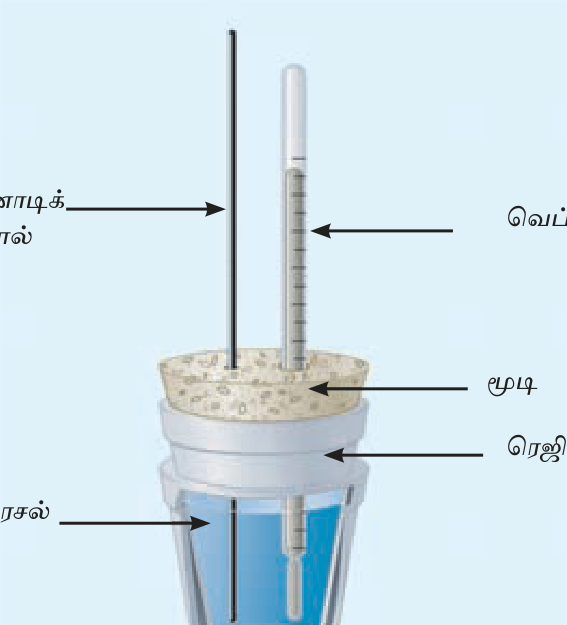
Components:
• Outer polystyrene cup — provides air gap → poor heat conductor → minimises heat loss to surroundings.
• Inner polystyrene cup — actual reaction container. Double-walled construction enhances insulation.
• Lid (cover) — also polystyrene foam. Prevents heat loss through convection at top + reduces evaporation losses.
• Thermometer (through small hole in lid) — measures temperature change ΔT.
• Stirrer — ensures uniform temperature throughout solution. Without stirring, thermometer might read local temperature only.
Why this design?
(1) Polystyrene = trapped air pockets = very poor conductor. Cheap + reusable.
(2) Air gap between cups = additional insulation barrier.
(3) Lid stops upward heat loss (convection) and steam escape (latent heat loss).
(4) Stirrer guarantees ΔT measurement accuracy.
(5) Thermometer directly reads temperature change for Q = mcθ.
Limitations:
• Not perfectly insulating — some heat lost.
• Pressure changes can't be measured (use bomb calorimeter for combustion).
• Volume changes can cause cap displacement (open systems).
----
5 Exothermic Real-Life Applications:
(1) Combustion fuels: LPG, kerosene, petrol → cooking + transport + power. Releases ~40-50 MJ/kg as heat that does work.
(2) Hand warmers: Iron filings + air + salt + activated carbon → slow controlled rusting (Fe → Fe₂O₃) → 60-70°C for hours. Winter pocket utility.
(3) Cement setting in construction: Hydration of Portland cement (Ca silicates + water → Ca silicate hydrates + heat). Bridges, dams cool slowly to prevent thermal cracking — Hoover Dam used internal cooling pipes.
(4) Body warmth: Cellular respiration (glucose + O₂ → CO₂ + H₂O + ATP) generates ~70 W resting BMR. Maintains 37°C body temperature.
(5) Neutralisation heat packs: Some commercial heat packs use Mg + Fe + saltwater → mild exothermic for post-workout muscle relaxation. Alternatively, supersaturated sodium acetate "snap" packs (technically crystallisation, exothermic).
----
5 Endothermic Real-Life Applications:
(1) Instant cold pack (sports injury): NH₄NO₃ + water → solution at 0-5°C. Used for sprains, bruises, fever reduction in remote settings without ice.
(2) Refrigerator + air conditioning: Refrigerant evaporation inside cooler/room absorbs heat (endothermic). Compressor cycle moves heat outside. Energy moved, not destroyed (heat pump).
(3) Photosynthesis: Plants store solar energy as glucose chemical bonds. Foundation of food chain. ~120 billion tonnes carbon fixed annually globally.
(4) Sweating (body cooling): Skin water evaporation absorbs ~2260 J/g. Critical for exercise + hot climate. Humid air reduces evaporation rate → why humidity feels hotter.
(5) Ice melting in drinks / preservation: Latent heat of fusion (334 J/g) absorbed → cools drink. Cold chain logistics for food + medicine preservation uses ice + dry ice (sublimation).
Bonus combined application — Internal combustion engine: Controlled exothermic combustion of fuel + air → mechanical work + waste heat. Endothermic — radiator-cooled to manage waste heat. Modern engines ~30-40% efficient; rest = waste heat.
விடைத் திட்டம் — சேர்க்க வேண்டிய புள்ளிகள்:
- Body uses both exo (resp) + endo (sweat) for thermoregulation.
- Respiration releases what photosynthesis stored.
- Acid rain caused by combustion exo reactions.
- Fuel combustion exo for cooking + steel/cement industry.
Human body maintains 37°C against changing environment.
Heat sources (Exothermic):
• Basal metabolic rate (BMR) ~70 W from cellular respiration. Liver + muscle major heat producers.
• During exercise — 10× higher heat production. Burning glucose + fats releases ~30 kJ/L O₂ consumed.
• Shivering (involuntary muscle contractions) generates heat when cold.
• Brown fat tissue (babies + cold-adapted adults) produces heat via uncoupled mitochondrial respiration.
Heat removal (Endothermic):
• Sweat evaporation — each gram removes ~2400 J. Critical in tropical climates.
• Radiation from skin surface — proportional to T⁴ (Stefan-Boltzmann).
• Vasodilation (skin vessels) — more blood to surface for radiation loss.
• Behavioural (seek shade, drink cold water).
Failure modes:
• Hypothermia (<35°C) — frostbite, confusion, death.
• Hyperthermia / heatstroke (>40°C) — multi-organ failure.
• Fever — controlled hyperthermia (immune response set-point reset to ~38-39°C).
Smart design: Body uses water's high specific heat (4200 J/kg/°C) and high latent heat (2260 J/g) for buffering and cooling efficiency.
----
(b) Respiration ↔ Photosynthesis Cycle:
Photosynthesis (endothermic — absorbs solar energy):
6CO₂ + 6H₂O + light → C₆H₁₂O₆ + 6O₂
Energy stored: ~2870 kJ/mol glucose. Solar energy → chemical bond energy.
Respiration (exothermic — releases stored energy):
C₆H₁₂O₆ + 6O₂ → 6CO₂ + 6H₂O + ~2870 kJ/mol
Released as: ~40% ATP (cellular work) + ~60% heat (body temperature).
Global cycle:
Plants store solar energy by day. Plants + animals consume energy continuously via respiration. Day-night equilibrium.
Carbon balance:
• Atmospheric CO₂ ~410 ppm (rising due to fossil fuels).
• Plants absorb ~120 GtC/year.
• Respiration + decay return ~120 GtC/year.
• Anthropogenic emissions ~36 GtC/year excess CO₂ → climate change.
Energy currency: All life energy ultimately solar. Even fossil fuels = ancient stored photosynthesis (millions of years).
----
(c) Acid Rain — Combustion Reactions Contribute:
Coal + oil combustion are highly exothermic — that's why we burn them. But byproducts include S + N compounds:
SO₂ formation (exothermic):
S + O₂ → SO₂ + ~297 kJ/mol (coal sulfur burning).
Further: 2SO₂ + O₂ → 2SO₃ + heat.
SO₃ + H₂O → H₂SO₄ (sulfuric acid rain).
NOₓ formation:
N₂ + O₂ → 2NO (endothermic at high T inside engines). NO + ½O₂ → NO₂.
3NO₂ + H₂O → 2HNO₃ + NO (nitric acid rain).
Result: Rain pH 2-5 instead of natural 5.6.
Damage:
• Forests, lakes, monuments dissolved.
• Soil acidification → nutrient leaching.
• Aquatic biodiversity loss.
• Sri Lanka tea plantations + Sigiriya monuments at risk if pollution continues.
Mitigation = limit exothermic combustion:
• Renewable energy (solar, wind, hydro) — no SO₂ or NOₓ.
• Scrubbers — remove SO₂ as gypsum (Ca-based).
• Catalytic converters — NOₓ → N₂.
• Energy efficiency — less burning needed.
----
(d) Cooking, Fuels, Cement:
Cooking (LPG):
C₃H₈ + 5O₂ → 3CO₂ + 4H₂O + 2200 kJ/mol (propane).
Sri Lankan kitchens majority LPG-cooked. Stove ~50% efficient.
Wood fire:
C + O₂ → CO₂ + 394 kJ/mol; H + O₂ → H₂O. Less efficient + more smoke. Indoor air pollution concern.
Electric / induction cooking:
Electricity-source-dependent. Coal-electric still emits CO₂ at power plant.
Steel making:
Iron ore + coke + limestone in blast furnace. Multiple exo reactions:
• Carbon combustion provides heat.
• Fe₂O₃ + 3CO → 2Fe + 3CO₂.
Massive energy + CO₂ source.
Cement (Portland):
• CaCO₃ + heat → CaO + CO₂ (endothermic — needs furnace).
• CaO + clay → cement clinker (exothermic curing).
• Cement industry ~7% global CO₂ emissions.
Energy + climate intersection: Modern civilization powered by exothermic combustion of carbon. Climate crisis demanding shift to renewable (no combustion) energy + electrification + carbon capture.
விடைத் திட்டம் — சேர்க்க வேண்டிய புள்ளிகள்:
- c definition.
- 5 problems including endo/exo.
- Water vs metal comparison.
Amount of heat needed to raise temperature of 1 kg of substance by 1°C. Unit: J kg⁻¹ °C⁻¹ or J kg⁻¹ K⁻¹.
Common values:
• Water (liquid): 4200 J/kg/°C — highest among common substances.
• Ice: 2100 J/kg/°C.
• Steam: 2010 J/kg/°C.
• Aluminium: 900 J/kg/°C.
• Copper: 385 J/kg/°C.
• Iron: 450 J/kg/°C.
• Mercury: 140 J/kg/°C.
• Air: 1000 J/kg/°C.
Why water so high? Hydrogen bond network absorbs heat into rotational + translational modes. Beneficial for Earth's climate (oceans buffer temperature) + body (sweat cools efficiently).
Why metals so low? Free electrons absorb heat efficiently — small temperature rise stores much energy. Why car radiator water (large c) needed for engine cooling.
----
Problem 1 — Water heating:
Heat needed to raise 2 kg water from 20°C to 90°C?
Q = mcθ = 2 × 4200 × 70 = 588,000 J = 588 kJ.
With 1.5 kW kettle: time = 588/1.5 = 392 seconds = ~6.5 min.
Problem 2 — Aluminium block:
500 g Al cube heated 25°C → 100°C. Heat absorbed?
m = 0.5 kg, c = 900, ΔT = 75°C.
Q = 0.5 × 900 × 75 = 33,750 J = 33.75 kJ.
Problem 3 — Endothermic dissolution (NH₄NO₃):
50 g NH₄NO₃ dissolved in 200 g water. Temperature dropped from 25°C → 13°C. Heat absorbed by reaction?
Total solution mass = 250 g = 0.25 kg, ΔT = 12°C (cooling).
Q = 0.25 × 4200 × 12 = 12,600 J = 12.6 kJ absorbed.
Endothermic dissolution (NH₄NO₃ → NH₄⁺ + NO₃⁻).
Problem 4 — Exothermic neutralisation:
100 cm³ 2M HCl + 100 cm³ 2M NaOH (both 25°C) mixed → 40°C.
Total solution = 200 g = 0.2 kg, ΔT = 15°C.
Q = 0.2 × 4200 × 15 = 12,600 J = 12.6 kJ released.
Moles NaOH = 0.2 mol. Heat per mole = 12,600 / 0.2 = 63 kJ/mol (close to 57 kJ/mol literature value; small heat loss difference).
Problem 5 — Mixing two waters:
200 g water at 80°C + 300 g water at 20°C. Final temperature?
Heat lost by hot = Heat gained by cold:
200 × 4.2 × (80 − T_final) = 300 × 4.2 × (T_final − 20)
200 × (80 − T) = 300 × (T − 20)
16000 − 200T = 300T − 6000
22000 = 500T
T_final = 44°C.
Note: c cancels out (same substance). General mixing formula: T_final = (m₁T₁ + m₂T₂)/(m₁ + m₂) for same substance.
----
Practical insights from c values:
(1) Why oceans moderate climate:
Water c = 4200; soil c ≈ 1500. Coastal areas warm slowly + cool slowly. Inland areas have extreme T swings.
(2) Why cooking pots are metal:
Low c → quick to heat up. Aluminum + steel popular. Bottom thicker for even heat distribution.
(3) Why thermos walls vacuum:
Vacuum stops convection + conduction. Reflective inner wall stops radiation. Coffee stays hot.
(4) Why nuclear reactor coolant water:
High c removes large heat from core efficiently. PWR + BWR designs use water.
(5) Why summer heat stress:
Humans depend on sweat evaporation (2260 J/g latent heat). Humid days reduce evaporation → heat trap. Wet bulb temperature critical metric.
Equation forms in heat transfer:
• Sensible heat: Q = mcΔT (temperature change, no phase change).
• Latent heat: Q = mL (phase change, no temperature change). L_fusion(water) = 334 J/g; L_vaporisation = 2260 J/g.
• Combined heating of ice → steam involves multiple stages: ice warms + ice melts + water warms + water boils + steam warms.
விடைத் திட்டம் — சேர்க்க வேண்டிய புள்ளிகள்:
- Specific heat differences.
- Solution mass = volume × density assumption.
- Common errors: wrong c, wrong mass, wrong ΔT sign.
- Sign conventions.
Pure substance heating:
• Use substance's own c.
• Mass directly given or measured.
• ΔT measured.
• Q = mcΔT straightforward.
Solution calorimetry:
• Assume solution properties ≈ water (dilute solutions).
• Total solution mass = volume_total × density (typically use 1 g/mL).
• Specific heat ≈ 4200 (water's value).
• Q calculated represents heat absorbed/released BY the solution → heat released/absorbed by the reaction (opposite sign).
• To get "per mole": divide by moles of limiting reactant.
Sign convention (NIE / exam):
• Q from formula = magnitude of heat involved.
• If solution cooled (ΔT negative) → reaction was endothermic.
• If solution warmed (ΔT positive) → reaction was exothermic.
• Some textbooks use ΔH negative for exo, positive for endo.
----
Problem 1 — Common error: wrong mass:
Q: 100 cm³ 1M HCl + 100 cm³ 1M NaOH (both 25°C) → 32°C. Calculate heat released per mole.
Common mistake: Using only 100 g (single reactant volume) instead of 200 g (total solution).
Correct approach:
• Total volume = 100 + 100 = 200 cm³.
• Mass = 200 g = 0.2 kg (density ≈ water).
• ΔT = 32 − 25 = 7°C.
• Q = 0.2 × 4200 × 7 = 5880 J = 5.88 kJ.
• Moles NaOH (or HCl) = 0.1 dm³ × 1 mol/dm³ = 0.1 mol.
• Heat per mole = 5880 / 0.1 = 58,800 J/mol ≈ 59 kJ/mol (matches literature 57 kJ/mol; small heat loss).
Lesson: Always use total combined mass after mixing.
----
Problem 2 — Common error: wrong specific heat:
Q: A 300 g iron block heated from 20°C → 100°C absorbs how much heat? (c_iron = 450 J/kg/°C)
Common mistake: Using c = 4200 (water) instead of c_iron = 450.
Correct calculation:
• m = 0.3 kg, c = 450, ΔT = 80.
• Q = 0.3 × 450 × 80 = 10,800 J = 10.8 kJ.
Mistake gives: 0.3 × 4200 × 80 = 100,800 J = ~10× wrong!
Lesson: Always identify substance + use correct c.
----
Problem 3 — Common error: ΔT sign + identifying type:
Q: 50 g KNO₃ added to 200 g water at 25°C. Temperature dropped to 16°C. (a) How much heat was absorbed by the solution? (b) Endo or exo?
Common mistakes:
• Sign confusion of ΔT.
• Confusing direction: "heat absorbed by solution" vs "heat involved in reaction".
Correct approach:
• Total solution mass = 50 + 200 = 250 g = 0.25 kg.
• ΔT magnitude = 25 − 16 = 9°C.
• Q (magnitude) = 0.25 × 4200 × 9 = 9450 J = 9.45 kJ.
• Solution LOST 9.45 kJ → solution's temperature dropped.
• The reaction (KNO₃ dissolving) ABSORBED 9.45 kJ from the solution.
• Therefore reaction = endothermic.
Visual: "Reaction takes heat from solution → solution cools."
Lesson: Direction of energy flow = key. Solution's temperature change is the OPPOSITE direction of the reaction's heat sign.
----
Problem 4 (bonus) — Latent heat involved:
Q: How much heat to convert 100 g ice at 0°C to 100 g steam at 100°C?
4 stages:
(i) Melt ice: Q₁ = m × L_fusion = 0.1 × 334,000 = 33,400 J.
(ii) Heat water 0 → 100°C: Q₂ = 0.1 × 4200 × 100 = 42,000 J.
(iii) Boil water: Q₃ = m × L_vapor = 0.1 × 2,260,000 = 226,000 J.
(iv) Heat steam (if continuing past 100°C): skip here.
Total = 33,400 + 42,000 + 226,000 = 301,400 J = 301.4 kJ.
Observation: Vaporisation absorbs the most by far (~75% of total). Why steam burns are far worse than water burns.
Lesson: Latent heat (Q = mL) for phase changes, NOT Q = mcΔT. ΔT = 0 during phase change.
----
Summary of common calorimetry errors:
(1) Using mass of only one reactant instead of total mixed mass.
(2) Using water's c for non-water substance.
(3) Using cm³ as kg or g (always convert).
(4) ΔT sign confusion.
(5) Forgetting to convert per-mole when asked.
(6) Using sensible heat formula for phase change (or vice versa).
(7) Ignoring heat loss to surroundings (acceptable approximation in school exams).
விடைத் திட்டம் — சேர்க்க வேண்டிய புள்ளிகள்:
- H-bond network absorbs energy.
- Climate without water buffer = extreme T.
- Biology depends on water.
- Climate change = increased atmospheric heat retention.
Molecular explanation:
Water (H₂O) molecules form extensive hydrogen bond network — each molecule attracts up to 4 neighbours via H-bonds.
When heat is added to liquid water:
• Translational motion energy stored (whole molecule speed).
• Rotational motion energy stored (molecule tumbling).
• Vibrational modes energy stored.
• H-bond breaking uses significant energy (~21 kJ/mol per H-bond).
Result: Much heat must be added before temperature rises significantly. c = 4200 J/kg/°C is 4× that of typical organic liquids + 10× metals.
Comparison values:
• Ethanol: ~2400 J/kg/°C
• Olive oil: ~2000 J/kg/°C
• Mercury: 140 J/kg/°C
• Iron: 450 J/kg/°C
• Aluminium: 900 J/kg/°C
Water is anomalously high among all liquids; only ammonia higher.
Additional anomalies:
• Latent heat of vaporisation: 2260 J/g (very high) — H-bonds completely broken in gas phase.
• Latent heat of fusion: 334 J/g — partial H-bond network broken.
• Maximum density at 4°C (not at freezing) — H-bond network optimisation.
----
Climate consequences IF water had low specific heat:
Imagine if water had c = 450 like iron (10× lower):
Oceans:
• Would heat up + cool down rapidly with day-night cycle + seasons.
• Coastal climates would have huge temperature swings.
• Storms more intense + frequent (temperature gradients steeper).
• Marine life faced with daily 20-40°C swings — most would be extinct.
• Ice ages might be triggered more easily.
Atmosphere:
• Water vapor wouldn't absorb much heat → climate buffer absent.
• Day-night T variation 50-70°C (like Mars desert).
• No moderating effect of water bodies.
Continental interiors:
Desert-like extremes already exist (Sahara, Gobi) but globally everywhere.
Earth would be inhospitable.
----
Biological consequences:
Body temperature regulation:
• 60% of human body = water. High c means body resists T change.
• Without it, fever/hypothermia easier to trigger.
• Sweating (latent heat) — only effective because of water's high L_vap.
• Without it, would need to drink + sweat 10× more for same cooling.
Cellular machinery:
• Enzymes work in narrow T range (35-40°C for humans).
• High T water swings would denature enzymes faster than evolution could keep up.
• Most biochemistry happens in aqueous solution — water's buffering essential.
Aquatic life:
• Lakes/oceans = stable thermal habitat.
• Coral reefs already stressed by small T rises (~2°C) — without water buffer, bleaching would be daily.
• Migration patterns, hibernation cycles all evolved around water's thermal stability.
Photosynthesis:
• Plants need water as reactant.
• Steady moderate temperatures support continuous photosynthesis.
• Without — boom-bust cycles dominate ecosystems.
----
Climate Change Energy Aspect:
Current global warming = increased heat retention in atmosphere + oceans.
Energy budget:
• Solar input: ~1361 W/m² at top of atmosphere.
• Earth radiates back ~393 W/m² average from surface.
• Greenhouse gases (CO₂, CH₄, N₂O, water vapor) absorb infrared from surface → re-emit downward → warming.
Anthropogenic forcing:
• CO₂ from fossil fuel combustion (exothermic) → atmospheric concentration up 50% since 1750.
• Methane from agriculture + leaks.
• Net imbalance ~+2.4 W/m² extra heat retained.
• Over a year, this is ~3×10²² J extra heat — equivalent to billions of nuclear bombs!
Where does it go?
• ~93% absorbed by oceans — water's high c makes oceans a massive heat sink. Without this, atmospheric warming would be 30× faster.
• ~3% melts ice (latent heat for phase change).
• ~3% warms atmosphere.
• ~1% warms land.
Oceans are buying us time via water's high specific heat. But consequences:
• Sea level rise (thermal expansion).
• Ocean acidification (CO₂ dissolved → carbonic acid).
• Coral bleaching.
• Disrupted currents (Gulf Stream slowdown).
• Marine ecosystem shifts.
Eventually:
If forcing continues, ocean buffering capacity saturates → atmospheric warming accelerates → tipping points (permafrost methane release, Amazon dieback, ice sheet collapse).
Solution:
• Reduce exothermic fossil fuel combustion → replace with endothermic (e.g., direct solar capture).
• Reforest (photosynthesis).
• Carbon capture (energy-intensive).
• Methane reduction (agriculture, industry).
Sri Lankan specifics:
• Coastal flooding risk (Colombo, Galle, Trincomalee).
• Monsoon disruption affects rice agriculture.
• Coral reef loss (Pasikuda, Mannar).
• Renewable energy push (solar farms Mannar, wind in Hambantota) = reduce combustion.
Final thought: Water's high specific heat is simultaneously the foundation of life + the reason we have time to address climate change. But that grace period is finite. Action required.
🔥 மீட்டல் மையம்
பரீட்சைக்கு முன் இறுதி ஒரு நிமிடம் — மறக்கக்கூடாதவை மட்டும்.
- Exothermic (புறவெப்பத்): Heat released. Beaker warms. Products lower energy than reactants.
- Endothermic (அகவெப்பத்): Heat absorbed. Beaker cools. Products higher energy than reactants.
- Exo examples: Combustion (LPG, petrol), Neutralisation (HCl+NaOH 57 kJ/mol), Respiration, CaO+H₂O, Rusting.
- Endo examples: Photosynthesis, NH₄NO₃+water (cold pack), Ice melting, Evaporation, CaCO₃ decomposition.
- Q = mcθ. Q joule, m kg, c J/kg/°C, θ ΔT °C.
- Water c = 4200 J/kg/°C — highest among common liquids.
- Heat (Q) = total energy. Temperature (T) = avg KE of particles. Different concepts.
- Standard heat of neutralisation: ~57 kJ/mol (strong+strong).
- Insulated cup calorimetry. Polystyrene minimises heat loss.
- Applications: Cold pack (NH₄NO₃), Hand warmer (Fe rust), Fridge (evap), Sweat (cooling), LPG (cook).
- ⚠ Strong ≠ concentrated. Hot ≠ high heat. m × c × θ — units crucial.
அலகின் முதுகெலும்பு — கருத்துக்களும் தொடர்புகளும்.
- 1. Exothermic: Heat output. Surroundings warm. ΔH negative. Combustion, neutralisation, respiration, hydration of CaO, rusting.
- 2. Endothermic: Heat input. Surroundings cool. ΔH positive. Photosynthesis, decomposition heating, dissolution of NH₄NO₃, melting/evaporating.
- 3. Heat vs Temperature: Heat (Q) = energy in J, extensive. Temperature (T) = avg KE in °C/K, intensive. Bath > beaker in heat; beaker > bath in T.
- 4. Q = mcθ formula: Universal calorimetry. Q J, m kg, c J/kg/°C, θ ΔT °C.
- 5. Specific heat values: Water 4200, Ice 2100, Steam 2010, Aluminum 900, Iron 450, Copper 385, Air 1000.
- 6. Why water special: H-bond network absorbs energy → high c, high latent heats. Climate + body buffer.
- 7. Calorimeter design: Polystyrene cup (insulator), lid (prevents heat loss + evaporation), thermometer + stirrer (accurate ΔT measurement).
- 8. Calorimetry assumptions: Solution density = water (1 g/mL); solution c = water's 4200; calorimeter absorbs negligible heat; no loss to surroundings.
- 9. Standard neutralisation heat: ~57 kJ/mol for strong acid + strong base. Weak slightly less (ionisation cost).
- 10. Endothermic dissolutions: NH₄NO₃, KCl, KNO₃ — lattice energy > hydration energy. Cold pack applications.
- 11. Exothermic dissolutions: NaOH, CaO, H₂SO₄ — hydration energy > lattice. Hot when dissolved.
- 12. Latent heat: Phase change without T change. Fusion (water) = 334 J/g; Vaporisation = 2260 J/g.
- 13. Energy diagram: Exo = downhill overall, activation hump first. Endo = uphill overall, hump first. Activation energy = initial bond-breaking.
- 14. Daily exo applications: Fuel cooking, hand warmer (Fe), cement setting, body heat, heat packs.
- 15. Daily endo applications: Cold pack (NH₄NO₃), refrigerator (refrigerant evap), photosynthesis, sweating, ice in drinks.
- 16. Calculation example: 200 g water rising 7°C: Q = 0.2 × 4200 × 7 = 5880 J.
- 17. Per mole calculation: Q ÷ moles of reactant. 5880 J / 0.1 mol = 58.8 kJ/mol.
- 18. Industrial scale: Steel making (exo: ore + coke), cement (endo: CaCO₃ heating then exo: hydration), explosives (very fast exo).
- 19. Climate connection: Combustion exo releases CO₂ → greenhouse → climate change. Renewable energy transition needed.
- 20. Body thermoregulation: Cellular respiration (exo) heats body + sweat evaporation (endo) cools. Water's high c + L_vap critical.
பரீட்சைக்கு முந்தின இரவு முழு அலகையும் ஓட்டிப் பார்.
- Exo = heat OUT. Combustion, neutralisation, respiration, CaO+water, rusting. Beaker warms.
- Endo = heat IN. Photosynthesis, NH₄NO₃ dissolution, ice melting, evaporation. Beaker cools.
- Q = mcθ. J = kg × J/kg/°C × °C.
- Water c = 4200 J/kg/°C (memorise!). Density 1 g/mL = 1000 kg/m³.
- Heat (Q, J) ≠ Temperature (T, °C). Heat = total; Temperature = average particle KE.
- Neutralisation heat: ~57 kJ/mol (strong + strong).
- Calorimeter: Polystyrene cup + lid + thermometer + stirrer. Insulating + accurate ΔT measurement.
- Assumptions: Solution = water properties.
- Per mole calculation: Q (total) ÷ moles of limiting reactant.
- Energy diagrams: Exo downhill (products lower), Endo uphill (products higher). Both have activation energy hump in middle.
- Phase changes: Latent heat. Water: fusion 334 J/g, vaporisation 2260 J/g. No T change during phase transition.
- Common exo apps: Cooking LPG, hand warmer (Fe oxidation), cement setting, body heat from respiration.
- Common endo apps: Instant cold pack NH₄NO₃, refrigerator (refrigerant evaporation), sweating cooling.
- ⚠ Sign confusion: Solution warming = reaction exo. Solution cooling = reaction endo. ΔT magnitude vs direction.
- ⚠ Mass = TOTAL mixed solution mass (not just one reactant).
- ⚠ Substance-specific c. Don't default to water for metals/non-aqueous.
- ⭐ Worked problem: 100 mL HCl + 100 mL NaOH (1M each) → 25°C → 31.8°C → Q=mcθ = 0.2 × 4200 × 6.8 = 5712 J = ÷ 0.1 mol = 57 kJ/mol.
- 📋 Glossary: வெப்பம்=heat; வெப்பநிலை=temperature; புறவெப்பத் தாக்கம்=exothermic; அகவெப்பத் தாக்கம்=endothermic; தன்வெப்பக் கொள்ளளவு=specific heat capacity; calorimeter=வெப்ப அளவி.