கேத்திர கணித ஒளியியல்
ஒளி நம் கண்களைச் சென்றடைய மட்டுமே நாம் பார்க்க முடிகின்றது. சூரியனின் ஒளி பூமியை அடைய 8 நிமிடம் ஆகும். ஒளி நேர்க்கோட்டில் செல்லும்; ஒரு கண்ணாடியில் தாக்கினால் எதிரொளிக்கின்றது (reflection); கண்ணாடி வழியாகப் பயணிக்கும்போது வேகம் மாறி முறிகின்றது (refraction); ஒரு வளைந்த கண்ணாடியோ வில்லையோ ஒளியின் திசையை மாற்றி படிமம் (image) உருவாக்குகின்றது. இவ்வலகில் ஒளியின் இவ்விரு அடிப்படை பண்புகளையும், கண்ணாடிகள் (mirrors) + வில்லைகள் (lenses) எவ்வாறு படிமம் உருவாக்குகின்றன என்பதையும், ஒளியின் முழு அக எதிரொளிப்பு (TIR) + நார்த்திரள் (fiber optics) + மனிதக் கண் — எல்லாம் கற்போம்.

1. ஒளித் தெறிப்பு / எதிரொளிப்பு (Reflection)
ஒளி ஒரு polished surface (கண்ணாடி, பளிங்கு வாள்) மீது தாக்கும்போது — surface-இல் இருந்து திரும்புதல். Two cardinal laws:
- Law 1: Incident ray, reflected ray, normal — மூன்றும் ஒரே plane-ல்.
- Law 2: தாக்கல் கோணம் (i) = எதிரொளிப்புக் கோணம் (r). i = r.
1.1 சமதள கண்ணாடி (Plane mirror)
உங்கள் வீட்டுக் கண்ணாடி. படிமத்தின் பண்புகள்:
- Object-உக்கும் mirror-உக்கும் உள்ள தூரம் = image-உக்கும் mirror-உக்கும் உள்ள தூரம்.
- Image is virtual (கண்ணாடிக்கு பின்னால்).
- Same size as object.
- Lateral inversion — இடது/வலது swap. அதனாலேயே கண்ணாடியில் "BUS" → "SUB"-ஆகத் தோன்றும்.
1.2 வளை கண்ணாடிகள் (Curved mirrors)
Two types: குழி கண்ணாடி (concave / converging), குவி கண்ணாடி (convex / diverging).
(a) குழி கண்ணாடி (Concave): Reflecting surface ஓரத்தில் (interior of bowl). Parallel rays reflect → converge at focus F. Real, inverted images formed (for objects beyond F). வாகனத்தின் headlight, shaving mirror (close magnify), satellite dish, telescope mirror.
(b) குவி கண்ணாடி (Convex): Outer surface reflects. Parallel rays diverge after reflection. Virtual, erect, smaller image (wide field of view). வாகனத்தின் side mirror, security mirror. "Objects in mirror are closer than they appear" — convex mirror property.
2. ஒளி முறிவு (Refraction)
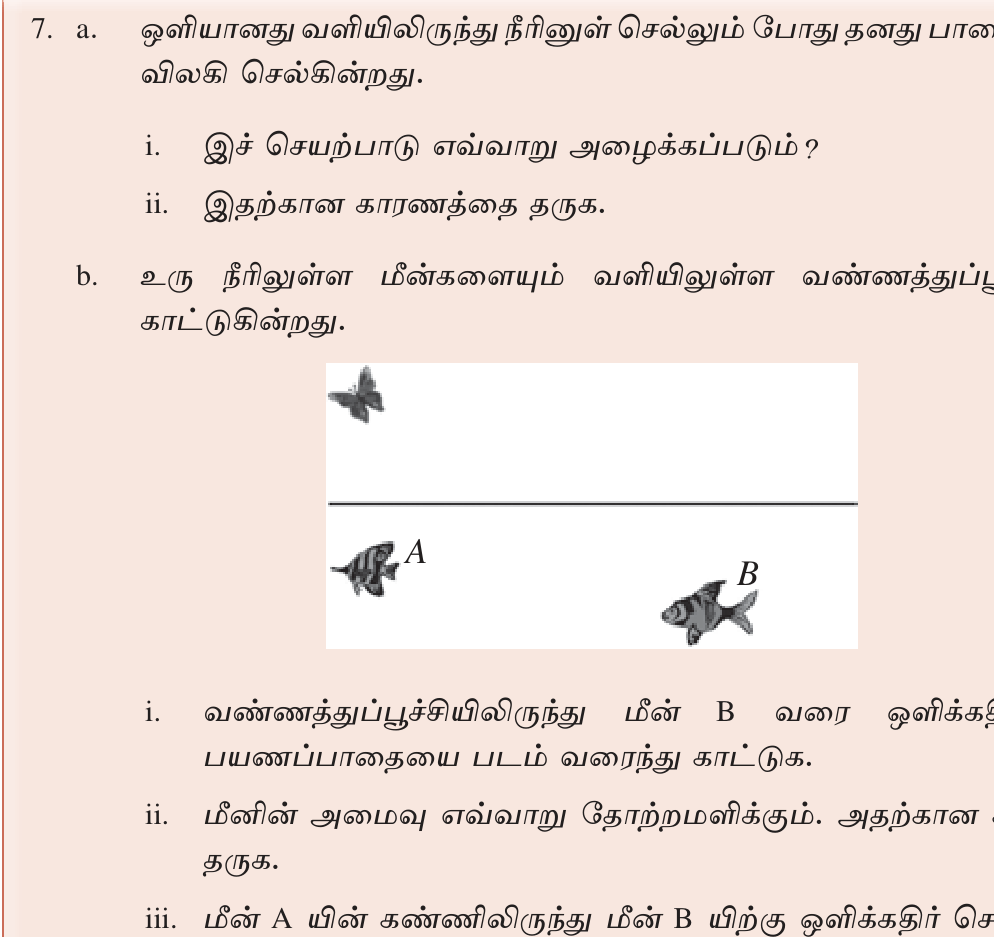
ஒளி ஒரு medium-ஐ விட்டு வேறு medium-உக்கு (air → glass, glass → water) செல்லும்போது வேகம் மாறி, அதனால் பாதை வளைந்துவிடும். தண்ணீர் கண்ணாடி glass-ல் pencil-ஐ partially நிமிர்த்தினால், pencil bent-ஆக தோன்றுவது இதனாலேயே.
2.1 ஒளி முறிவு விதிகள் (Snell's law)
- Incident ray, refracted ray, normal — ஒரே plane-ல்.
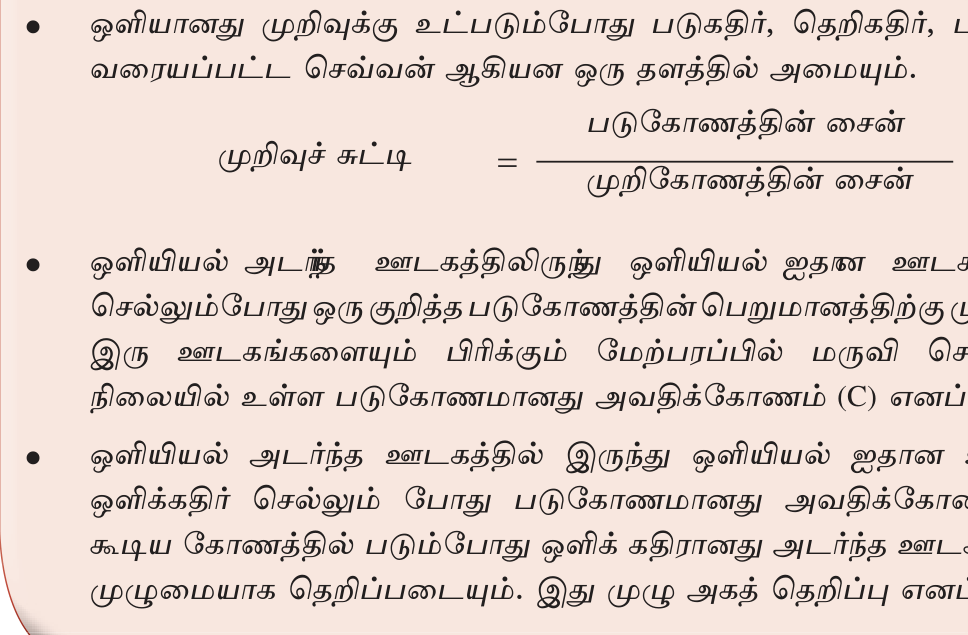
- n₁ sin(i) = n₂ sin(r) (Snell's law). n = refractive index.
Refractive index n = c/v = vacuum-ல் ஒளி வேகம் ÷ medium-ல் வேகம். Always n ≥ 1. நீர் n=1.33, glass n=1.5, diamond n=2.42.
2.2 முழு அக எதிரொளிப்பு (Total Internal Reflection — TIR)
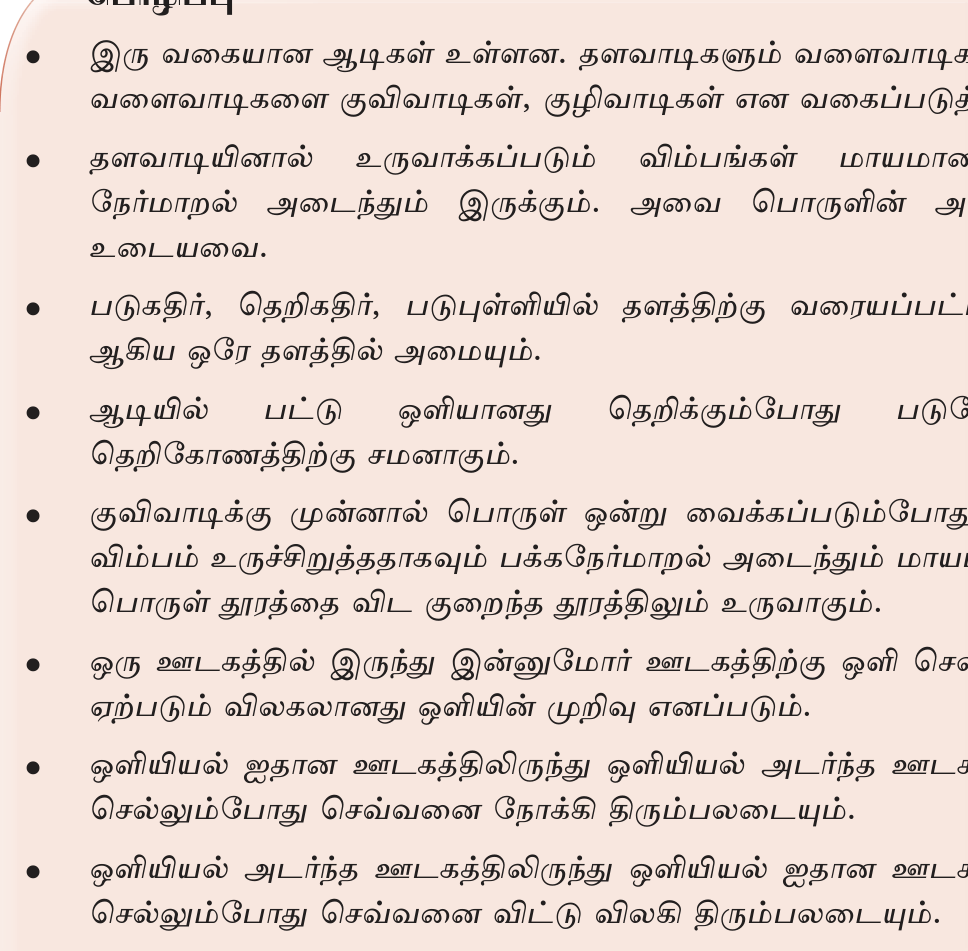
Optically denser medium-இலிருந்து (glass) less dense medium-உக்கு (air) ஒளி செல்லும்போது — i ஒரு critical angle θc-ஐ விட அதிகமாக இருந்தால் — ஒளி refract ஆகாமல் முழுவதும் reflect ஆகும். இதே TIR.
Glass-ல் θc ≈ 42°; diamond-ல் θc ≈ 24° — அதனாலேயே diamond brilliantly sparkle. ஒளி அதிக angles-ல் உள்ளே bounce ஆகி, ஒரே ஒரு face-ஆல் வெளியேற்றப்படுகின்றது.
2.3 நார்த்திரள் (Fiber optics)
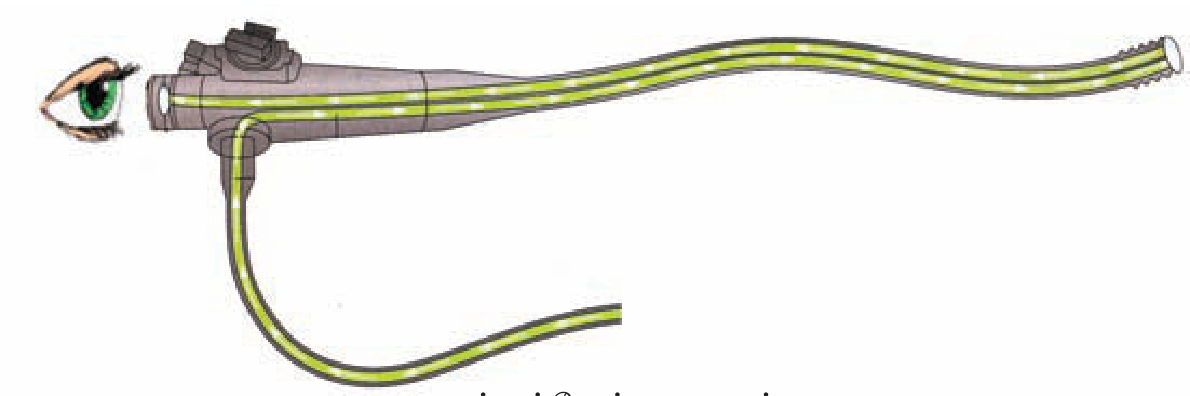
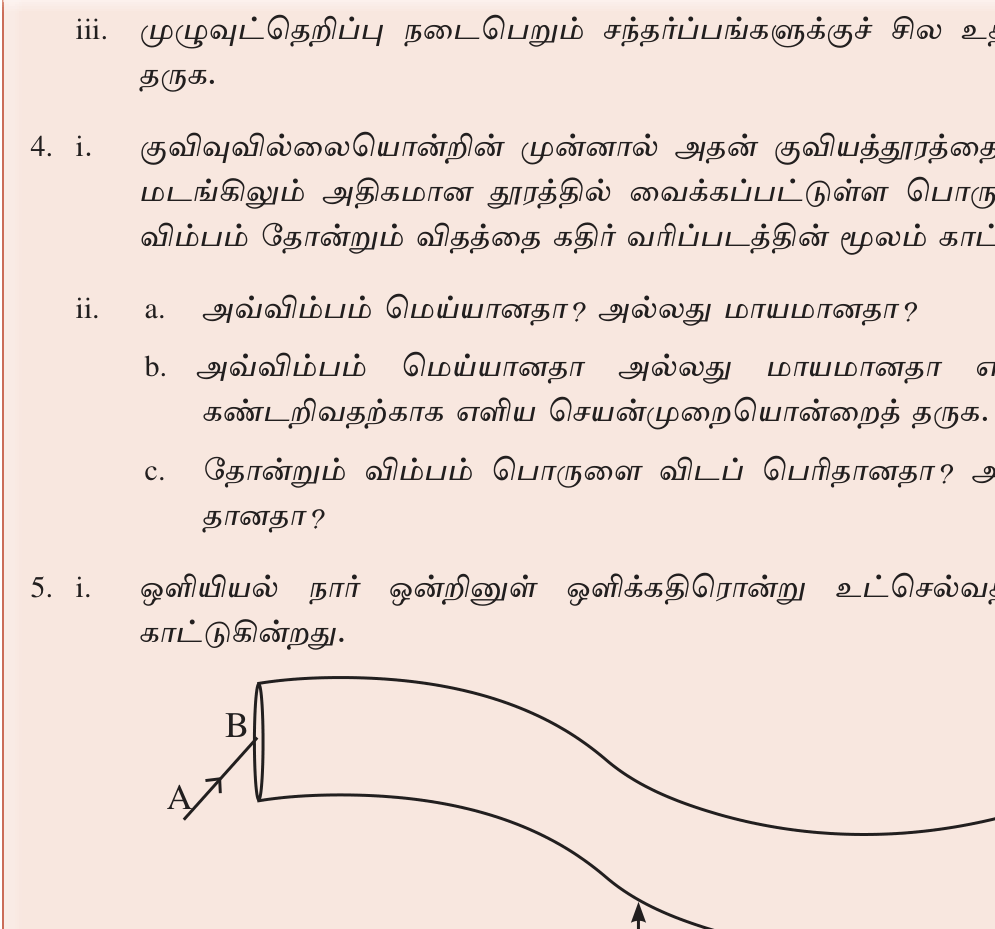
நுண்ணிய glass நார்-ஊடாக ஒளி total internal reflection-ஆல் kilometers தூரம் எடுத்துச் செல்லப்படுகின்றது. Communication revolution: Internet backbone (Atlantic submarine cables), endoscope (உடல் உள் பார்த்தல்), decorative lighting.
3. வில்லைகள் (Lenses)
3.1 குவி வில்லை (Convex / converging lens)
நடுவில் தடித்து, ஓரத்தில் மெல்லியது. Parallel rays focal point F-ல் converge செய்யும். Magnifying glass, camera lens, eye lens, projector — எல்லாம் convex.
3.2 குழி வில்லை (Concave / diverging lens)
நடுவில் மெல்லியது, ஓரத்தில் தடித்தது. Parallel rays diverge, virtual focal point உருவாக்கும். Spectacles for myopia (short-sightedness), binoculars eyepiece.
3.3 Lens formula + magnification
1/v − 1/u = 1/f           (sign convention crucial)
m = h_image / h_object = v/u
- u = object distance from lens
- v = image distance from lens
- f = focal length
- m = magnification (negative = inverted, |m| > 1 enlarged)
4. மனிதக் கண் (Human eye)
இயற்கையின் கச்சித camera. Cornea + lens convex system → retina-ல் inverted real image. மூளை upright-ஆகப் interpret செய்கின்றது.
4.1 கண் பகுதிகள்
- Cornea (கண் சுவர்): 70% refraction இங்கேதான்.
- Iris (கரு விழி): Pupil-ஐ adjust செய்து வரும் ஒளி அளவை control.
- Lens (கண் வில்லை): Focal length adjustable (accommodation) — ciliary muscle-ஆல்.
- Retina (விழித்திரை): Rod (light/dark) + cone (color) photoreceptors.
- Optic nerve: Signal → brain.
4.2 பார்வை குறைபாடுகள்
- தூரப்பார்வை குறைபாடு (Hypermetropia / hyperopia): அருகே உள்ள பொருள் blur. Concave instead → wait, actually convex lens spectacles needed.
- குறுகியப்பார்வை குறைபாடு (Myopia / short-sight): Distant objects blur. Concave lens spectacles needed.
- முதிர்வுப் பார்வை (Presbyopia): Old age accommodation loss. Bifocal lens.
- Astigmatism: Cornea irregular curvature. Cylindrical lens correction.
5. கருவிகள் (Instruments)
- Camera: Convex lens → film/sensor. Aperture (like pupil), focus (like accommodation), shutter (no biological equivalent).
- Magnifying glass: Single convex lens, object within f.
- Compound microscope: Objective + eyepiece — high magnification.
- Telescope: Large objective + small eyepiece — distant viewing.
- Periscope: Two mirrors at 45°, submarine vision.
- Projector: Convex lens projects enlarged image of slide/transparency.
✅ விரைவுச் சோதனை
முக்கியக் கருத்துக்களை உறுதிப்படுத்துங்கள். தவறான விடைகள் உங்கள் தவறுக் குறிப்பேட்டில் சேமிக்கப்படும்.
🖊 கட்டுரை வினாக்கள் (பகுதி II)
பரீட்சை வடிவில் கட்டமைப்பு வினாக்கள். முதலில் நீங்களே எழுதுங்கள்; பின்னர் மாதிரி விடையைத் திறந்து சரிபாருங்கள்.
(ஆ) சமதள கண்ணாடியில் (plane mirror) உருவாகும் படிமத்தின் 4 பண்புகளை விளக்குக. (4)
(இ) குழி + குவி கண்ணாடிகளின் தினசரி பயன்பாட்டை ஒவ்வொன்றுக்கும் தருக. (3) (10 புள்ளி)
விடைத் திட்டம் — சேர்க்க வேண்டிய புள்ளிகள்:
- Law 1: i, r, normal same plane.
- Law 2: i = r.
- Plane mirror: virtual, erect, same size, lateral inversion.
- Concave: shaving, headlight, telescope.
- Convex: side mirror, security.
Law 1 — Incident ray, reflected ray, normal (perpendicular at point of incidence) — மூன்றும் ஒரே plane-ல்.
Law 2 — தாக்கல் கோணம் = எதிரொளிப்புக் கோணம் (i = r), both measured from normal.
(ஆ) Plane mirror image — 4 properties:
• Virtual — mirror பின்னால் தோன்றும், screen-ல் project முடியாது.
• Erect — object upright இருந்தால் image-ம் upright.
• Same size — m = 1.
• Lateral inversion — left-right swap. "BUS" → "SUB" appearance.
• Equal distance — object distance = image distance from mirror.
(இ) Concave mirror uses:
• Shaving / dressing mirror (closeup magnification when object < f).
• Vehicle headlight (place bulb at f → parallel beam out).
• Telescope reflector (Newton-style large concave primary).
• Solar furnace / cooker (concentrate sun rays at focus).
Convex mirror uses:
• Vehicle rear-view side mirror (wide angle, virtual smaller image).
• Security mirror at shop / corner.
• Inside elevators, parking garages.
• ATM lobby + corridor blind-spot mirrors.
விடைத் திட்டம் — சேர்க்க வேண்டிய புள்ளிகள்:
- Refraction = light bending across media.
- Snell: n₁sin i = n₂sin r.
- n = c/v.
- TIR: denser → rarer, i > θc.
- sin θc = n₂/n₁.
- Fiber optics + endoscope + diamond brilliance.
(ஆ) Snell's law:
n₁ sin θ₁ = n₂ sin θ₂
இதில் θ₁ = incident angle (in medium 1), θ₂ = refracted angle (in medium 2).
Refractive index (n): ஒரு medium-ன் optical density அளவீடு.
n = c / v = (Speed of light in vacuum) / (Speed of light in that medium).
Typical values: vacuum 1.00, air ~1.00, water 1.33, glass 1.5, diamond 2.42. Larger n → slower light → more bending.
(இ) முழு அக எதிரொளிப்பு (Total Internal Reflection):
இரண்டு conditions ஒரே நேரத்தில்:
(1) ஒளி denser → less dense medium-உக்கு செல்ல வேண்டும் (e.g., glass → air).
(2) Incident angle i > critical angle θc.
Critical angle equation:
sin θc = n₂ / n₁
Glass-air interface: sin θc = 1 / 1.5 → θc ≈ 42°.
Diamond-air: sin θc = 1/2.42 → θc ≈ 24°.
When i ≥ θc — refracted ray would need sin > 1 (impossible) — ஆகவே refraction நிகழாது, முழு light reflect ஆகும்.
(ஈ) TIR Applications:
• Fiber optics (நார்த்திரள்): Core (high n) + cladding (low n) interface — light TIR செய்து கிலோமீட்டர்கள் travel. Internet backbone, transatlantic submarine cables. Bandwidth + low loss > copper wires.
• Endoscope: Flexible fiber bundle medical instrument. Doctor stomach (gastroscopy), colon, blood vessels-ஐ visualise — invasive surgery தேவையில்லாமல்.
• Diamond brilliance: Diamond θc = 24° low. Cut to maximise internal reflections — light bounces inside multiple times then exits brilliantly. "Fire" of diamonds = engineered TIR + dispersion.
(ஆ) Lens formula 1/v − 1/u = 1/f பயன்படுத்தி: ஒரு 20 cm focal length convex lens முன்னால் 30 cm-ல் object இருந்தால் image distance + magnification கணக்கிடுக. (4)
(இ) Lens power (dioptre) என்றால் என்ன? +2D + −1D ஆகியவற்றின் focal lengths. (2) (10 புள்ளி)
விடைத் திட்டம் — சேர்க்க வேண்டிய புள்ளிகள்:
- Convex thick center, converges, real images possible.
- Concave thin center, diverges, only virtual.
- u=30, f=20 → v=60, m=2.
- P = 1/f(m). +2D → 0.5m convex; -1D → -1m concave.
| பண்பு | Convex | Concave |
|---|---|---|
| Shape | Center thick, edges thin | Center thin, edges thick |
| Parallel rays | Converge at focal point F | Diverge — virtual focal point behind lens |
| Focal length | Positive (+) | Negative (−) |
| Image type | Real or virtual (depends on object position) | Always virtual, erect, reduced |
| Use | Camera, eye, magnifier, hyperopia spectacles | Myopia spectacles, binoculars eyepiece |
(ஆ) Lens calculation:
Given: f = +20 cm (convex), u = −30 cm (object distance, negative by sign convention as object on left of lens; some textbooks use positive — here using lens formula 1/v − 1/u = 1/f with sign convention).
Note — Sri Lankan NIE convention varies; let's use: 1/v − 1/u = 1/f, distances measured from lens, object distance u taken positive on incident side.
For object at 30 cm in front: u = 30 cm.
1/v = 1/f + 1/u (rearranged when object distance positive) — alternatively using 1/f = 1/v − 1/u with u negative:
1/v − 1/(−30) = 1/20
1/v + 1/30 = 1/20
1/v = 1/20 − 1/30 = (3 − 2)/60 = 1/60
v = +60 cm (positive → real image on far side, 60 cm from lens).
Magnification:
m = v/u = 60 / (−30) = −2
Negative sign → inverted image; |m| = 2 → image 2× enlarged.
Image properties: Real, inverted, magnified (2×), at 60 cm behind lens. Used in projectors (slide between f and 2f → enlarged real image).
(இ) Lens Power (Dioptre, D):
P = 1/f(metres). Convex lens P positive; concave negative.
• +2 D convex lens: f = 1/2 = 0.5 m = 50 cm.
• −1 D concave lens: f = −1/1 = −1 m = −100 cm.
Spectacle prescriptions written in dioptres. Right eye +2D / Left eye −1.5D = typical age-related correction.
விடைத் திட்டம் — சேர்க்க வேண்டிய புள்ளிகள்:
- Cornea — 70% refraction. Iris/pupil — light control. Lens — fine focus. Retina — image plane.
- Myopia: eyeball long → concave lens. Hyperopia: short → convex. Presbyopia: accommodation lost → bifocal. Astigmatism: cornea irregular → cylindrical.
(1) Cornea (கண்சுவர் / பின்னலையம்): பளிங்கு வடிவ வெளி dome. ~70% refraction here (fixed). காற்றில் இருந்து கண்ணுக்குள் ஒளி enter.
(2) Iris (கருவிழி) + Pupil (கருமணி): Iris colored ring; pupil center hole. Iris muscle pupil-ஐ adjust செய்து வரும் ஒளி amount control. Bright → constrict (2 mm); dark → dilate (8 mm).
(3) Lens (கண் வில்லை): Biconvex flexible lens. Ciliary muscles relax/contract → lens shape change → focal length adjust (accommodation). அருகே / தூரம் automatic focus.
(4) Retina (விழித்திரை): Image plane. ~125M rod cells (low light, monochrome) + ~6M cone cells (color, daylight). Fovea = cone-dense central area = sharpest vision. Photo signal → optic nerve → brain visual cortex.
(ஆ) 4 பார்வை குறைபாடுகள்:
(1) Myopia (குறுகியப் பார்வை / short-sight):
காரணம்: Eyeball axial length அதிகம்; image retina-உக்கு முன்னால் focus ஆகின்றது. தூரப் பொருட்கள் blur.
Correction: Concave (diverging) lens — diverges incoming light → effective focal point retinaக்குப் பின்னுக்குச் சென்று focus retina-ல்.
உதா: -2D, -3D spectacles. கணினி, mobile phone work-ஆல் modern epidemic.
(2) Hyperopia / Hypermetropia (தூரப் பார்வை / long-sight):
காரணம்: Eyeball too short; image retina-உக்குப் பின்னால் focus. அருகே blur (writing, reading).
Correction: Convex (converging) lens — converges light → focus moves forward to retina.
உதா: +1D, +2D reading glasses.
(3) Presbyopia (முதிர்வுப் பார்வை):
காரணம்: Age-related — lens hardens, ciliary muscle weakens → accommodation fails. அருகே blur (after 40-45 typically).
Correction: Bifocal / progressive lenses — top portion distance + bottom portion reading.
உதா: அப்பாக்கள் near-blind without specs to read newspaper.
(4) Astigmatism (வளிவு குறை):
காரணம்: Cornea irregular curvature (not perfectly spherical) — horizontal lines + vertical lines focus at different points.
Correction: Cylindrical lens — compensates differential curvature. Often combined with myopia/hyperopia correction.
உதா: மங்கலான வரிகள், reading strain. Common combined prescription.
Modern alternatives: Contact lenses, LASIK surgery (reshape cornea), intraocular lens implant after cataract.
விடைத் திட்டம் — சேர்க்க வேண்டிய புள்ளிகள்:
- Fiber optics: core+cladding, low loss, internet.
- Endoscope: medical visualization.
- Diamond: TIR + dispersion = fire.
Structure: Cylindrical glass core (high refractive index ~1.5) surrounded by cladding (lower n ~1.48). Total diameter — typically 125 μm (hair thickness).
Physics: Light enters at angle < critical angle → travels in straight line inside core. When it hits core-cladding interface — angle > θc (~70°) → TIR. Zigzag propagation through entire fiber, no escape, minimal energy loss.
Real impact:
• Internet: Trans-Atlantic + Trans-Pacific submarine cables fiber-based. Single fiber Tbps capacity.
• Telephone networks: Long-distance calls digitised → fiber → low cost.
• FTTH: Fiber to the home — Sri Lanka now Dialog/SLT rollout.
• Sensors: Strain, temperature, pressure detection (oil pipelines, structural health monitoring).
(2) Endoscope:
Structure: Flexible thin tube with bundle of optical fibers (10,000+). One bundle illuminate (light from outside in) + another bundle imaging fibers (image out). Modern: CCD/CMOS chip at tip + LED.
Physics: Each fiber TIR-carries light. Bundle of ordered fibers preserves spatial mapping → coherent image transmission.
Real impact:
• Gastroscopy: Stomach + esophagus inspection — ulcers, cancer biopsy.
• Colonoscopy: Colon polyps + cancer screening; removal during same procedure.
• Bronchoscopy: Airway inspection (asthma, tumours).
• Arthroscopy: Knee, shoulder joint surgery — minimal invasion.
• Angiography + angioplasty: Heart blood vessel visualisation + stent placement.
• Minimally invasive surgery replaced many open surgeries → faster recovery + smaller scars.
(3) Diamond Brilliance:
Structure: Diamond cut into specific geometry (round brilliant cut = 58 facets — 33 crown + 24 pavilion + culet).
Physics: Diamond n = 2.42 (highest natural material) → θc = 24° very low. Light entering top — pavilion facets reflect via TIR (twice typically) — exits through crown facets toward viewer.
Additional optical effects:
• Dispersion (fire): Different wavelengths different n → colors separate → rainbow flashes.
• Brilliance: Light returning to viewer eye = total internal reflection efficiency.
• Scintillation: Sparkle as diamond/light source moves.
Real impact:
• Jewelry industry: Multi-billion dollar global market driven by TIR-engineered cuts.
• Synthetic diamond (CVD): Same optical properties at lab cost.
• Industrial cutting tools: Hardness + thermal conductivity benefits.
• Optical windows: Diamond high-pressure cells in research.
விடைத் திட்டம் — சேர்க்க வேண்டிய புள்ளிகள்:
- Camera: single convex lens + sensor.
- Magnifier: single convex, object inside f.
- Microscope: 2 short-f convex.
- Telescope: long-f objective + short-f eyepiece.
- Projector: convex, object 1
| Instrument | Lens(es) | Object Position | Image Type | Magnification | Use |
|---|---|---|---|---|---|
| Camera | Single convex | Outside 2f | Real, inverted, reduced | M < 1 | Photography |
| Magnifying glass | Single convex | Inside f (between lens + F) | Virtual, erect, enlarged | M > 1 | Reading, hobbies |
| Compound microscope | 2 convex (short-f objective + eyepiece) | Object very close to objective | Final virtual + magnified | 100×–1000× | Cell biology, microbiology |
| Astronomical telescope | Long-f objective + short-f eyepiece | Object at infinity | Virtual, inverted, distant | M = f_obj / f_eye | Astronomy, defense |
| Slide projector | Single convex | Between f and 2f | Real, inverted, magnified | M > 1, large | Lectures, cinema |
Details:
(1) Camera:
Single (or compound) convex lens system. Object > 2f → image between f and 2f. Inverted real image on sensor/film. Phone cameras: complex lens stack + computational photography. Aperture (like iris), shutter speed, sensor sensitivity (ISO) — exposure triangle.
(2) Magnifying glass (Simple magnifier):
Object placed inside focal length. Virtual enlarged image far behind lens. Sherlock Holmes\'s classic tool. Modern variants: jeweler\'s loupe, surgeon\'s magnifier.
(3) Compound microscope:
• Objective lens (short f, near object): Creates real, inverted, magnified intermediate image inside tube.
• Eyepiece (ocular) lens: Acts as magnifier on intermediate image → final virtual magnified image.
• Total mag = M_objective × M_eyepiece. Typically 4× × 10× = 40×; up to 100× × 25× = 2500×.
• Compound microscope cells visible. Bacteria detection. Pathology slides.
(4) Astronomical telescope:
• Objective (large diameter, long focal length): Collects distant light + forms real image of object at focal plane.
• Eyepiece (short f): Magnifies the focal-plane image.
• Mag = f_obj / f_eye. Large objective → high light-gathering + high resolution.
• Optical (Galileo) or reflecting (Newton concave mirror).
• Astronomy: planets, galaxies. Defense: distant observation. Geodesy.
(5) Slide projector:
• Convex projection lens. Object (slide/transparency) placed between f and 2f → image beyond 2f, inverted, real, enlarged.
• Slide inserted upside-down so screen image upright.
• Bright lamp + condenser lens for illumination.
• Modern: digital projectors with DLP/LCD panels — same optics, electronic image source.
விடைத் திட்டம் — சேர்க்க வேண்டிய புள்ளிகள்:
- Sunlight + water droplets.
- Step 1: refraction into droplet.
- Step 2: dispersion — colors separate.
- Step 3: TIR at back of droplet.
- Step 4: refraction out.
- Primary: one TIR, 42° red, 40° violet, red outside.
- Secondary: two TIRs, ~51°, colors reversed, fainter.
A rainbow appears when sunlight encounters water droplets (rain, mist, waterfall spray) at the proper angle relative to the observer.
Step 1 — Refraction (entry):
White sunlight strikes a spherical water droplet. Light enters the droplet at the air-water interface — bends toward normal (denser medium). All wavelengths refract, but slightly different amounts.
Step 2 — Dispersion (color separation):
Refractive index of water depends slightly on wavelength:
• Red light: n ≈ 1.331
• Violet light: n ≈ 1.343
Different n → different bending angles → white light splits into VIBGYOR spectrum. Violet bends most, red least. (Same principle as Newton\'s prism.)
Step 3 — Total Internal Reflection (back wall):
Dispersed light reaches the far side of the droplet (back wall). Strikes water-air interface at angle > critical angle (θc ≈ 48° for water). TIR — light reflects back inside droplet.
Step 4 — Refraction (exit):
Reflected light reaches front of droplet again. Refracts out into air, bending away from normal. Final emission angle ≈ 42° (red) to 40° (violet) from the original incoming sunlight direction.
Geometric result:
• Observer back to sun, droplets in front.
• Light from each droplet emerges at angles 40°-42° from the anti-solar point.
• Each color forms a circle at its specific angle → arcs visible.
• Red on outer edge (42°), violet on inner edge (40°). Spans ~2° of sky.
Primary Rainbow (vivid):
• One internal TIR inside each droplet.
• Light intensity: most light follows this path → bright.
• Color order: Red outside, violet inside.
• Angle: ~42° (red) — 40° (violet).
Secondary Rainbow (faint, outside primary):
• Two internal TIRs inside each droplet.
• Each TIR loses some light → secondary much fainter (~10% intensity).
• Color order REVERSED: Violet outside, red inside.
• Angle: ~51° — wider arc, located outside primary.
• Gap between primary + secondary = "Alexander's dark band" — geometric exclusion zone where no light direction returns.
Observation tips:
• Best seen against dark background (rain cloud).
• Sun must be behind viewer, low in sky (early morning / late afternoon).
• Drizzle / mist gives best rainbows.
• Each viewer sees their own personal rainbow (depends on geometry from observer eye).
Cultural significance: Tamil literature ஐந்து-வண்ண பெரும் வில்; biblical covenant; pot of gold legend (Irish). Real impact: same physics enables optical glory rings (around aircraft shadow) and corona around the moon.
🔥 மீட்டல் மையம்
பரீட்சைக்கு முன் இறுதி ஒரு நிமிடம் — மறக்கக்கூடாதவை மட்டும்.
- Reflection 2 laws: (1) i, r, normal same plane (2) i = r.
- Plane mirror: Virtual, erect, same size, lateral inversion.
- Concave mirror: Converging. Headlight, shaving, telescope.
- Convex mirror: Diverging. Vehicle side mirror, security.
- Refraction: Speed change crossing media → bending. n₁ sin i = n₂ sin r.
- n = c/v. Vacuum=1, water=1.33, glass=1.5, diamond=2.42.
- TIR: Denser → rarer + i > θc. sin θc = n₂/n₁. Glass 42°, diamond 24°.
- TIR uses: Fiber optic, endoscope, diamond brilliance, periscope.
- Convex lens: Center thick, converges, magnifier/camera/eye.
- Concave lens: Center thin, diverges, myopia spectacles.
- Lens formula: 1/v − 1/u = 1/f. m = v/u.
- Power P = 1/f(m). Convex+, Concave−. Unit = Dioptre (D).
- Eye: Cornea (70% refraction) + iris (pupil) + lens (accommodation) + retina (rods+cones).
- Defects: Myopia → concave. Hyperopia → convex. Presbyopia → bifocal. Astigmatism → cylindrical.
அலகின் முதுகெலும்பு — கருத்துக்களும் தொடர்புகளும்.
- 1. Reflection laws: Coplanar; i = r relative to normal.
- 2. Plane mirror: Virtual image equal distance behind, erect, same size, lateral inversion (left-right swap). \"BUS\" → \"SUB\". Ambulance front mirror = \"ECNALUBMA\".
- 3. Concave (converging) mirror: Reflective inner curved surface. Parallel rays converge at focus F = R/2. Real inverted image (object > f), virtual erect magnified (object < f). Uses: shaving, vehicle headlight, telescope reflector, solar concentrator.
- 4. Convex (diverging) mirror: Reflective outer curved surface. Diverges rays — virtual erect reduced image. Wide field of view. Uses: vehicle side mirror, security mirror, ATM lobby.
- 5. Refraction: Light bending across boundary due to v-change. Air to denser (glass) → bend toward normal. Denser to air → bend away.
- 6. Snell's law: n₁ sin θ₁ = n₂ sin θ₂. Refractive index n = c/v_medium. Larger n = optically denser = slower light.
- 7. Refractive indices: Vacuum/air ≈ 1.00; water 1.33; window glass 1.5; flint glass 1.6; diamond 2.42.
- 8. TIR conditions: (a) Light going denser → rarer medium. (b) i > critical angle θc. sin θc = n_rarer / n_denser. Glass θc=42°. Diamond θc=24°.
- 9. TIR applications: Fiber optics (internet, FTTH), Endoscope (medical visualization), Diamond brilliance (engineered cut), Periscope (submarine via prism), Atmospheric mirage.
- 10. Convex lens: Center thick. Converges parallel rays at F. f positive. Real or virtual image depending on object position.
- 11. Concave lens: Center thin. Diverges parallel rays — virtual F behind lens. f negative. Always virtual, erect, reduced image.
- 12. Lens formula: 1/v − 1/u = 1/f (with sign convention). Magnification m = v/u = h_image / h_object. Negative m = inverted.
- 13. Lens Power: P = 1/f(m). Unit = Dioptre. Convex P+, Concave P−. Spectacle prescription dioptres.
- 14. Eye structure: Cornea (70% refraction), Iris+Pupil (light control), Lens (accommodation), Retina (rods 125M + cones 6M), Optic nerve.
- 15. Vision defects:
• Myopia (short-sight): long eyeball → image before retina → concave lens.
• Hyperopia (long-sight): short eyeball → image behind → convex lens.
• Presbyopia (age 40+): accommodation lost → bifocal.
• Astigmatism: irregular cornea → cylindrical lens. - 16. Optical instruments: Camera (single convex), Magnifier (single convex inside f), Compound microscope (2 convex short-f, 100×-2500×), Telescope (long-f objective + short-f eyepiece), Projector (convex, slide 1
- 17. Dispersion + rainbow: White light through prism splits VIBGYOR. Rainbow = refraction + dispersion + TIR + refraction in water droplets. Primary 42° red outer; secondary 51° reversed.
பரீட்சைக்கு முந்தின இரவு முழு அலகையும் ஓட்டிப் பார்.
- Reflection: i = r at smooth surface. Plane mirror = virtual erect same-size lateral-inverted.
- Concave mirror = converging. Headlight, shaving, telescope.
- Convex mirror = diverging. Side mirror, security.
- Refraction: n₁ sin i = n₂ sin r. n = c/v. Bigger n → slower light → more bending.
- Common n values: Air 1.0, Water 1.33, Glass 1.5, Diamond 2.42.
- TIR conditions: Denser → rarer + i > θc. sin θc = n₂/n₁. Glass 42°, diamond 24°.
- TIR uses: Fiber optic (internet, endoscope), diamond brilliance, periscope, mirage.
- Convex lens (center thick) — converges, real or virtual image.
- Concave lens (center thin) — diverges, only virtual image.
- Lens formula: 1/v − 1/u = 1/f. m = v/u. Power P = 1/f (dioptre).
- Eye parts: Cornea (refraction) + iris+pupil (light) + lens (accommodation) + retina (rods+cones).
- Vision defects + correction:
• Myopia → concave lens.
• Hyperopia → convex lens.
• Presbyopia (old age) → bifocal.
• Astigmatism → cylindrical lens. - Instruments: Camera + magnifier + microscope + telescope + projector + periscope.
- Rainbow: Refraction + dispersion + TIR + refraction in water droplets. Red outer 42°, violet inner 40°.
- ⚠ Real image = on screen (camera, projector). Virtual = behind (mirror, magnifier).
- ⚠ Lateral inversion = left-right swap (mirror).
- ⭐ Sign convention crucial in lens formula. Inverted real image has m negative.
- 📋 Glossary: ஒளி = light; எதிரொளிப்பு = reflection; ஒளிமுறிவு = refraction; குழி கண்ணாடி = concave mirror; குவி கண்ணாடி = convex mirror; குவி வில்லை = convex lens; குழி வில்லை = concave lens; கண் சுவர் = cornea; விழித்திரை = retina.