இந்த ஒரு பக்கத்தில் அலகு 2 இன் அனைத்து உயர் மதிப்பெண் புள்ளிகளும் அடங்கியுள்ளன.
1. 🔗 பிணைப்பு வகைகள் (bonding types)
- Ionic = metal + non-metal (e⁻ transfer). High MP, conducts in melt.
- Covalent = non-metal + non-metal (e⁻ sharing). Low MP except network.
- Metallic = sea of e⁻ in cation lattice. Conducts, malleable.
- Dative = covalent with both e⁻ from one atom (NH₃→BF₃; [Cu(NH₃)₄]²⁺).
2. ✏ Lewis dot — 5 steps
- Total valence e⁻ (add ⁻ / subtract ⁺)
- Skeleton: least-EN atom central (NOT H)
- Single bonds + complete outer octets
- If central lacks octet → double / triple bonds
- Check formal charges → minimum + on least-EN
3. ⚠ Octet exceptions
- Incomplete: BF₃ (6), BeCl₂ (4)
- Expanded: PCl₅ (10), SF₆ (12) — period 3+ uses d
- Odd-electron radicals: NO, NO₂, ClO₂ — paramagnetic
4. σ + π bonds
- Single = 1σ
- Double = 1σ + 1π
- Triple = 1σ + 2π
- σ allows rotation; π locks (cis/trans)
5. 🎯 VSEPR shapes ★★★★★
| Total/bond/lone | Shape | Angle | Example |
|---|---|---|---|
| 2/2/0 | linear | 180° | CO₂, BeCl₂, HCN |
| 3/3/0 | trig planar | 120° | BF₃, SO₃, CO₃²⁻ |
| 3/2/1 | bent | ~119° | SO₂, O₃ |
| 4/4/0 | tetrahedral | 109.5° | CH₄, NH₄⁺, SO₄²⁻ |
| 4/3/1 | pyramidal | 107° | NH₃, H₃O⁺, PCl₃ |
| 4/2/2 | bent | 104.5° | H₂O, OF₂ |
| 5/5/0 | trig bipyramidal | 90,120° | PCl₅ |
| 5/4/1 | see-saw | — | SF₄ |
| 5/3/2 | T-shaped | — | ClF₃ |
| 5/2/3 | linear | 180° | XeF₂, I₃⁻ |
| 6/6/0 | octahedral | 90° | SF₆, [Fe(H₂O)₆]³⁺ |
| 6/4/2 | square planar | 90° | XeF₄, [Ni(CN)₄]²⁻ |
Repulsion order: lp–lp > lp–bp > bp–bp. Double/triple bond = 1 domain.
6. 🧬 Hybridisation
- 2 domains → sp (linear)
- 3 → sp² (120°)
- 4 → sp³ (109.5°)
- 5 → sp³d
- 6 → sp³d²
- π-bonds use leftover p — sp³ has 0, sp² has 1, sp has 2
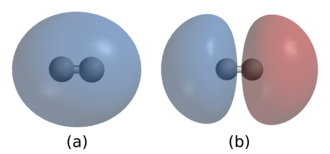
7. ⚛ MO theory
- Bond order = ½(bonding − antibonding)
- O₂: π*² with 2 unpaired → paramagnetic; BO = 2
- N₂: BO = 3, diamagnetic, BE 945 kJ
- O₂⁺ > O₂ > O₂⁻ > O₂²⁻ in bond order
- He₂ doesn't exist — BO = 0
8. ⚡ Polar bond ≠ polar molecule
- Symmetric → μ = 0: CO₂, BF₃, CH₄, CCl₄, SF₆, XeF₄
- Asymmetric → polar: H₂O, NH₃, CHCl₃, NF₃
- Δχ ≥ 0.4 bond polar; ≥ 1.7 ionic-ish
9. 🔗 Intermolecular forces (weak → strong) ★★★★★
| IMF | Found in | Strength | Effect |
|---|---|---|---|
| London (vdW) | ALL molecules | weakest | ↑ with mass + surface area |
| Dipole-dipole | polar only | medium | ↑ with μ |
| H-bond | F-H, O-H, N-H only | strongest IMF | ↑ BP/MP/viscosity |
"FON" rule: H-bond needs H bonded to F / O / N. C-H does NOT H-bond.
10. 🌡 Anomalous BPs
- H₂O (100°) > H₂S (−60°) — H-bond
- NH₃ (−33°) > PH₃ (−88°) — H-bond
- HF (+20°) > HCl (−85°) — H-bond
- H₂O highest — up to 4 H-bonds per molecule
11. ⚠ Common traps
- Forgetting lone pairs in VSEPR (H₂O is bent, not linear!)
- Polar bond = polar molecule (NO — CO₂!)
- O₂ as diamagnetic (NO — paramagnetic, MO theory)
- C–H H-bonding (NO — only F/O/N)
- BF₃ = octet (NO — only 6 e⁻, incomplete)
- cis vs trans dipole: cis polar, trans not
12. 🧠 Memory tricks
- "FON" = F, O, N — only H-bond acceptors/donors
- "AXE notation" — A central, X bonds, E lone pairs
- sp³ = 4, sp² = 3, sp = 2 (count of domains)
- O₂ paramagnetic — "Oxygen pairs aren't all paired"
- "Like dissolves like" — polar↔polar, nonpolar↔nonpolar
13. 💡 One-liner — take home
Shape decides everything. VSEPR (lp count) → shape → hybridisation → polarity → IMF → BP/MP/solubility. Master VSEPR + H-bonding "FON" rule + CO₂-vs-H₂O symmetry distinction → Paper I 8+ marks guaranteed. O₂ paramagnetism via MO is a single-MCQ jewel — worth 5 min of memorisation.
🌐 விளக்க படம் / Explanatory Diagram
Chemical bonding — summary
Credit: Wikimedia Commons · CC BY-SA 4.0
📖 மேலதிக தகவல் / More on Wikipedia →